
By Chris Mchenga | Last Updated: June 15, 2026
Disclosure: As an Amazon Associate, this site earns from qualifying purchases. This article contains Amazon affiliate links — if you make a purchase through these links, we may earn a small commission at no extra cost to you. This helps support the site and allows us to continue creating detailed motorcycle guides. Thank you for your support!
If you’ve ever stood in a parts store staring at a wall of chains and had no idea what you were looking at, you’re not alone. Motorcycle chain and sprocket sizes confuse a lot of riders. The numbers — 520, 525, 530 — don’t explain themselves. And buying the wrong one isn’t just a waste of money. It can destroy your sprockets in under 500 miles.
I’ve been wrenching on motorcycles for years, and the one thing I always tell riders is this: know your motorcycle chain and sprocket sizes before you buy anything. That single habit will save you time, money, and a lot of headaches at the side of the road.
This guide breaks everything down from scratch — what the numbers mean, which chain types are worth your money, how to know when it’s time to replace, and a full factory spec table covering the most popular sport bikes on the market.
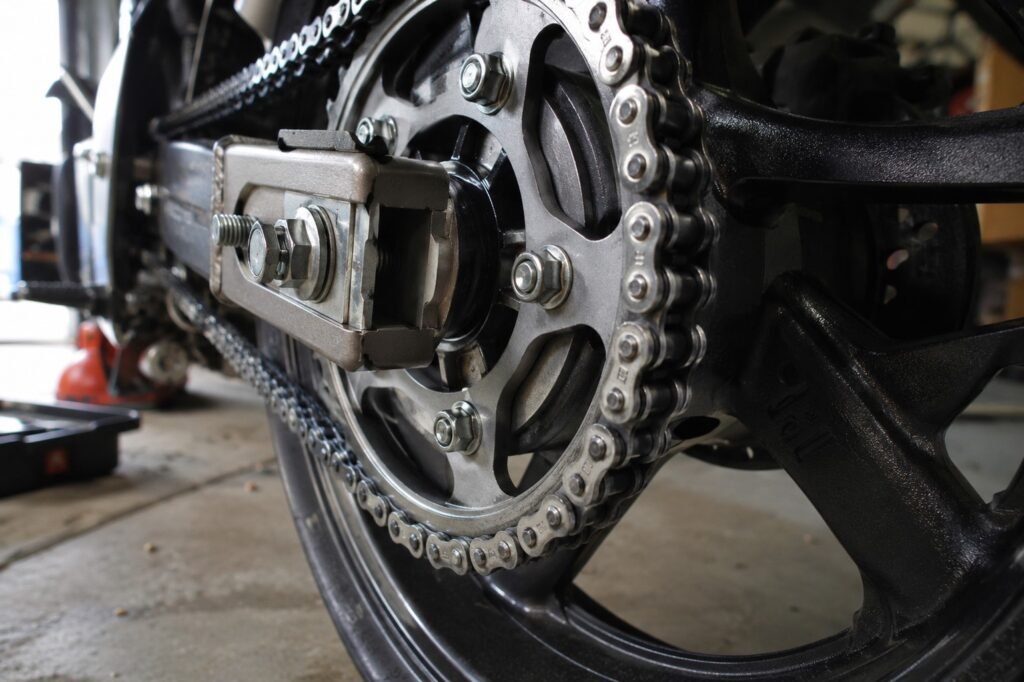
What Do Those Three Numbers Actually Mean?
Every motorcycle chain carries a three-digit code stamped on the side plates. These aren’t random. They tell you two critical measurements: pitch and inner width.
The First Digit — Pitch
The “5” in 520, 525, and 530 means the chain pitch is 5/8 of an inch (15.88mm). Pitch is the distance between the center of one pin and the center of the next. All three sizes share the same pitch, which is why they use the same sprocket tooth profile. This is also why you can’t just swap a 520 onto 530 sprockets — the width is different even though the pitch matches.
The Last Two Digits — Inner Width
This is where the sizes differ. The inner width determines how the chain sits on the sprocket teeth, and it must be an exact match.
- 520 — Inner width of 6.35mm (1/4 inch). The lightest and narrowest option.
- 525 — Inner width of 7.94mm (5/16 inch). The current standard for most modern superbikes.
- 530 — Inner width of 9.53mm (3/8 inch). The widest and strongest, common on older and high-torque machines.
The Golden Rule: Never mix chain and sprocket sizes. A 530 chain forced onto 520 sprockets will either not fit at all or run so loose it chews through the teeth in no time. Always match the three digits on your chain to your sprockets.
520 vs 525 vs 530 — Which One Does Your Bike Need?
Understanding motorcycle chain and sprocket sizes also means knowing why manufacturers choose one size over another.
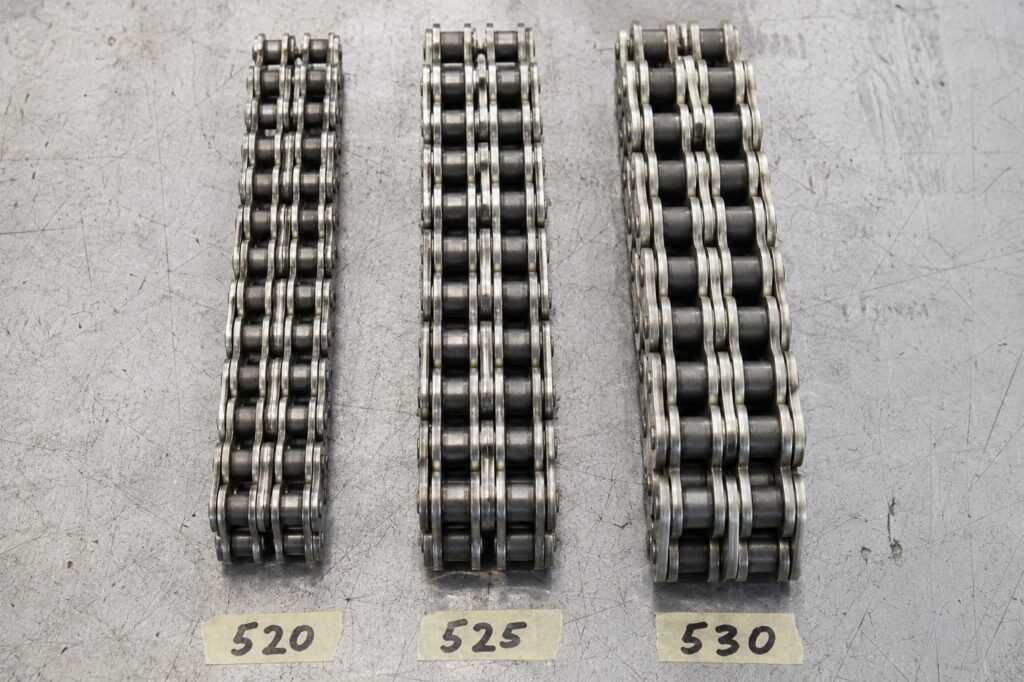
520 — Light and Fast
The 520 is the go-to for mid-sized bikes and smaller displacement machines. It’s also the choice for track-focused riders who want to shed rotating mass. Brands like DID (with their 520ZVMX), EK (the 520MVXZ2 Quadra-X), and RK (520ZXW) all offer high-strength 520 options capable of handling liter-bike power — but only when paired with matching 520 sprockets as a complete conversion kit.
See the RK 520ZXW on amazon— MotoGP-proven and rated to 200hp
If your bike came from the factory with a 520, stick with 520. If you’re converting from 530 to 520 for track use, you must change both sprockets at the same time. Never run a narrower chain on wider sprockets.
525 — The Modern Standard
Most new superbikes — including the BMW S1000RR, Honda CBR1000RR, and the GSXR600/1000 — use a 525. It hits a sweet spot between strength and weight savings. You’ll find premium 525 options from every major brand: RK’s 525ZXW, DID’s 525ZVM-X, and EK’s 525MVXZ2 are all well-regarded by riders and mechanics alike.
Running a 525 superbike? This is the DID chain mentioned above — check it here on amazon
530 — Built for Brute Strength
The 530 is heavier but tougher. It was the standard on older superbikes — the GSXR1000 from 2007–2008 and the Yamaha XJR1300 are classic examples. If your bike originally ran a 530, that’s what it needs. The strength advantage matters on high-torque machines and bikes that see long highway miles or heavy loads.
Chain Types: O-Ring, X-Ring, and Everything In Between
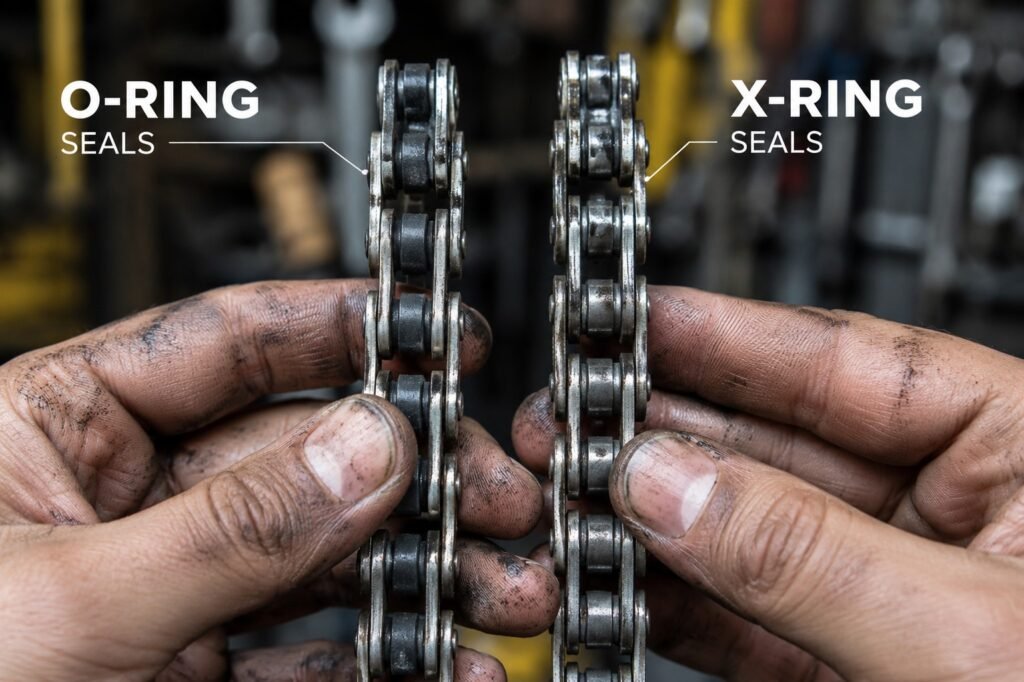
Once you know your motorcycle chain and sprocket sizes, the next decision is which chain type to buy. This is where quality really matters.
Standard (Non-Sealed) Chains
No rubber seals between the plates. Lightweight and cheap, but they require frequent cleaning and lubrication. Not ideal for street bikes that rack up real miles.
O-Ring Chains
Rubber O-rings sit between the inner and outer plates, sealing in factory grease and keeping dirt out. They last significantly longer than non-sealed chains and need less maintenance. RK’s SO series and similar budget-friendly O-ring options are solid choices for commuters and casual riders.
New chain installed? Keep it sealed and lasting with this cleaner + lube combo

X-Ring Chains
The X-ring design uses a four-contact-point seal instead of the O-ring’s single contact point. This creates two lubrication pools, which means better sealing, less friction, and longer service life. According to RK, their ZXW X-ring series lasts up to 1.7 times longer than standard O-ring chains. EK’s MVXZ2 Quadra-X Ring and DID’s ZVMX series operate on the same principle.
For any bike that sees regular street riding, an X-ring chain is worth the extra cost. The reduced friction also means slightly better power delivery, which matters on a sport bike.
XW-Ring and Z-Ring Chains
These are premium variations on the X-ring concept. RK’s ZXW chain uses a proprietary XW-ring with three contact lips and two lubrication pools, rated for up to 220 horsepower. These are the chains used in racing and on high-displacement machines that take a beating.
Factory Chain Specs Table — Every Popular Sport Bike
This is the data that matters. Use this table to confirm the correct motorcycle chain and sprocket sizes for your specific model and year before ordering any parts.
| BIKE | MODEL (YEARS) | CHAIN | LINKS | FRONT (TEETH) | REAR (TEETH) |
|---|---|---|---|---|---|
| BMW | S1000RR (2019–2025) | 525 | 120 | 17 | 45 |
| BMW | S1000RR (2013–2018) | 525 | 122 | 17 | 46 |
| BMW | M1000RR (2023–2025) | 525 | 120 | 17 | 45 |
| Honda | CBR1000RR (2017–2020) | 525 | 120 | 16 | 43 |
| Honda | CBR600RR (2007–2020) | 525 | 112 | 16 | 42 |
| Honda | CBR500R (2013–2023) | 520 | 120 | 15 | 41 |
| Honda | CBR300R (2015–2020) | 520 | 108 | 14 | 36 |
| Suzuki | GSXR1000 (2009–2016) | 525 | 114 | 17 | 42 |
| Suzuki | GSXR1000 (2007–2008) | 530 | 112 | 17 | 42 |
| Suzuki | GSXR750 (2006–2020) | 525 | 116 | 17 | 45 |
| Suzuki | GSXR600 (2011–2025) | 525 | 114 | 16 | 43 |
| Suzuki | GSXR600 (1996–2000) | 525 | 108 | 16 | 45 |
| Yamaha | YZF-R1 (2015–2020) | 525 | 114 | 16 | 41 |
| Yamaha | YZF-R6 (2006–2020) | 525 | 114 | 16 | 45 |
| Yamaha | MT-09 (2021–2025) | 520 | 116 | 16 | 45 |
| Yamaha | MT-07 (2021–2025) | 520 | 112 | 16 | 45 |
| Yamaha | Ténéré 700 (2019–2025) | 520 | 116 | 15 | 46 |
| Yamaha | XJR1300 (2004–2015) | 530 | 110 | 17 | 39 |
Note: Always cross-check link count with your owner’s manual if you’re running non-stock sprockets, as gearing changes affect the chain length you need.
Changing Gearing: What Happens When You Go Up or Down in Teeth?
One thing riders often ask when looking up motorcycle chain and sprocket sizes is whether they can change the gearing. The short answer is yes — and it’s one of the most cost-effective performance upgrades you can make.
Adding teeth to the rear sprocket gives you quicker acceleration off the line. You lose a little top speed, but the bike feels more responsive. Going from a 45-tooth rear to a 47-tooth is a popular street mod on R6s and similar bikes.
Removing teeth from the rear sprocket (or adding to the front) lowers your rev count at highway speeds, making for a more relaxed ride and sometimes better fuel economy.
Important: Any time you change sprocket sizes, recalculate your chain length. Adding two or more teeth to the rear sprocket will usually require an extra link or two. Get this wrong and you’re either stretching the chain beyond its adjustment range or running it too tight, both of which cause premature wear.
How to Know When It’s Time to Replace
Even the best chain in the right motorcycle chain and sprocket sizes wears out eventually. Here’s what to look for:
Chain stretch — This is the most common sign. As the pins and bushings inside the chain wear down, the effective length increases. Hold a ruler against 20 links. If they measure more than 12.5 inches, the chain has stretched past 0.5% and needs to go.
The pull test — Grab the chain at the 3 o’clock position on the rear sprocket and pull it away from the wheel. If you can see more than half a tooth exposed underneath, the chain is overstretched and no longer seating properly.
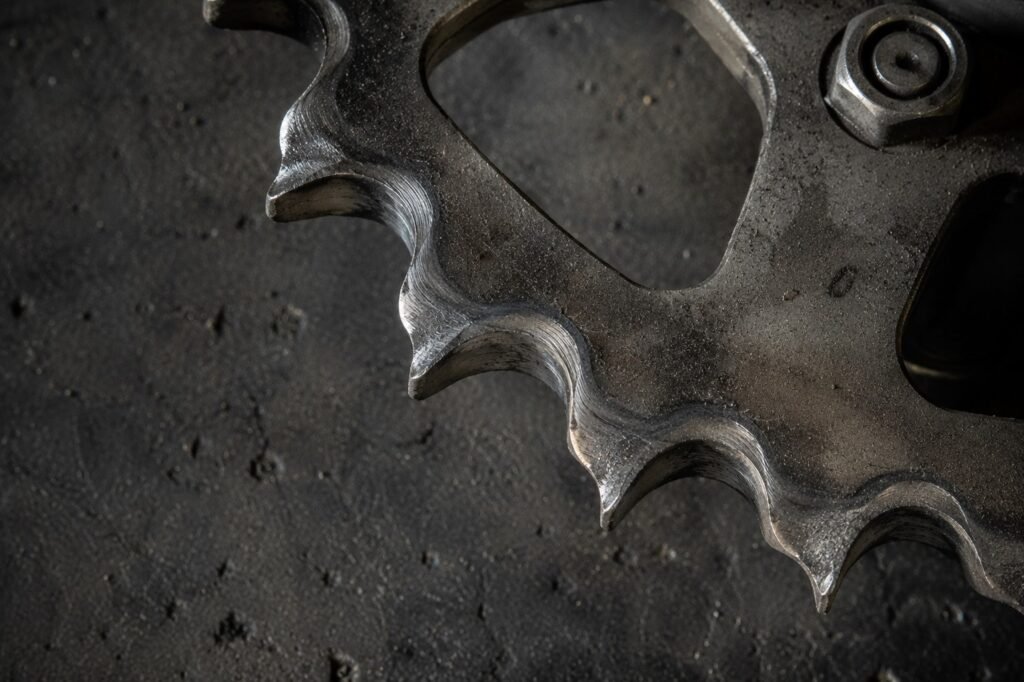
Hooked sprocket teeth — Look at your front and rear sprocket teeth. New teeth have a flat, symmetrical profile. Worn teeth look like shark fins — hooked to one side, pointed, or asymmetrical. If you see this, replace both sprockets along with the chain.
Stiff or kinked links — Put the bike on a rear stand and slowly spin the wheel by hand. Watch the chain travel around the sprockets. Any spot where the chain hesitates, binds, or doesn’t flex smoothly is a kink. Kinked links don’t distribute load evenly and put stress on the sprockets.
Rust and corrosion — Surface rust can be cleaned off. Deep rust that pits the rollers or causes the chain to flake is a different story. At that point, the chain is structurally compromised.
The most important rule: Always replace the chain and both sprockets as a complete set. A new chain running on worn sprockets wears out fast. Worn sprockets running on a new chain do the same damage. They wear together, and they need to be replaced together.
Top Chain Brands Worth Knowing
When you’ve confirmed your motorcycle chain and sprocket sizes and you’re ready to buy, stick with established manufacturers.
DID (Daido) — Made in Japan, widely regarded as one of the best in the business. The DID 520ZVMX and 525ZVM-X are top picks for sport bikes.
RK Excel — Strong product lineup from budget O-ring chains to the flagship ZXW X-ring series rated to 220 horsepower. Their 20,000-mile warranty on street chains backs up the quality claims.
EK Chain — The EK MVXZ2 Quadra-X Ring is a favourite among CBR and GSXR owners. Lightweight side plates, oversized pins, and their patented four-point seal make it a strong choice for 600–1000cc bikes.
All three brands are available in 520, 525, and 530 sizes across multiple models, so you’ll find exactly what you need regardless of which bike you’re running.
Quick-Reference: How to Find Your Chain Size Without a Manual
If your chain is so old and oily that you can’t read the stamp, don’t guess. Grab a vernier caliper and measure:
- Pitch — Measure from the center of one pin to the center of the next. Around 15.9mm means you have a 5-series chain (520/525/530). Around 12.7mm means a 4-series (428).
- Inner width — Measure the gap between the inner plates. 6.35mm is a 520. 7.94mm is a 525. 9.53mm is a 530.
That’s it. Two measurements, and you know exactly what you’re working with.
Final Word
Motorcycle chain and sprocket sizes aren’t complicated once you understand the system. A three-digit number tells you everything you need to know about pitch and width. Match it to your factory spec, buy from a reputable brand, replace the full set when it’s worn, and your drivetrain will stay smooth and reliable for tens of thousands of miles.
Before you order anything — look up your bike in the table above. Five seconds of checking the right spec will save you from a wasted return, a worn-out sprocket, or worse, a chain that fails mid-ride.