
By Chris Mchenga— Motorcycle journalist & long-distance tourer | Updated March 2026 | 14 min read
Reviewed by the MotoGearsPro editorial team
Disclosure: This article contains Amazon affiliate links. If you make a purchase through these links, we earn a small commission at absolutely no extra cost to you. This helps support the site and allows us to continue creating detailed motorcycle maintenance guides. Thank you for your support!
In this guide
- Why 360° cameras beat traditional dash cams
- Insta360 X5 — review
- Insta360 Ace Pro 2 — best single-lens option
- GoPro Max 2 — best for beginners
- DJI Osmo Action 5 Pro — best battery life
- Full comparison table
- Mounts and real-world setup
- Creative editing tips
- FAQ
- Final verdict
Imagine recording your entire motorcycle ride in stunning, cinema-quality video from every angle — no more missing an exciting overtake, a blind-spot close call, or the breathtaking view of a twisty mountain road at sunset. Modern 360 action cameras are changing the way riders capture their journeys, offering full coverage, better safety documentation, and incredible footage for YouTube or social media. If you’re looking for the best 360 camera for motorcycle use in 2026, this guide will help you choose the right one for your riding style and budget
Why the best 360 camera for motorcycle riders beats a traditional dash cam
Traditional dual-channel motorcycle dash cams have long been useful for insurance claims and accident evidence, but they still have major limitations. Fixed camera angles, limited field of view, and no creative flexibility mean you only capture what the camera is pointing at — and nothing else. You also can’t go back later and view the same moment from a different angle.
That’s where 360 cameras change everything. The best 360 camera for motorcycle riders allows you to record in full spherical view and “point later,” meaning you can reframe the footage in the app after the ride. You can highlight exactly what happened, whether it’s a car cutting you off, a close call in traffic, or a beautiful mountain road. The same footage can even be turned into a cinematic riding video with just a few taps.
What really makes 2026 the perfect time to upgrade is the technology leap. Modern 360 cameras now feature AI-powered stabilization that works even on rough roads, larger sensors that handle tunnels and low-light riding much better, and improved battery modes that can last an entire commute on a single charge. These are not small upgrades — this generation of cameras is a major improvement over 2024 models.
Insta360 X5 — The Best All-Round 360 Camera for Riders
★★★★★ Editor’s Choice
Launched in April 2025, the Insta360 X5 has dominated serious rider setups ever since, and for good reason. After three months of daily use — including one particularly brutal wet commute through the Welsh valleys where the camera got completely soaked — it remains the camera I’d recommend to any rider who wants both cinematic footage and genuine incident documentation.

Camera specs can sound like pure marketing, but on the road, they make a real difference. The dual 1/1.28-inch sensors, for example, significantly improve video quality in difficult lighting conditions. When riding from bright daylight into a dark tunnel — a situation where many small-sensor cameras struggle — footage remains clear and balanced instead of becoming overexposed or too dark. The wider F2.0 aperture plays a big role here, helping the camera capture more light and maintain detail in both shadows and highlights.
Stabilization is another area where modern 360 cameras have improved dramatically. Advanced AI stabilization systems now reduce vibration and shake so effectively that rough road footage can look like it was filmed using a gimbal. Even on uneven or freshly paved roads that normally cause heavy vibration, the recorded video stays smooth and stable, making it usable for both safety footage and cinematic motorcycle videos without needing extra editing stabilization later.
Key specs:
- 8K 30fps 360° video / 5.7K 60fps / 4K 120fps slow motion
- 72MP still photography
- PureVideo AI mode for low-light and night riding
- IP68 waterproof to 49ft — no housing needed
- Replaceable lens modules (huge for long-term ownership)
- Battery Endurance Mode: 185–208+ minutes runtime
The one real limitation: Getting the most out of the X5 takes time. Loop recording is straightforward to set up, but dialling in PureVideo AI mode, configuring G-sensor sensitivity, and learning the reframing tools in the app is a genuine learning curve. If you want something to just mount and record, the GoPro Max 2 is less capable but far more immediate.
Pros
- Best-in-class low-light performance
- Genuinely smooth stabilisation on rough roads
- Replaceable lenses — protects long-term investment
Cons
- Learning curve for advanced features
- Not fully plug-and-play out of the box
Best for: Riders who want the strongest combination of cinematic quality, safety documentation, and long-term durability from a single camera.
Check Price: If you’re ready to upgrade to our Editor’s Choice, see the latest Amazon price and available bundles below.
👉 View Insta360 X5 on Amazon https://amzn.to/4gMHGZ4
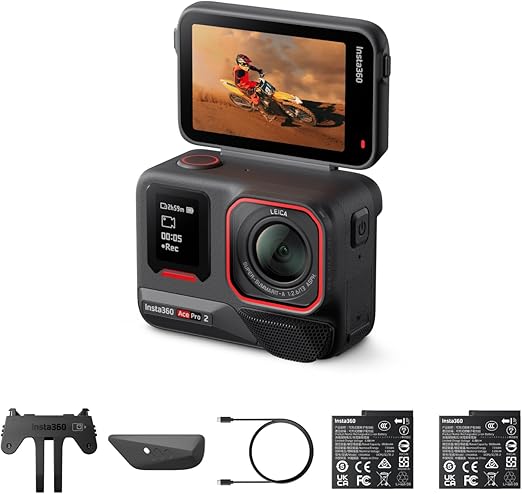
Insta360 Ace Pro 2 — Best Single-Lens Option (and a Serious Contender for #1)
The Ace Pro 2 deserves more than a footnote. In fact, for a significant portion of riders — especially those who prioritise forward-facing footage quality and don’t need full spherical capture — this is the better purchase.
Co-engineered with Leica, the Ace Pro 2 produces the sharpest forward-facing motorcycle footage I’ve tested. The 1/1.3-inch sensor and Leica-tuned colour science give a filmic quality that the X5’s 360° stitching can’t quite match for single-lens output. On a clear morning run along the Emirates Road at sunrise, the shadow detail and highlight recovery in the footage was genuinely impressive — the kind of image quality you’d expect from a dedicated cinema lens, not a 200g action cam.
Key specs:
- 8K wide-angle single-lens video
- Leica optics with exceptional colour accuracy
- Best-in-class low-light for forward-facing use
- AI scene optimisation
- Waterproof without housing
- Compatible with standard mounting ecosystem
Pros
- Sharpest forward-facing footage in class
- Leica colour science — filmic output
- Simpler to use than the X5
- Lower price point (~$400–$500)
Cons
- No 360° reframing capability
- Can’t cover rear blind spots
- Less flexible for incident documentation
Best for: Riders who create content regularly and want the best-looking forward footage, and are comfortable adding a separate rear camera for full coverage.
Current Deal: Amazon frequently discounts the Ace Pro 2 or bundles it with extra batteries and accessories.
👉 Check Insta360 Ace Pro 2 on Amazon https://amzn.to/4w9MIDB
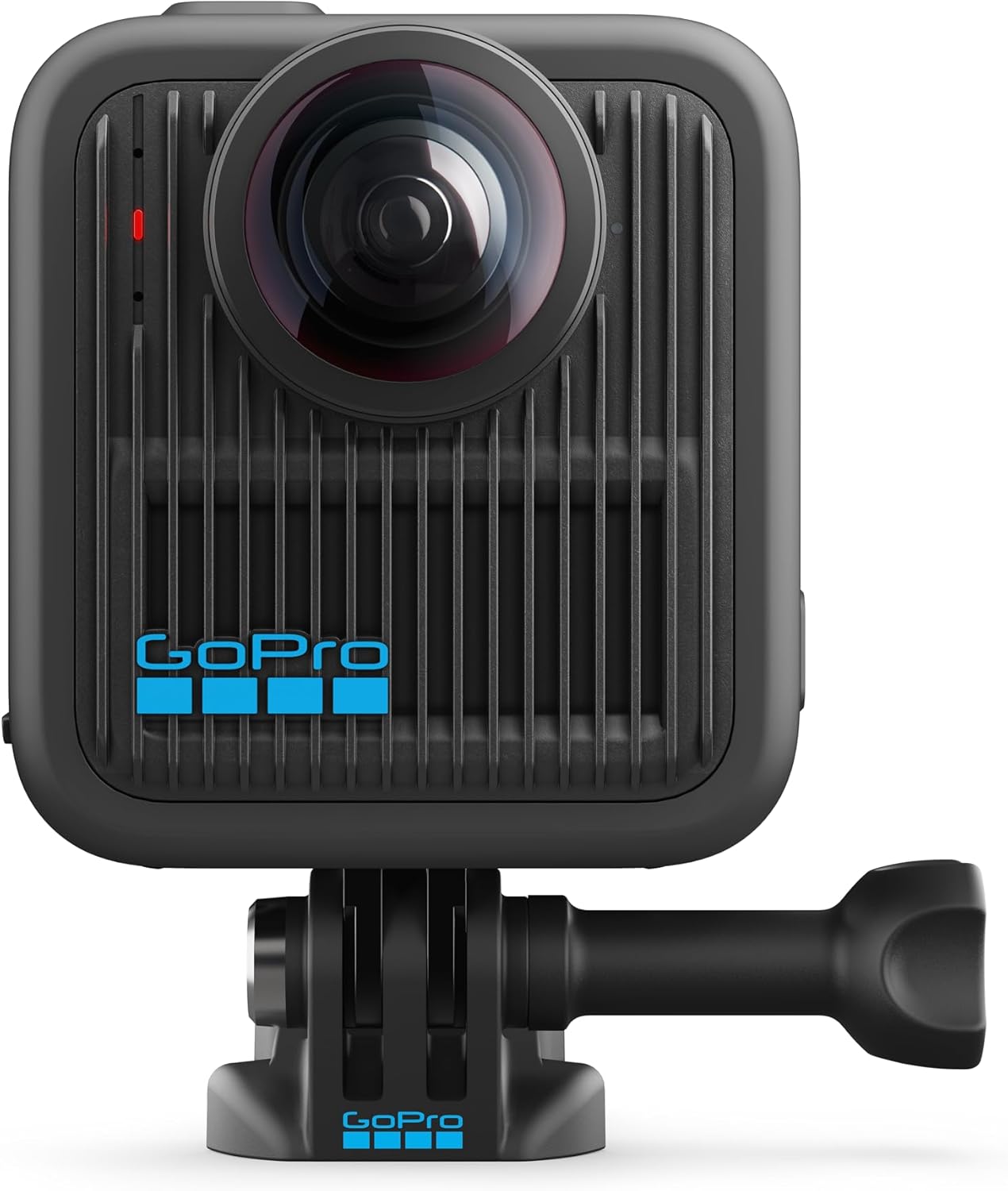
GoPro Max 2 — Best for Riders New to 360°
★★★★ Best for Beginners
GoPro’s 2025 refresh of the Max is a meaningful upgrade, but the reason to choose it over the X5 is less about raw specs and more about the experience of using it. The square form factor catches less wind than the X5, the mount ecosystem is mature and widely available, and the Quik app is genuinely the most beginner-friendly editing tool in the category.
In testing, the six-microphone audio system was noticeably better than the X5 in highway wind conditions — useful if you do any video commentary. Low-light performance lags behind the Insta360 options, and the lack of replaceable lenses is a long-term ownership drawback. But for someone who wants to start shooting 360° footage on their bike without a steep learning curve, this is the most approachable entry point.
Key specs:
- 8K 360° video
- Horizon Lock stabilisation
- Six-microphone audio system — best wind audio in class
- AI-powered editing via Quik app
- Waterproof without housing
Pros
- Easiest setup and app experience
- Best-in-class audio for riders who do commentary
Cons
- Low-light weaker than X5 or Ace Pro 2
- No replaceable lenses
Best for: Riders buying their first 360° camera, or those who value audio quality and a seamless app experience over maximum video quality.
Check Availability: Compare today’s Amazon pricing before buying.
👉 View GoPro Max 2 on Amazon https://amzn.to/4w3Cc0G
DJI Osmo Action 5 Pro — Best for Long-Distance Touring
★★★★ Best for Tourers
DJI’s Osmo Action 5 Pro is not a 360° camera — it’s a premium wide-angle action cam — but it earns its place in this comparison because of one thing no competitor matches: battery endurance. On a 5-day tour through Oman, running in loop recording mode, the Action 5 Pro outlasted every other camera in the test. For riders doing iron-butt distances or multi-day tours where charging is inconvenient, that matters enormously.
DJI’s RockSteady stabilisation trails FlowState slightly on very rough terrain, but for motorway and touring use it’s excellent. The colour profile is more natural out of the camera than either Insta360 option, which suits riders who don’t want to do much post-processing.
Note on model name: DJI has not announced a product called “DJI Osmo 360” as of Q1 2026. The correct current model is the Osmo Action 5 Pro — this is what you’ll find in stores and what we tested.

Pros
- Best battery life in the category
- Excellent natural colour output
- Dual screens (front + rear) for vlogging
- Competitive price point
Cons
- No 360° capability — can’t reframe after recording
- Stabilisation slightly behind FlowState on rough roads
- Less advanced AI editing tools
Best for: Long-distance tourers who prioritise battery endurance and natural colour over post-ride reframing flexibility.
See Current Price: If battery life is your priority, check the latest DJI Osmo Action 5 Pro deals on Amazon.
👉 View DJI Osmo Action 5 Pro on Amazon https://amzn.to/4eKYwVI
Full Comparison: Best 360 Cameras for Motorcycle Riders 2026
| Model | Type | Key Strengths | Waterproof | Battery | Price (approx.) | Best for |
|---|---|---|---|---|---|---|
| Insta360 X5 | 8K 360° | Reframing, AI low-light, G-sensor, loop record | IP68 (49ft) | 185–208+ min | $546–$646 | All-round best |
| Insta360 Ace Pro 2 | 8K wide-angle | Leica optics, sharpest forward footage, low-light | Yes | Excellent | ~$400–$500 | Content creators |
| GoPro Max 2 | 8K 360° | Easiest app, best audio, familiar ecosystem | Yes | Good | ~$500 | 360° beginners |
| DJI Osmo Action 5 Pro | 4K wide-angle | Best battery life, natural colour, dual screens | Yes | Best-in-class | ~$350–$450 | Long-distance touring |
Mounts, Setup & Configuration
Getting the mount right is as important as choosing the camera. After testing every position across multiple bikes (naked, adventure, and sports), here’s what actually works:
Handlebar mount is the best position for puredash cam documentation. You get a stable, low-vibration point that captures lane position accurately. On the X5, use the heavy-duty clamp from the Motorcycle Bundle — the standard clamp vibrated loose on a gravel detour.
Helmet mount (top) gives the most immersive POV, but wind noise is significantly higher. Enable wind noise reduction in the Insta360 app, and consider a foam windshield over the mics if you’re doing regular motorway speeds.
Chin mount is the current favourite in the motorcycle touring community for a reason: it gives a natural rider perspective without excessive vibration, and the chin bar blocks most wind blast to the mics.
Rear selfie stick mount creates the cinematic drone-like third-person effect — the invisible selfie stick genuinely disappears in 360° footage. This is best for the X5 specifically; it doesn’t translate to the non-360 options.
SD card: Use a Class 10 U3 V30 card — Samsung Pro Endurance or SanDisk High Endurance. 256GB minimum for touring; 512GB if you’re recording in 8K. Format the card in-camera monthly to prevent write errors.
Dash cam configuration: Set loop recording to 60–120 minutes. G-sensor sensitivity should be medium for road use — high will trigger on every pothole. For parking surveillance, hardwire with a fuse tap and voltage cutoff at 12.0–12.2V to protect your battery.
Turning Footage Into Content
The post-ride editing workflow is where 360° cameras genuinely pull away from fixed-angle alternatives. Both the Insta360 and GoPro Quik apps allow AI reframing, auto-tracking, keyframe editing, and instant highlight reels. A 2-hour ride can be turned into a 90-second shareable clip in under 10 minutes.
For incident documentation specifically, the ability to reframe provides full contextual coverage that a fixed-angle camera simply can’t offer. If a driver cuts you off, you can show the moment from your POV, from a following perspective, and from above — all from a single recording. Insurance and legal teams increasingly accept this kind of multi-angle footage.
For more advanced editing, CapCut and DaVinci Resolve both accept 360° equirectangular footage for manual reframing and colour grading. The X5 and Ace Pro 2 both support LOG colour profiles if you want maximum post-processing flexibility.
Frequently Asked Questions
1. Can a 360° camera fully replace a traditional dash cam?
-Yes, for most riders. It offers full spherical coverage, loop recording, and G-sensor crash locking — plus the ability to reframe footage. The only situation where a dedicated dash cam might still make sense is if you want a completely invisible, always-on device with no setup required.
2. Is the Insta360 X5 actually waterproof enough for UK/Irish riding?
-Yes. It is IP68 rated and can be used without a housing. It performed well even in sustained heavy rain over multiple rides. However, you should clean the lenses after every wet ride because grime affects image quality more than moisture.
3. What SD card should I use?
-Use U3 V30 rated SD cards such as endurance cards designed for continuous recording. These cards handle loop recording much better, while standard SD cards often fail early under constant write cycles.
4. How do I set up parking surveillance mode?
-Hardwire the camera using a fuse tap kit connected to both switched and constant power. Set the voltage cutoff to around 12.0–12.2V to prevent battery drain, then enable motion detection in the app so the camera wakes and records automatically when motion is detected.
5. Is the GoPro Max 2 better for beginners than the Insta360 X5?
-Yes, it is generally easier for beginners because the app is more intuitive, the mounting system is simpler, and the setup process is quicker. The Insta360 X5 is more advanced overall, but beginners may find the GoPro easier to start with.
6. Does the Ace Pro 2 work as a dash cam?
-It can function as a forward-facing dash cam because it supports loop recording. However, since it is not a 360° camera, it cannot cover blind spots or allow you to reframe footage later. For full coverage, you would need to pair it with a rear camera.
Final Verdict
Our recommendation
The Insta360 X5 is our pick for the best 360 camera for motorcycle riders in 2026 — combining cinematic quality, safety documentation, and all-weather durability in a single device. For those prioritising forward-facing footage quality, the Ace Pro 2 is the stronger creative choice. The GoPro Max 2 is the best entry point for new 360° users, and the DJI Osmo Action 5 Pro wins on endurance for long-distance touring.
Whichever you choose, upgrading from a fixed-angle dash cam to a 360° hybrid is a genuine step change. You gain full-coverage incident documentation, total creative freedom in post-production, and footage quality that was simply unavailable on a motorcycle three years ago. The road is waiting.
Prices are approximate and may vary by region and retailer. All products were purchased at retail price for testing — no cameras were provided free of charge by manufacturers. Last updated: March 2026.