
Disclosure: This article contains Amazon affiliate links. If you make a purchase through these links, we earn a small commission at absolutely no extra cost to you. This helps support the site and allows us to continue creating detailed motorcycle maintenance guides. Thank you for your support!
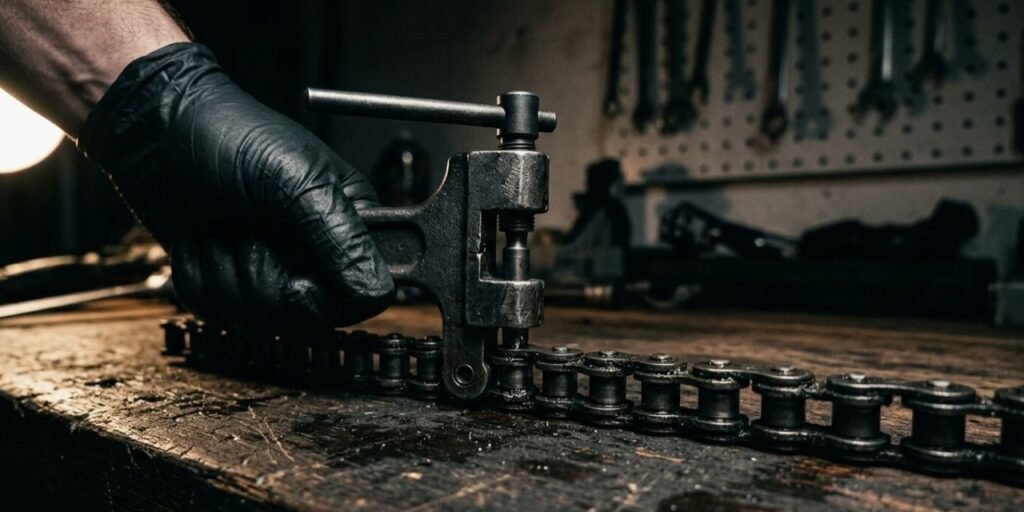
You’re halfway through a chain swap, torque wrench on the bench, new chain laid out — and the push pin on your $15 harbor freight special snaps clean off inside the link. Now you’ve got a mangled master link, a tool stuck to your chain, and zero way to finish the job. That’s the tax you pay for skimping on a motorcycle chain tool.
It happens more than anyone admits. Cheap cast-iron tools can’t handle the clamping load of a 530 heavy-duty street chain, and the replaceable pins on bargain-bin breakers are about as heat-treated as a butter knife. A bent or snapped extractor pin doesn’t just waste your afternoon — it ruins the link, contaminates your X-rings, and potentially puts you on the road with a compromised chain that you think is solid.
The right motorcycle chain tool is a one-time investment that pays back every service interval. Whether you’re swapping to a lightweight 520 setup for track days or pressing a fresh 530 link on a loaded touring rig, this guide breaks down the four best tools on the market, how to actually use them without destroying your master link, and what to look for when you’re shopping.
Before you start replacing a motorcycle chain, make sure you have the right supporting tools. These workshop essentials will make the job faster, safer, and help prevent costly mistakes.
Recommended Product
Chain Alignment Tool
Many riders replace the chain but forget to check rear wheel alignment afterwards. Check today’s price on Amazon

Master Comparison Table
| Tool Name | Est. Price | Max Chain Pitch | Best For | Key Standout Feature |
|---|---|---|---|---|
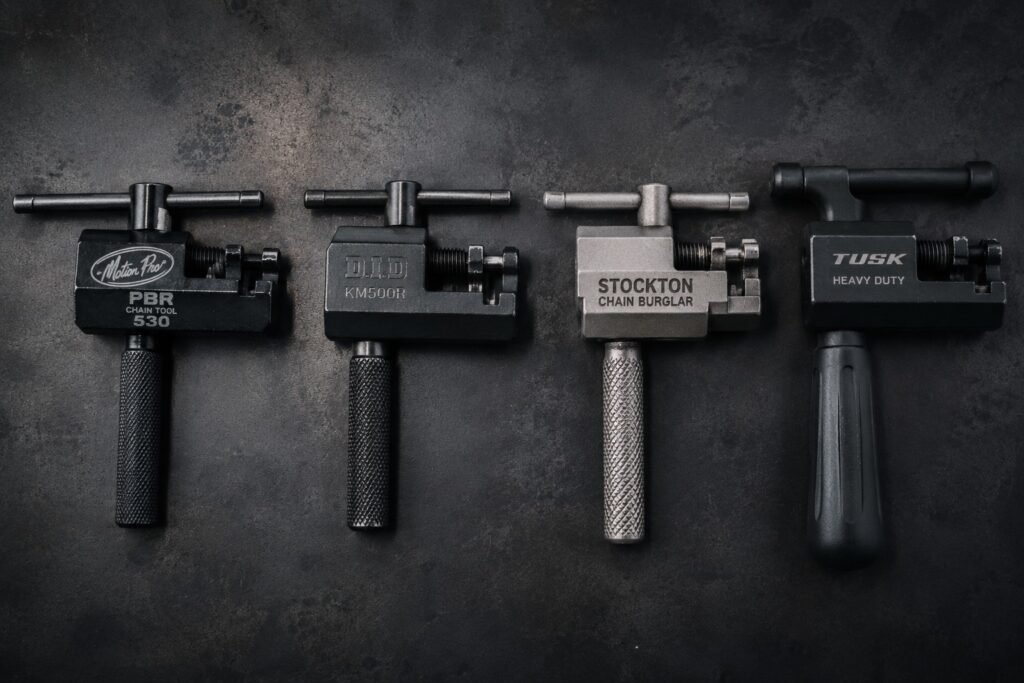
| Motion Pro PBR Chain Tool | $90–$100 | 520–530 | Professionals & serious enthusiasts | Indexed 3-in-1 (break, press, rivet) — one tool, zero guessing |
| D.I.D. KM500R Chain Tool | $110–$130 | 420–530 | OEM & D.I.D. chain users | OEM-grade precision; purpose-built for D.I.D. rivet links |
| Stockton Chain Burglar | $30–$40 | 520–530 | Budget-conscious home mechanics | Solid value at entry level; covers most sport/street sizes |
| Tusk Heavy Duty Chain Breaker | $25–$35 | 520–530 | Dual-sport/adventure riders on a budget | Compact, trail-friendly; surprisingly capable for the price |
Deep-Dive Product Reviews
Motion Pro PBR Chain Tool — The Premium Gold Standard
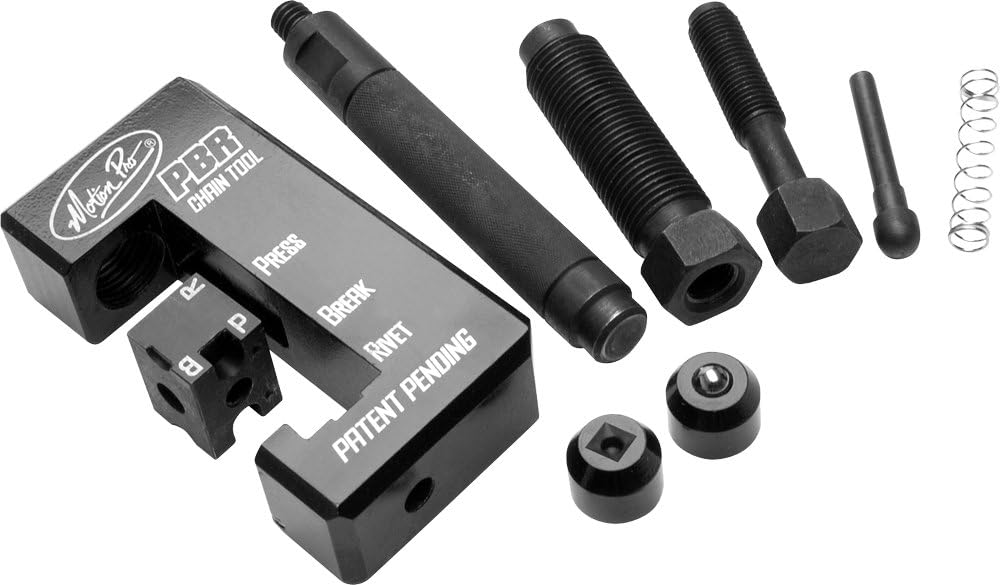
If you do one chain job a year, this tool feels like overkill. If you do ten, it feels like not having it was overkill. The Motion Pro PBR is the motorcycle chain tool most professional shops keep on the bench, and for good reason: it’s genuinely a three-in-one unit that handles breaking, pressing, and riveting without switching tools or buying adapters.
Build quality is where it earns its price tag. The body is CNC-machined from hardened steel, and the extractor pins are replaceable and heat-treated. The pressure screw is silky smooth under load — which matters when you’re pressing a side plate against an O-ring chain. Too much resistance and you rush it; that’s how you crush rings and kill your chain’s lubrication.
The Motion Pro PBR chain tool review really comes down to one word: indexing. The tool uses a rotating head that clicks into each function — Break, Press, Rivet — so you never cross-thread an adapter or misalign the anvil under pressure. That feature alone eliminates the most common beginner error: pressing a side plate at an angle.
Chain size compatibility: Handles 520, 525, and 530 without changing anything. The 530 heavy-duty work is where cheap tools fail and this one doesn’t.
Pros:
- Indexed 3-in-1 system eliminates setup errors
- Replaceable, heat-treated pins
- Works on all common street/sport/touring pitches (520–530)
- Precise side-plate press depth stops you from crushing O/X-rings
Cons:
- Price is high for casual once-a-year use
- Overkill if you never touch 530 chains
D.I.D. KM500R Chain Tool — The OEM Specialist
D.I.D. makes some of the most widely-used OEM and aftermarket chains on the planet, so it’s no surprise their heavy duty motorcycle chain breaker is engineered to work precisely with their own rivet links. The KM500R is the tool you want when you’re running D.I.D. X-ring or ZVM-X series chains and need guaranteed compatibility.

The body is forged steel — not machined billet like the Motion Pro, but substantial. It handles 420 through 530, making it the widest-range tool in this roundup, which matters for anyone who works on multiple bikes across different displacement classes. A 125cc pit bike with a 420 chain and a liter-class street bike with a 530 all fall under this tool’s wheelhouse.
Where it shines is rivet flare precision. The KM500R’s riveting anvil applies even pressure that mushrooms the pin head consistently, which is critical for 530 OEM-spec chains on touring bikes that see 20,000+ miles between swaps. It’s also the best chain tool for 525 motorcycle chain applications that sit between lightweight sport and heavy touring setups.
Pros:
- Handles 420–530 — widest range in this list
- OEM-grade riveting precision for D.I.D. chains
- Forged steel construction
- Excellent for 525 mid-range chains
Cons:
- Most expensive option
- Slight learning curve for non-D.I.D. rivet links
- Heavier than competitors; not ideal for trail-side repairs
Stockton Tool Company Chain Burglar — The Budget Garage Option
The Chain Burglar is the best budget motorcycle chain tool kit for home mechanics who aren’t doing chains every week but need something better than the import-bin specials. It’s a 3-in-1 design covering break, press, and rivet, and it handles 520 through 530 — the bread-and-butter sizes for most sport, naked, and entry street bikes.
Build quality is mid-tier: cast steel body, not forged or machined, but adequate for occasional use. The pins are replaceable, which is the one non-negotiable feature any chain tool must have. The riveting function works, but requires more attention than the Motion Pro — you need to feel the torque feedback carefully to avoid over-flaring the pin.
At $30–$40, this is the right tool for a rider who changes their own chain once a season and wants a tool that won’t embarrass them mid-job.
Pros:
- Best price-to-functionality ratio in this group
- Covers 520, 525, 530
- Replaceable pins
- Widely available
Cons:
- Cast steel body, not forged — less durable under heavy use
- Riveting requires more feel/experience than premium tools
- Not suitable for 420 chains (limits use on smaller bikes)
Tusk Heavy Duty Chain Breaker — The Rugged Value Choice
Tusk is a Rocky Mountain ATV/MC house brand, which means their tools are designed for riders who break chains on trails, not in climate-controlled garages. The Tusk Heavy Duty Chain Breaker is compact, packable, and handles 520–530 — enough for the vast majority of dual-sport and adventure applications.

This is primarily a breaker and press tool. Riveting is possible, but requires careful technique. For adventure riders running 520 or 525 chains who need something in the pack for field repairs, it’s the right call. For anyone trying to do a full chain-and-sprocket swap in the garage on a 530 touring chain, step up to the Motion Pro or D.I.D.
Pros:
- Compact — fits in a trail kit
- Solid for breaking and pressing 520/525 chains
- Very competitive price point
- Handles unexpected mid-ride chain failure scenarios
Cons:
- Riveting function is functional but not refined
- Not recommended for repeated 530 heavy-duty work
- Lacks the indexing/precision of premium tools
Buying Guide: What Makes a “Heavy Duty” Chain Tool Actually Heavy Duty?
Shopping for a heavy duty motorcycle chain breaker means knowing which specs actually matter and which are marketing noise.
Pin Strength and Replacement
The extractor pin is the single point of failure on any chain tool. When it’s not heat-treated, it deforms under load, and if it snaps inside a link, you’ve created a much bigger problem than a worn chain. Every tool worth buying has replaceable extractor pins — this is non-negotiable. Heat-treated or hardened pins are the standard on anything above the bargain tier.
Also check the thread pitch on the pressure screw. Fine-thread screws give better load control; coarse threads can jerk the pin unexpectedly.
Pitch Compatibility
Chain pitch — the center-to-center distance between link pins — determines which tools you need and which chain you’re running:
- 520: Lightweight. Common on sport and motard conversions. Narrower inner width means the tool anvils must align precisely.
- 525: The middle ground. Common on mid-displacement sport bikes and adventure bikes. The best chain tool for 525 motorcycle chain work is the Motion Pro or D.I.D. KM500R, both of which handle the pitch without adapter swaps.
- 530: Heavy-duty. Stock on most big touring and large-displacement bikes. Requires a tool that can handle significant rivet press force without flexing.
A tool rated for 530 will handle anything below it. A tool rated only for 520 will not press a 530 side plate — the geometry doesn’t fit.
Functionality: Why a Breaker Alone Isn’t Enough
A motorcycle chain tool that only breaks is half a tool. Completing a chain replacement with a rivet master link requires three distinct operations:
- Breaking — pushing the old pin out
- Pressing — seating the new side plate to the correct depth without compressing the O/X-rings
- Riveting — flaring the pin head to lock the side plate permanently
A rivet master link cannot be reused once removed — and it shouldn’t be installed without a proper flare. A clip-type master link is an option, but for chains above 520 under hard acceleration loads, a properly riveted link is safer. That means you need the full best motorcycle chain breaker and riveter tool, not a standalone breaker.
Step-by-Step Practical Guide: How to Use a Motorcycle Chain Riveting Tool Without Ruining Your Master Link
This is where most DIY jobs go sideways. Follow these steps and you’ll have a properly installed rivet link every time.
Before removing the old chain, gather these workshop essentials. Having everything ready will save time and reduce the risk of damaging your new chain during installation.
Check today’s price on Amazon

Step 1: Grind the Old Rivet Heads
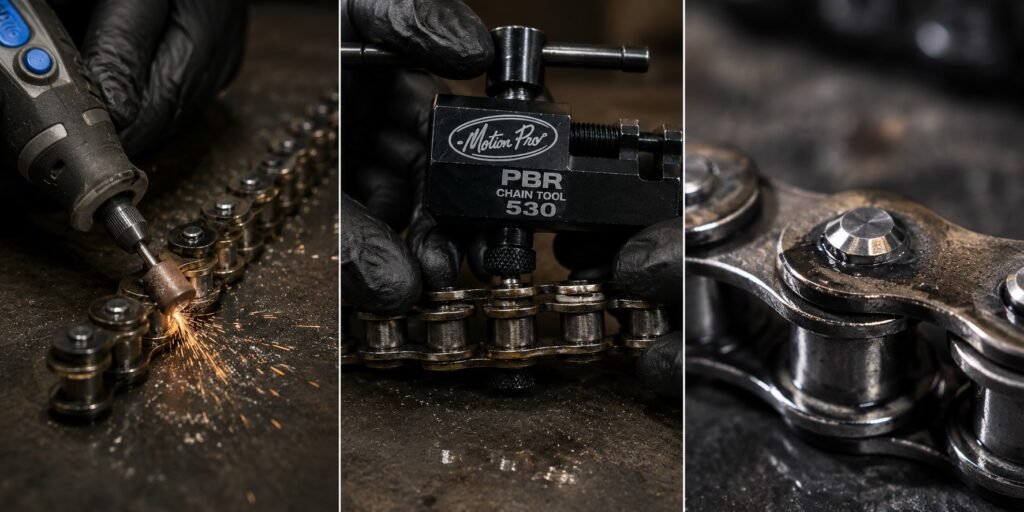
Before you push anything, use a small grinding wheel or Dremel to gently grind down the flared heads of the pin you’re removing. This step is critical — trying to push a fully flared rivet through the link without grinding first bends extractor pins and damages the tool. You want to remove the flare, not grind to the inner plate. Stop when the pin head is flush and the flare is gone.
Step 2: Push the Pin Out
Set your motorcycle chain tool to the break function. Place the push pin directly over the link pin, check alignment, and apply slow, even pressure. Do not rush this. If you feel unusual resistance, stop and recheck — the pin may not be centered. Uneven pressure cracks side plates and bends extractor pins.
Step 3: Press the New Side Plate to Correct Depth
Thread the new master link through the chain ends, seat the O/X-rings on both sides, and place the outer plate loosely. Switch the tool to press mode. Press the side plate until the pin grooves are just barely visible past the outer plate — typically 1.0–1.5mm of pin protrusion. Do not over-press. Crushing the O/X-rings ruins the chain’s internal lubrication and shortens its life dramatically.
Step 4: Flare the Rivet Pin
Switch to rivet mode. The anvil should contact the pin nose — not the side plate. Apply torque in slow, controlled increments. The pin nose should mushroom outward symmetrically to approximately the diameter of the original factory rivet (check your chain manufacturer’s spec — D.I.D. specifies 5.50–5.80mm for most 530 applications). An under-flared pin can back out under load. An over-flared pin cracks the side plate.
Maintenance Tips for the Tool Itself
A precision tool that sits forgotten on a shelf for a year is a tool that will fail you mid-job. Here’s how to keep your motorcycle chain tool ready every time:
Grease the pressure screw threads. Every time you use the tool, wipe the main screw threads and apply a thin coat of marine grease or anti-seize. Heat, sweat, and chain lube residue corrode fine threads fast, and a corroded pressure screw applies uneven load — which leads to bent pins.
Inspect extractor pins before every use. Look for deformation at the tip. A pin that’s slightly mushroomed at the business end will misalign in the next link and snap. Pins are cheap. Replace them if there’s any doubt.
Store the tool with the screw backed fully off. Leaving the tool under load deforms the thread engagement and pre-stresses the body. Back off, wipe down, grease, store. Five minutes of care extends tool life by years.
If you’re buying a chain breaker today, pairing it with a quality chain lubricant ensures your new chain lasts as long as possible while reducing friction and wear. Check today’s price on amazon

Conclusion & Final Verdict
Here’s where it shakes out.
For the professional or dedicated enthusiast: The Motion Pro PBR chain tool is the clear winner. Indexed functions, heat-treated pins, and precision side-plate depth control make it the most foolproof and repeatable motorcycle chain tool on the market. The price is real money, but it’s a tool you hand down, not replace.
For the OEM specialist or multi-bike shop: The D.I.D. KM500R edges ahead on 525 and 530 rivet precision and the widest pitch range (420–530). If your garage sees everything from a quarter-liter commuter to a fully loaded adventure tourer, this is your tool.
For the budget-conscious home mechanic: The Stockton Chain Burglar delivers the essential 3-in-1 functionality without the premium price. Treat it carefully, feel the feedback during riveting, and it won’t let you down on seasonal chain swaps.
For the trail rider: The Tusk gets in the pack and handles emergency 520/525 breaks when you’re 30 miles from the truck.
Here’s the bottom line on safety: a chain that fails at speed isn’t just a mechanical failure. It’s a wheel-lock, a tank-slapper, or a leg injury waiting to happen. The chain is a safety-critical component, and the tool that installs it deserves the same respect. A cheap, bent extractor pin that leaves a half-pressed side plate on the road isn’t a savings — it’s a liability. Invest in a motorcycle chain tool that does the job right. Your chain, your bike, and your body are all counting on it.