
By Chris Mchenga
Disclosure: As an Amazon Associate, MotoGearsPro earns from qualifying purchases. If you buy through links in this article, we may earn a small commission at no extra cost to you.
Vantrue F1 vs Innovv K7 is the choice many riders face when they want a premium front and rear motorcycle dash cam. Both systems are hardwired and built for riding. However, they chase video quality in different ways.
The Vantrue F1 puts its resolution into the front camera. The Innovv K7 shares it evenly between both cameras. As a result, each one shines in a different direction.
This guide covers video performance only. We compare resolution, lens angle, stabilization, night video, and storage. We also cover plate readability and which riding styles suit each camera. By the end, you will know which one fits your riding.
Quick Answer and Spec Comparison
Neither camera wins everywhere. The Vantrue F1 records 4K at the front and 1080p at the rear. In contrast, the Innovv K7 records 2K (1440p) on both cameras. Therefore, the F1 leads on front detail, while the K7 leads on rear detail and balance.
Here is how the key specs compare.
| Spec | Vantrue F1 | Innovv K7 |
|---|---|---|
| Front resolution | 4K (2160p) at 30fps | 2K (1440p) at 30fps |
| Rear resolution | 1080p at 30fps | 2K (1440p) at 30fps |
| Lens angle | 160° wide angle | 120° front and rear |
| Sensor | STARVIS technology | Sony IMX335 STARVIS, f/1.8 |
| GPS | Built-in, speed stamp on video | Built-in, 10Hz |
| Wi-Fi | Built-in | Dual-band (5.8GHz and 2.4GHz) |
| Max card size | 512GB | 512GB |
| Waterproofing | IP67 | IP67 |
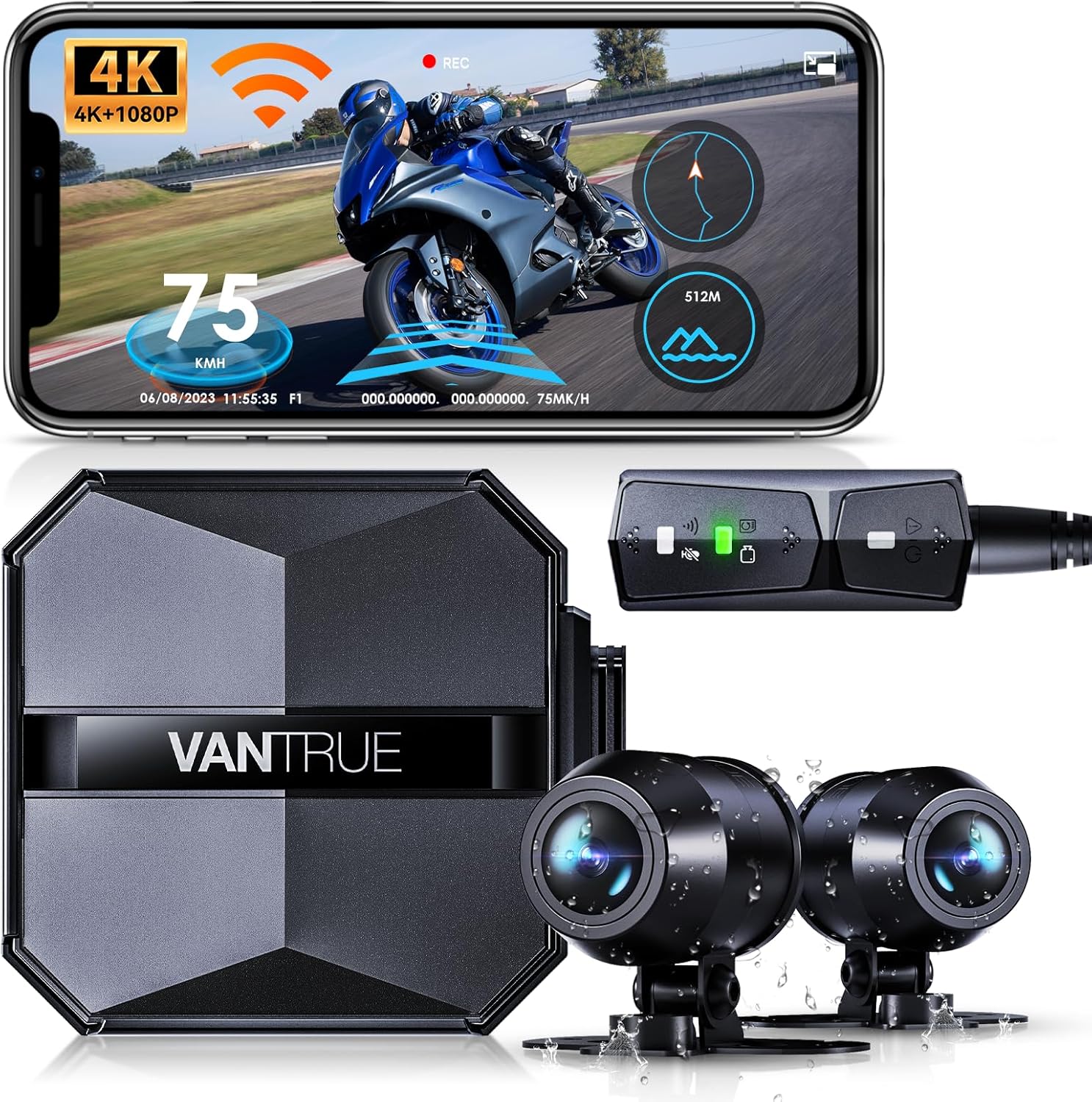
The Vantrue F1 is worth considering if you want 4K front recording, a wide viewing angle, and a dedicated rear camera. Its front camera captures more detail than the Innovv K7 on paper, although real-world footage also depends on lighting, mounting, and lens performance.
Check the latest price and product specifications before purchasing.
The INNOVV K7 features dual 2K front and rear recording, electronic image stabilization (EIS), GPS tracking, and IP67-rated waterproof protection. It is a good choice for riders who want the same video resolution from both cameras.

4K vs 2K Motorcycle Dash Cam: What the Difference Means
A 4K motorcycle dash cam records 3840 by 2160 pixels. A 2K camera, in this case 1440p, records 2560 by 1440. That means 4K holds about 2.25 times as many pixels in every frame.
More pixels give you more room for detail. For example, you can zoom into a clip and still read a sign. However, resolution does not guarantee a better picture. Lens quality, sensor, and video compression also matter. A clean 2K clip can beat a poor 4K clip.
Resolution also affects how you handle footage. Higher resolution clips are larger files. They can also take longer to move to your phone. For many riders, a balanced 2K setup is simply easier to manage.
Vantrue F1 vs Innovv K7: Front Camera Video
The front camera matters most for most riders. It records plates, signs, and the road ahead. The F1 records at 3840 by 2160 pixels. The K7 records at 2560 by 1440. That gives the F1 about 2.25 times as many pixels.
More pixels mean more detail. For example, a plate far ahead has more pixels on it in 4K. You can also crop the footage and still keep useful detail. One published review called the F1’s front video superb.
Frame rate is similar on both. Each camera records at 30fps in its top resolution modes. The K7 also offers 1080p at 60fps for smoother motion, but at a lower resolution.
Still, resolution is only part of the picture. A clean 2K clip can beat a poor 4K clip. On paper, though, the F1 has the clear front camera advantage.
Vantrue F1 vs Innovv K7: Rear Camera Video
The rear camera tells a different story. The K7 records at 1440p, while the F1 rear camera records at 1080p. This is where the K7 pulls ahead.
Motorcycle dash cam rear camera quality matters after tailgating or a rear-end hit. In those moments, you need to read a plate on a car close behind you. The K7’s extra pixels help here. The F1’s 1080p rear camera is still capable, and one reviewer called it pretty good. It simply records less detail than the K7’s rear camera.
Also, the K7 gives you matching 2K footage from both cameras. As a result, front and rear clips share the same resolution when you review them. With the F1, the rear clip has a lower resolution than the front clip.
160° vs 120° Dash Cam Lens: Which View Is Better?
Lens angle changes what the camera sees. The F1 listings describe a 160° wide-angle lens. The K7 uses a 120° lens on both cameras.
A wider lens captures more of the scene. For example, you see the lanes beside you and cars entering from side streets. That helps when you need to show how an incident unfolded. However, a wide lens makes distant objects look smaller. It can also bend straight lines near the edges.
A narrower lens does the opposite. Distant objects look larger, and the image looks more natural. The Vantrue F1 vs Innovv K7 lens difference therefore creates a clear trade-off. The F1 shows more of the scene. The K7 shows less width, but with a tighter and more natural view. Choose based on what you want on record: the full scene or a closer look.
Vantrue F1 vs Innovv K7 Night and Low-Light Video
Night riding tests any dash cam. Both systems use STARVIS-type sensors, which are designed for low light. The K7 also lists an f/1.8 aperture, which lets in plenty of light.
A published K7 review reported solid low-light performance and accurate white balance on pavement. We could not find a published side-by-side night test of these two cameras. For that reason, we do not name a night winner.
Instead, test them yourself in the conditions you ride in most. After installation, ride a familiar route at dusk and review the clips. Look at plate readability, glare from headlights, and how dark areas look. That check tells you more than any spec sheet.
Rain, Glare, and Tunnel Footage
Rain, glare, and tunnels are hard on any camera. Both units are rated IP67, so water and dust should not stop them. Even so, a wet lens can blur any image. Wipe the lenses before each ride.
Wide lenses also catch more sun glare. Therefore, aim the camera carefully, and avoid angles that point straight at low sun. In tunnels, the sudden change from bright to dark can wash out detail. Clean lenses and a steady mount help in all of these cases.
Keeping both camera lenses clean can help preserve footage clarity in changing weather. A soft microfiber lens-cleaning kit is a practical accessory to keep with your motorcycle maintenance supplies.

K&F CONCEPT 4 in 1 Camera Lens Cleaning Kit for Photography
Motorcycle Dash Cam With Image Stabilization: Does EIS Matter?
Bumps shake a motorcycle camera. The K7 includes electronic image stabilization, or EIS, to reduce that shake.
A reviewer mounted the K7 on an adventure bike. On asphalt, playback looked stable. On rocky ground, the footage still bounced a lot. So EIS helps, but it cannot erase heavy vibration.
This matters when you compare Vantrue F1 vs Innovv K7 on real roads. Stability can decide whether a plate is readable. A shaky 4K frame may show less usable detail than a steady 2K one. Therefore, rough-road riders should weigh stabilization as heavily as resolution. Also, mount each camera on a solid part of the bike to cut vibration.
For riders handling their own motorcycle electronics, a waterproof connector kit may be useful for separate wiring repairs or custom installations. Check the connector type, wire size and weather-sealing rating before choosing one.

Motorcycle Dash Cam License Plate Readability
Most riders buy a dash cam for evidence. Three things matter: detail, framing, and reliable saving of clips.
For detail, the F1 leads at the front, and the K7 leads at the rear. For framing, the F1’s wider lens captures more of the scene. Both also record GPS data, which helps show where and how fast you rode. The K7 uses 10Hz GPS for finer tracking, and the F1 can embed a speed stamp in the video.
Reliability counts too. One reviewer found random clips missing from the K7. They had been saved in a protected folder by the g-force trigger. Support suggested turning that setting off. Therefore, check your g-sensor settings after installation. In the Vantrue F1 vs Innovv K7 choice, either camera needs a short test ride before you trust it. Confirm that the clips saved and that plates are readable.
Storage, Loop Recording, and File Size
Higher resolution generally creates larger files. A 4K front camera therefore asks more of your card than a 1440p one. Both systems support cards up to 512GB.
Loop recording overwrites the oldest clips when the card fills. As a result, a bigger card keeps more rides on file. For the Vantrue F1 vs Innovv K7 storage question, check the video quality and loop settings in each app. Then choose a high-endurance card rated for constant recording. A 256GB or 512GB card suits daily riders.
A high-endurance microSD card is worth considering if you want reliable storage for repeated motorcycle dash cam recordings. Check the supported capacity and speed rating before choosing a card for your camera.

Wi-Fi, GPS, and Footage Transfer
Both cameras include GPS and Wi-Fi, so you can review clips on your phone. The K7 adds dual-band Wi-Fi, which gives its app a choice of 5.8GHz or 2.4GHz.
The F1 can place a speed stamp on the video. One reviewer said app setup was easy, and that the first connection took about a minute. Meanwhile, the K7’s 10Hz GPS records your position more often, which suits detailed route tracking.
If you prefer reviewing or backing up footage on a computer, a USB-C microSD card reader can make file transfers more convenient. Check that the reader supports your device and memory card.

Vantrue F1 vs Innovv K7 for Commuting, Touring, and Adventure Riding
Your riding style should guide the choice.
- Daily commuters: The K7 suits city traffic and tailgaters, thanks to its sharper rear video and stabilization. It is a strong pick for the best motorcycle dash cam for commuting.
- Touring riders: The F1 captures scenery and road in one wide, detailed front frame.
- Adventure riders: The K7’s EIS helps on bumps, though heavy vibration still shows.
If your motorcycle spends long periods parked, a compatible battery maintainer may help with routine battery care. Check your battery type and the maintainer’s specifications before connecting it.

Which Camera Should You Buy?
The Vantrue F1 vs Innovv K7 decision comes down to where you need detail. Choose the F1 if front detail and a wide view matter most. Choose the K7 if you want sharper rear footage, matched cameras, and stabilization.
Neither choice is wrong. Each one trades strength in one direction for strength in the other.
Frequently Asked Questions
Does the Vantrue F1 record 4K on both cameras? No. Only the front camera records 4K. The rear camera records 1080p.
Is the Innovv K7 a 4K dash cam? No. It records 2K (1440p) on both cameras, or 1080p at 60fps.
Which camera has the wider lens? The Vantrue F1 does, at 160° versus 120° for the K7.
Which camera has better rear video? The K7 does. Its rear camera records at 1440p, against 1080p for the F1.
Which camera is better for rough roads? The K7 lists EIS, which helps with bumps. Heavy vibration can still affect the footage.
Is 4K always better than 2K on a motorcycle? Not always. 4K adds detail, but lens, sensor, stabilization, and mounting also shape the result.
Who wins the Vantrue F1 vs Innovv K7 matchup? Neither wins outright. The F1 wins on front resolution and lens width. The K7 wins on rear resolution, balance, and stabilization.