

Riders in 2025 are still making the same helmet buying mistakes—and most of them don’t even realize it until it’s too late. Picking the wrong helmet leads to pressure points, noise, poor protection, and wasted money. The truth is simple: the problem usually isn’t the helmet… it’s choosing the wrong one.
This guide breaks down the top 5 Helmet Buying Mistakes in 2025, why riders fall into these traps, and how to avoid every single one. By the end, you’ll know exactly how to choose a helmet that fits better, lasts longer, and protects you when it matters.

Why Riders Keep Making Helmet Buying Mistakes
Buying a helmet should be easy—measure your head, check the size chart, pick a brand, done. But in reality, it’s one of the most confusing purchases a rider makes.
Why?
- Brands use different internal shapes.
- A “comfortable” shop feeling often turns into pain on the road.
- Noise levels vary massively at highway speeds.
- Many helmets that look safe… aren’t.
- Riders forget that helmets age and lose protection over time.
These mistakes add up—and they’re the biggest reason so many riders regret their helmet purchase. Let’s fix that.
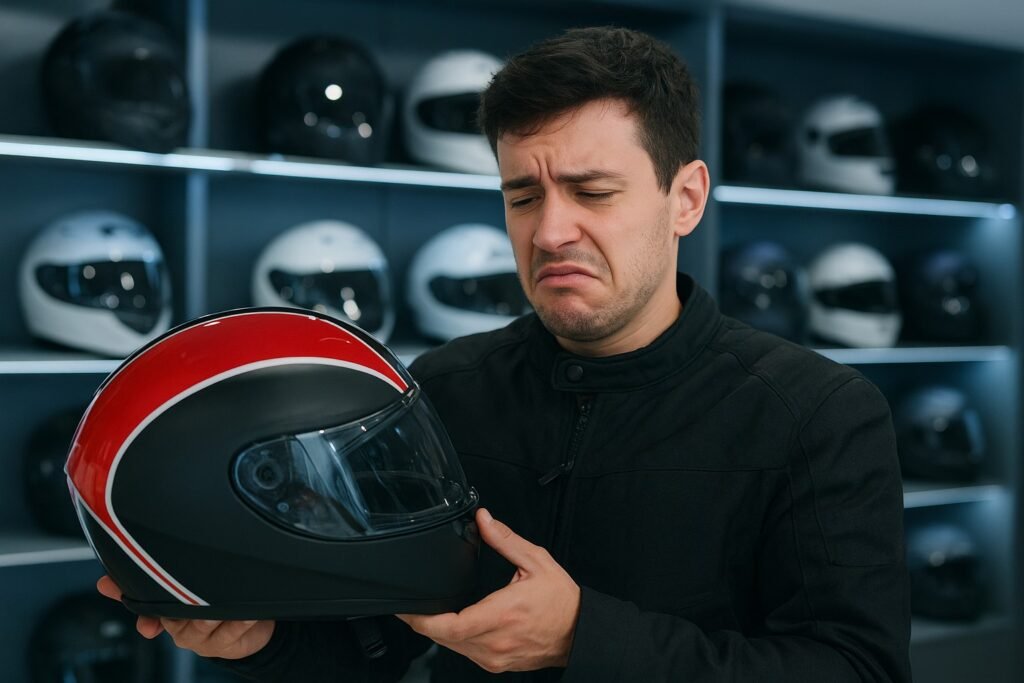
Mistake #1: Choosing by Brand or Looks
This is one of the most common helmet buying mistakes.
A premium brand does not guarantee the right fit for your head shape.
Your head shape (round oval, intermediate oval, long oval) determines:
- If the helmet stays stable
- Whether pressure points form
- Whether you can ride for hours pain-free
A beautiful helmet that doesn’t match your shape will hurt—fast.
Fix:
- Try 2–3 brands, not just one.
- Focus on shape and comfort, not the logo.
- Let the helmet choose you, not the other way around.
Mistake #2: Trusting the Size Chart Alone
Another huge helmet buying mistakes trap is believing that a size chart is perfectly accurate.
Sizing changes from brand to brand—and sometimes even between models from the same company. A “Medium” in one brand may fit like a “Small” or a “Large” in another.
Fix:
- When between sizes, choose the smaller one (pads break in).
- Look for helmets with replaceable cheek pads.
- Re-measure your head every time you buy a new helmet.
Mistake #3: Not Testing the Helmet Like You Actually Ride
Trying a helmet for 60 seconds in a shop mirror tells you nothing.
A helmet that feels fine standing still may become a torture device at 100–120 km/h.
This is one of the most overlooked Helmet Buying Mistakes.
Fix:
- Wear it 10–15 minutes before buying.
- Sit on your bike (or a similar one) to test the riding posture.
- If buying online, only buy from stores with easy returns.
Real-world posture and wind pressure reveal discomfort that a shop test cannot.
Mistake #4: Ignoring Noise Levels
Noise is a serious safety factor—and one of the sneakiest helmet buying mistakes.
Many helmets advertised as “quiet” become loud on the highway due to:
- Poor aerodynamics
- Wrong fit
- Weak padding
- Gaps around your ears
- Turbulence from your motorcycle or windscreen
High noise for long periods causes fatigue and kills focus.
Fix:
- Treat noise as a priority if you ride long distances.
- Test helmets at realistic speeds whenever possible.
- Use earplugs for extra protection—even with quiet helmets.
Mistake #5: Thinking “I’ll Replace It Soon Anyway”
This mindset leads riders into one of the most dangerous Helmet Buying Mistakes.
Helmets degrade with time—even if you never crash.
- EPS foam hardens
- Sweat and humidity break down materials
- UV weakens the shell
- Interior padding compresses
A cheap “temporary” helmet usually ends up being used for years—long after its safe lifespan.
Fix:
- Buy the best helmet your budget allows.
- Check the manufacturing date before purchasing.
- Replace helmets every 3–5 years (or immediately after a crash).
Bonus Mistake: Buying a Helmet With No Intercom Compatibility
In 2025, communication is a big part of riding. Choosing a helmet without speaker cutouts or intercom support can lead to:
- Ugly mounting
- Damaged liner
- Reduced safety
- Voided warranty
Fix:
- Choose helmets with built-in speaker recesses or intercom-ready designs.
- Avoid drilling or gluing anything inside the helmet.
2025 Helmet Buying Checklist (Copy & Use!)
Before you buy, make sure you tick all these boxes:
✔ Try 2–3 brands to match your head shape
✔ Wear the helmet at least 10–15 minutes
✔ Choose the smaller size if between two
✔ Confirm DOT / ECE 22.06 or relevant certification
✔ Check manufacturing date
✔ Assess noise and ventilation
✔ Prefer intercom-ready models
✔ Verify return/exchange policy (if buying online)
This checklist alone helps avoid nearly all common helmet buying mistakes.
Which Helmet Buying Mistake Were You About to Make?
- You might have relied too heavily on the size chart.
- Or perhaps the brand or design influenced your decision more than the fit.
- Maybe details like real noise levels, certification, or the manufacturing date slipped through the cracks.
Now you know exactly what to avoid—and exactly how to choose a helmet that truly fits and protects you.