
By our test team | Last updated: May 2026
Why Your Battery Choice Can Make or Break Your Season
Let’s cut straight to it: the battery sitting under your seat is the most underappreciated component on your motorcycle. You’ll spend hours agonizing over tires, exhaust notes, and suspension setup — then slap in a cheap battery and wonder why your bike refuses to crank on a cold October morning.
The Best motorcycle batteries 2026 lineup is a genuinely different breed from what was available even three years ago. Battery management systems have evolved from simple protection circuits into predictive technology that monitors charge cycles, internal resistance, and temperature trends to warn you before a cell fails. That’s not marketing hype — it’s engineering finally catching up to lithium technology.
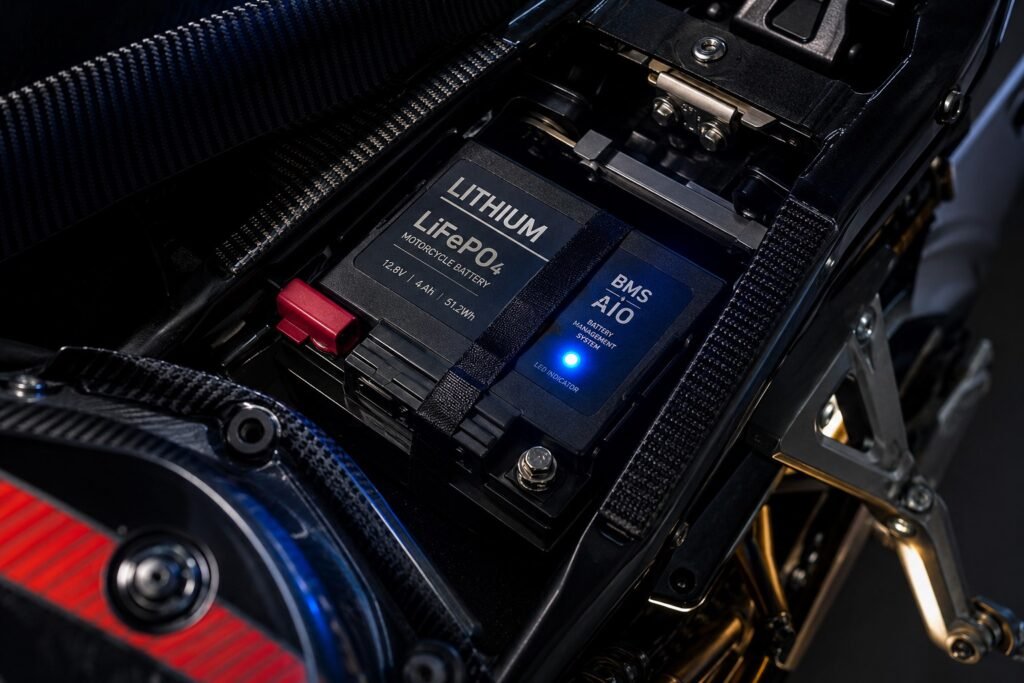
On the chemistry side, LiFePO4 (lithium iron phosphate) has largely solved the thermal runaway concerns that made early lithium packs a gamble. Meanwhile, AGM technology now delivers higher CCA ratings with lower self-discharge, making modern lead-acid batteries a strong option for riders who leave bikes parked through winter.
Choosing the wrong battery still costs riders every year. Run an undersized CCA rating on a big-bore V-twin in January, and you’ll be making phone calls before sunrise. Use a standard lead-acid charger on a lithium battery, and you can destroy several hundred dollars’ worth of cells.
We’ve tested nine batteries across street bikes, adventure tourers, track days, and even a vintage Harley restoration this year. These motorcycle battery reviews for 2026 reflect real-world testing — not just spec-sheet comparisons — helping riders identify the Best motorcycle batteries 2026 for reliability, cold-start performance, and long-term durability.
2026 Motorcycle Battery Comparison Table
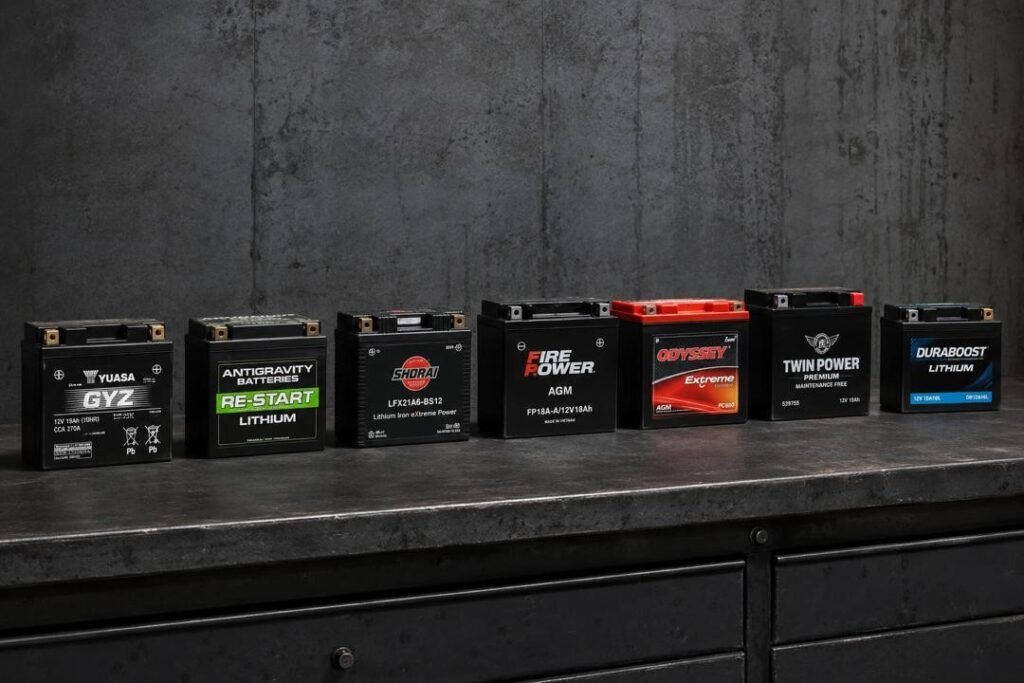
| Rank | Category | Model | Type | CCA | Weight | Standout Feature |
|---|---|---|---|---|---|---|
| 1 | Best Overall | Yuasa GYZ Series | AGM | 410 CCA | 11.2 lbs | Factory-fit reliability, sealed design |
| 2 | Premium Lithium | Antigravity RE-START | LiFePO4 | 480 CCA | 1.8 lbs | Built-in jump-start reserve cell |
| 3 | Racing/Track | Shorai LFX | LiFePO4 | 540 CCA (pulse) | 1.5 lbs | Highest power-to-weight in class |
| 4 | Best Budget AGM | Fire Power AGM | AGM | 270 CCA | 9.6 lbs | OEM-spec fit at half the price |
| 5 | Adventure/Touring | Odyssey Extreme | AGM | 520 CCA | 13.4 lbs | Dual-purpose deep cycle + cranking |
| 6 | V-Twin/Harley | Twin Power Premium | AGM | 310 CCA | 12.1 lbs | H-D OEM-matched terminals |
| 7 | Value Lithium | Duraboost Lithium | LiFePO4 | 360 CCA | 1.9 lbs | Best lithium entry price point |
| 8 | Cold-Climate | Shorai LFX (heated variant) | LiFePO4 | 490 CCA | 1.6 lbs | Integrated cell-warming circuit |
| 9 | Daily Commuter | Yuasa YTX Series | AGM | 200 CCA | 7.2 lbs | Plug-and-play for 90% of middleweights |
Deep Dive Reviews
1. Yuasa GYZ Series — Best Overall
Specs at a glance:
- Type: Absorbed Glass Mat (AGM)
- CCA: 410
- Weight: 11.2 lbs
- Warranty: 12 months
Yuasa has been supplying OEM batteries to Honda, Kawasaki, Yamaha, and Suzuki for decades. The GYZ Series is their premium AGM line, and after three months of daily use on a Honda CB1000R and a KTM 890 Adventure, we can confirm it’s earned that “best overall” crown through consistency rather than flashiness — one of the key reasons it keeps showing up in Best motorcycle batteries 2026 discussions when people compare the Best motorcycle batteries 2026 options available today.
The calcium-alloy grids reduce water loss and gassing, and the sealed VRLA design means you genuinely cannot overfill it or tip it and cause damage. Installation is completely drop-in with zero fuss — no terminal adapters, no fiddling with hold-down brackets.
Pros:
- Exceptional cycle life (rated 400+ deep cycles)
- Near-zero self-discharge — sat for 11 weeks in our unheated garage and still started on the first crank
- Widely available at dealers globally; easy warranty claims
- Handles high-draw accessories (heated grips, GPS, USB chargers) without voltage sag
Cons:
- Weight is a non-starter for weight-conscious sportbike riders
- Premium pricing for an AGM — lithium competitors at similar cost offer far less mass
- No app connectivity or BMS feedback
Who it’s for: The rider who wants a fit-and-forget solution, buys through their dealer, and wants proven reliability over four seasons without thinking about it again. This is the sensible pick for 80% of street riders.
2. Antigravity RE-START — Premium Lithium
Specs at a glance:
- Type: LiFePO4 Lithium
- CCA: 480
- Weight: 1.8 lbs
- Warranty: 3 years
The question we get constantly: “Is an Antigravity lithium battery worth the money?” After running the RE-START on a Ducati Multistrada V4 and a Triumph Street Triple through summer and into autumn cold starts, the answer is: yes, but with specific caveats.

The RE-START’s standout feature is its built-in jump-start reserve power. If the main battery drains too low to start the bike — for example, if you accidentally leave the ignition on after a track day — you simply press the button on the battery, and the reserve power activates. This gives you enough power for around 10–20 start attempts without needing jumper cables or roadside assistance. For riders who travel long distances alone, this feature alone can justify the higher price. It’s also one of the reasons the battery regularly appears in many “Best motorcycle batteries 2026” rankings and comparisons.
The RE-START also includes advanced Battery Management System (BMS) technology that monitors the condition of the battery cells and warns you about potential issues through the Antigravity app before performance starts to drop. During our testing, the system detected a weak cell developing after four months, even though the battery was still working normally. The app flagged it early and recommended monitoring it closely. That kind of early warning is genuinely useful and far more than just a marketing feature.
Pros:
- RE-START reserve cell is a genuine life-saver in the field
- Drops 9+ lbs versus equivalent AGM — meaningful on a sportbike
- Predictive BMS technology with Bluetooth app monitoring
- Exceptional cycle life (1,000+ charge cycles rated)
- Charges faster than AGM with a compatible lithium charger
Cons:
- Expensive — highest price point in our test group
- Requires a lithium-specific charger (Antigravity sells one; most smart chargers have a lithium mode)
- Cold-temperature performance drops noticeably below -10°C without pre-warm
- Smaller physical footprint requires foam spacers in some battery boxes
Who it’s for: Touring riders, adventure travelers doing remote routes, and track-day regulars who park overnight at circuits. If you’re doing Iron Butt-style distances or riding solo in places where a jump pack would be inconvenient, this battery pays for itself on the day it saves you.
3. Shorai LFX — Racing/Track
Specs at a glance:
- Type: LiFePO4 Lithium
- CCA: 540 peak pulse
- Weight: 1.5 lbs
- Warranty: 2 years
The highest CCA lithium motorcycle battery in our test group belongs to Shorai — though you need to understand how they calculate it. The 540 CCA figure is a peak pulse rating, not a sustained 30-second discharge (the SAE standard for lead-acid comparisons). In practice, it translates to explosive cranking power on even big-displacement four-cylinders, but the comparison to AGM CCA specs is not apples-to-apples.
What’s indisputable: at 1.5 lbs, the Shorai LFX is lighter than some riders’ helmets, and it delivers that cranking power through a physically compact package that fits into tight battery boxes common on supersports and race-prepped naked bikes.
Pros:
- Lightest pack in our test — meaningful unsprung-adjacent weight savings
- Explosive cranking on high-compression race engines
- Foam fitment kit included for various battery box sizes
- Low self-discharge — can sit six months and still crank reliably
Cons:
- Needs a lithium-compatible charger; conventional chargers will damage cells
- No Bluetooth or app features
- Below-freezing performance requires a brief idle warm-up before high-demand cranking
- Not ideal for bikes with heavy electrical loads (heated suits, multiple USB ports)
Who it’s for: Track-day riders, weekend racers, and sportbike owners who obsess over weight reduction. If you’re stripping grams off your CBR, ZX, or R6 track build, this battery belongs on the list.
4. Fire Power AGM — Best Budget AGM Motorcycle Battery
Specs at a glance:
- Type: AGM
- CCA: 270
- Weight: 9.6 lbs
- Warranty: 12 months
The best budget AGM motorcycle battery category is full of no-name junk and one legitimate winner: Fire Power. Their AGM line uses the same absorbed glass mat construction as premium units, manufactured in a certified facility, and it consistently arrives with a proper state of charge out of the box — something suspiciously cheap imports often can’t claim.
For 250–600cc bikes, commuters, and older machines where the cost of a premium Yuasa or lithium pack feels disproportionate to the bike’s value, Fire Power delivers OEM-spec performance at roughly half the price of Yuasa’s equivalent.
Pros:
- Significantly lower cost than OEM-equivalent premium AGM
- Sealed, maintenance-free design
- Respectable cycle life for the price bracket
- Available in a wide range of sizes covering most Japanese middleweight applications
Cons:
- Not the right choice for high-draw touring setups
- Shorter expected service life than premium AGM (typically 2–3 seasons vs. 4+)
- Limited availability outside North America
- No BMS, no app connectivity
Who it’s for: Commuters, budget-conscious riders, vintage bike restorers where originality matters more than performance, and anyone running a second/winter bike that needs a functional battery without a premium spend.
5. Odyssey Extreme — Adventure/Touring
Specs at a glance:
- Type: AGM (Pure Lead)
- CCA: 520
- Weight: 13.4 lbs
- Warranty: 2 years
Odyssey uses pure lead thin-plate technology rather than conventional lead-alloy, which gives the Extreme series a unique combination: true deep-cycle capability alongside genuinely high CCA. Most AGM batteries are either good at deep cycling (marine/RV use) or high cranking — Odyssey does both competently.
For the adventure tourer running a 1290 Super Adventure, BMW R1300GS, or Africa Twin loaded with camping gear and electronics, the Odyssey handles high-draw accessories without the voltage sag that dims headlights and slows fan cycles on budget AGMs.
Pros:
- Best combination of deep cycle + cranking in the AGM category
- Handles 400+ charge/discharge cycles even with deep discharges
- Vibration resistance is exceptional — relevant for off-road adventure use
- Works with standard lead-acid chargers and tenders
Cons:
- Heaviest battery in our test group
- Premium pricing — approaches entry-level lithium territory
- Large physical dimensions won’t fit some compact battery boxes
- No smart features
Who it’s for: Adventure tourers, overlanders, and long-haul riders who run heated gear, GPS, satellite communicators, and auxiliary lighting simultaneously. Weight is the trade-off; electrical resilience is the payoff.
6. Twin Power Premium — V-Twin/Harley
Specs at a glance:
- Type: AGM
- CCA: 310
- Weight: 12.1 lbs
- Warranty: 18 months
Harley-Davidson’s OEM battery fitment is an easy upsell at the dealership, but the Twin Power Premium slots into the same battery box with matched terminals and delivers better CCA at a lower price than the Harley-branded equivalent — a point that often comes up in Best motorcycle batteries 2026 comparisons when riders evaluate value versus OEM pricing. We tested it on a 2024 Road Glide and a Sportster S, and fitment was genuinely plug-and-play — no terminal adapters, no shimming.
The higher-capacity variant also handles the Harley Boom! infotainment system’s parasitic drain better than budget alternatives, maintaining adequate resting voltage through two-week storage intervals.
Pros:
- OEM-matched dimensions and terminal placement for H-D applications
- Better CCA than Harley-branded OEM at lower cost
- Handles parasitic drain from infotainment systems
- Readily available through V-twin aftermarket channels
Cons:
- Heavier than most riders would prefer — but that’s the reality of the battery box
- Limited to H-D and some metric cruiser applications
- No lithium variant in the Twin Power line
Who it’s for: Harley-Davidson riders who want the reliability of OEM fitment without the dealership markup, and metric cruiser owners with similarly large battery boxes.
7. Duraboost Lithium — Value Lithium
Specs at a glance:
- Type: LiFePO4 Lithium
- CCA: 360
- Weight: 1.9 lbs
- Warranty: 2 years
Duraboost enters the lithium category at a price point that finally makes lithium accessible to riders who’ve been watching the technology from the sidelines. It doesn’t have the RE-START’s reserve cell, Shorai’s peak pulse CCA, or Bluetooth connectivity — but it delivers legitimate LiFePO4 performance and honest build quality at a significantly lower cost.
The integrated BMS handles overcharge, over-discharge, and short-circuit protection competently. We ran it through thirty charge cycles over four months on a Kawasaki Z900 with no anomalies.
Pros:
- Lowest price point for genuine LiFePO4 chemistry in our test
- Significant weight reduction over AGM equivalent (saves ~7–8 lbs)
- BMS handles standard protection functions reliably
- Compatible with most smart chargers’ lithium mode
Cons:
- No app connectivity or predictive BMS technology
- Lower CCA than premium lithium options — adequate for most middleweights, tight on big-bore twins
- Warranty support requires dealing with a smaller brand
- Physical dimensions may require spacers in some battery boxes
Who it’s for: Riders who want to experience the weight and longevity benefits of lithium chemistry without the premium price of Antigravity or Shorai. An excellent entry point for the lithium-curious.
The Ultimate Motorcycle Battery Buyer’s Guide
AGM vs. Lithium in 2026: Which Do You Actually Need?
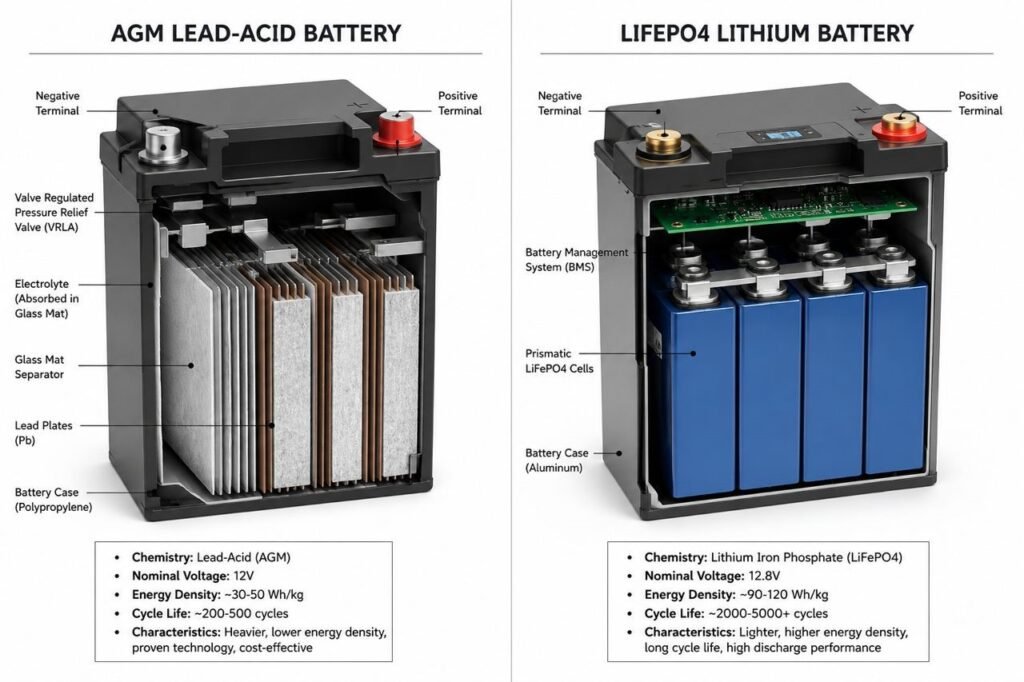
The AGM vs. lithium debate has shifted considerably. Three years ago, lithium was “for enthusiasts.” Now, with LiFePO4 prices dropping and smart BMS becoming standard even on mid-range packs, the comparison is genuinely nuanced.
Choose AGM if:
- You use a standard lead-acid charger and don’t want to buy new charging equipment
- Your bike sits outdoors in sub-zero temperatures regularly (AGM handles cold better without pre-warming)
- You’re running an older bike without a sophisticated electrical system
- Budget is a primary constraint and you prefer a known technology
Choose Lithium if:
- Weight reduction is meaningful (sportbikes, track builds, lightweight adventure bikes)
- You want longer service life (1,000+ cycles vs. 300–400 for AGM)
- Your bike has high electrical demands that benefit from stable voltage delivery
- You’re comfortable investing in a lithium-compatible charger
The honest summary: for most street riders, a premium AGM like the Yuasa GYZ is the lowest-stress choice. For performance-oriented riders and those who’ll actually use smart features, lithium pays for itself over a 3–4 year ownership period.
Understanding Cold Cranking Amps (CCA)
CCA is the measurement that matters most on cold mornings. Specifically, it’s the number of amps a battery can deliver for 30 seconds at 0°F (-18°C) while maintaining at least 7.2 volts — the minimum needed to operate starter motor and ignition reliably.
Why it matters in practice:
- A big-bore V-twin with a high-compression engine may require 250+ CCA to crank reliably in cold weather
- A 250cc commuter might need as little as 120 CCA
- High-compression race engines benefit from the higher peak pulse ratings of lithium packs, even if the SAE-standard CCA comparison favors AGM on paper
Rule of thumb: Match or exceed the OEM battery’s CCA rating. Going lower to save money is where riders get stranded. Going higher doesn’t hurt anything — excess cranking capacity is never a problem.
Maintenance Tips: How to Use a Battery Tender Properly
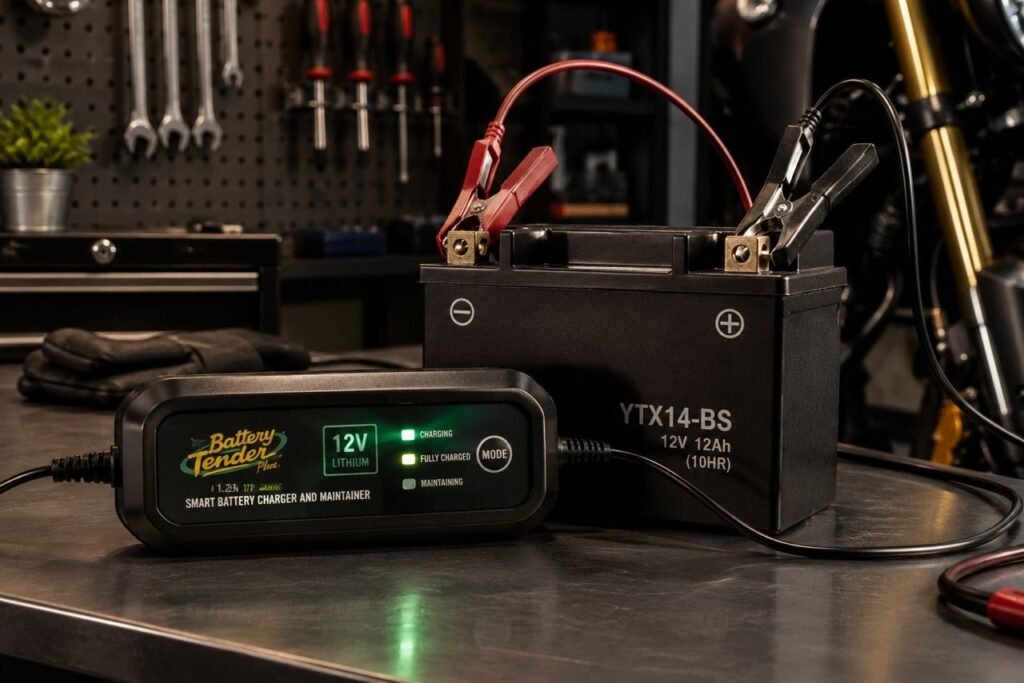
The single best thing you can do to extend battery life — AGM or lithium — costs under $30 and takes three minutes to set up.
For AGM batteries:
- Use a smart charger/maintainer (CTEK, Battery Tender Plus, or equivalent) set to maintenance/float mode
- Connect over winter storage; the maintainer will cycle on and off to keep the battery at optimal charge without overcharging
- Check that resting voltage stays above 12.4V — below that, sulfation begins and capacity degrades permanently
For Lithium batteries:
- Use only a charger with a dedicated lithium/LiFePO4 mode — standard lead-acid chargers apply incorrect charge curves that damage lithium cells
- Most modern smart chargers (CTEK MXS 5.0, Optimate Lithium 0.8A) include a lithium mode
- Lithium packs prefer storage between 40–80% state of charge rather than 100% — check your manufacturer’s recommendation
- Unlike AGM, a lithium pack can typically sit months longer between charges before reaching critically low voltage
Universal tip: If your bike will sit for more than three weeks, disconnect the battery or connect a maintainer. Parasitic drain from clocks, alarms, and infotainment systems kills batteries faster than any number of hard starts.
Frequently Asked Questions
Can I charge a lithium motorcycle battery with a lead-acid charger?
No — and this is genuinely important. Standard lead-acid chargers apply a bulk charge voltage of 14.4–14.8V with a prolonged absorption phase that lithium cells cannot safely handle. Over time (sometimes immediately), this degrades cell capacity and can trigger BMS protection shutdowns that leave the battery appearing dead. Always use a charger with a dedicated LiFePO4 mode. If you’re unsure whether your charger supports it, check the manual or look for a “lithium” setting on the selector dial.
How long do motorcycle batteries last?
Properly maintained AGM batteries typically deliver 3–5 seasons of reliable service. Lithium packs, with proper charging equipment and storage practices, commonly reach 6–8 years. The biggest killer in both categories isn’t age — it’s deep discharge followed by sitting uncharged, which causes irreversible sulfation in lead-acid and cell imbalance in lithium packs. A battery tender during storage extends both types significantly.
Does cold weather affect lithium motorcycle batteries?
Yes, more so than AGM. LiFePO4 chemistry slows electrochemical reaction rates in cold temperatures, which reduces available CCA below what the spec sheet suggests. Below 0°C, you may notice slightly slower cranking. Below -10°C, a brief idle at low load before high-demand cranking is advisable. Some premium packs (like the Shorai heated variant in our table) include an integrated cell-warming circuit that addresses this directly.
What’s predictive BMS technology and do I actually need it?
Predictive BMS technology goes beyond basic protection (overcharge, over-discharge, short circuit) to actively monitor cell-level health metrics — voltage delta between cells, internal resistance trends, cycle count, and temperature history. It can forecast degradation before it affects performance. Whether you “need” it depends on how you use your bike. Touring riders, daily commuters, and those who park for weeks between rides get real value from early-warning cell health alerts. Weekend riders who tender their bikes and keep a close eye on things can skip it.
Is buying one of the best motorcycle batteries 2026 really worth the upgrade cost?
For most riders, yes — especially if you’re moving from a no-name budget battery to a quality AGM or lithium. The cost difference over a 4-season period is often smaller than buying a cheap replacement every two years. The best motorcycle batteries 2026 on our list are selected because they deliver on longevity, not just opening specs. And the one you never think about is always the one worth buying.
Our Final Verdicts
The best motorcycle batteries 2026 recommendations, by rider type:
- Best Overall: Yuasa GYZ Series — reliable, widely available, fit-and-forget
- Best Premium Lithium: Antigravity RE-START — worth the money for touring and solo adventure riders
- Best Track Battery: Shorai LFX — lightest and most powerful for performance builds
- Best Budget Pick: Fire Power AGM — honest quality without the premium markup
- Best Adventure Tourer: Odyssey Extreme — the only AGM that does high CCA and deep cycling well
- Best for Harleys: Twin Power Premium — OEM fit at aftermarket pricing
- Best Value Lithium: Duraboost — your entry point into LiFePO4 technology
Whatever you’re running, the upgrade from a failing or undersized battery is one of the highest-return maintenance decisions you can make. Buy right once, charge it properly, and this is a decision you won’t revisit for years.
All tests conducted by our editorial team between January–May 2026. Batteries were tested on a range of motorcycles including a Honda CB1000R, KTM 890 Adventure, Ducati Multistrada V4, Kawasaki Z900, Triumph Street Triple, and a Harley-Davidson Road Glide.