
Last Updated: May 16, 2026 — By Chris Mchenga
Disclosure: This article contains Amazon affiliate links. If you make a purchase through these links, we earn a small commission at absolutely no extra cost to you. This helps support the site and allows us to continue creating detailed motorcycle maintenance guides. Thank you for your support!
A motorcycle tool kit is one of those things you never think about until the moment you desperately need it. A loose mirror, dead battery terminal, chain adjustment issue, or unexpected roadside repair can instantly turn a perfect ride into a stressful situation — especially if your bike’s factory toolkit is missing critical tools or built with cheap hardware.
The problem is that most motorcycle tool kits on the market fall into two extremes: ultra-cheap kits filled with low-quality tools that bend under pressure, or oversized mechanic sets that are far too bulky to carry on a real ride. Finding the right balance between portability, durability, and practical usefulness is what actually matters.
In this guide, we researched and compared the best motorcycle tool kits for different types of riders, including daily commuters, touring riders, adventure motorcyclists, and home garage enthusiasts. Whether you need a compact emergency roadside kit or a more complete setup for regular maintenance, these are the motorcycle tool kits worth considering in 2026.
Metric Motorcycle Tool Kit vs Standard: What Do You Actually Need?
This is where a lot of beginners make their first expensive mistake when shopping for the best motorcycle tool kits (#3): buying the wrong kind of tools for their bike.
The Metric World (Most of You Live Here)
If you ride a Japanese, European, or modern Asian motorcycle, your bike is almost entirely metric. Honda, Yamaha, Suzuki, Kawasaki, BMW, KTM, Ducati, Triumph, Royal Enfield—all metric. That means the bolts on your bike are measured in millimeters, and you’ll primarily be reaching for sockets and wrenches in the following sizes:
- 8mm — common on fairings, small brackets, mirrors
- 10mm — everywhere. Seriously, everywhere. It’s the universal motorcycle bolt size.
- 12mm — exhaust brackets, swingarm bolts, frame bolts
- 14mm — axle nuts on smaller bikes, caliper bolts
- 17mm, 19mm, 22mm, 24mm — larger axle nuts depending on your model
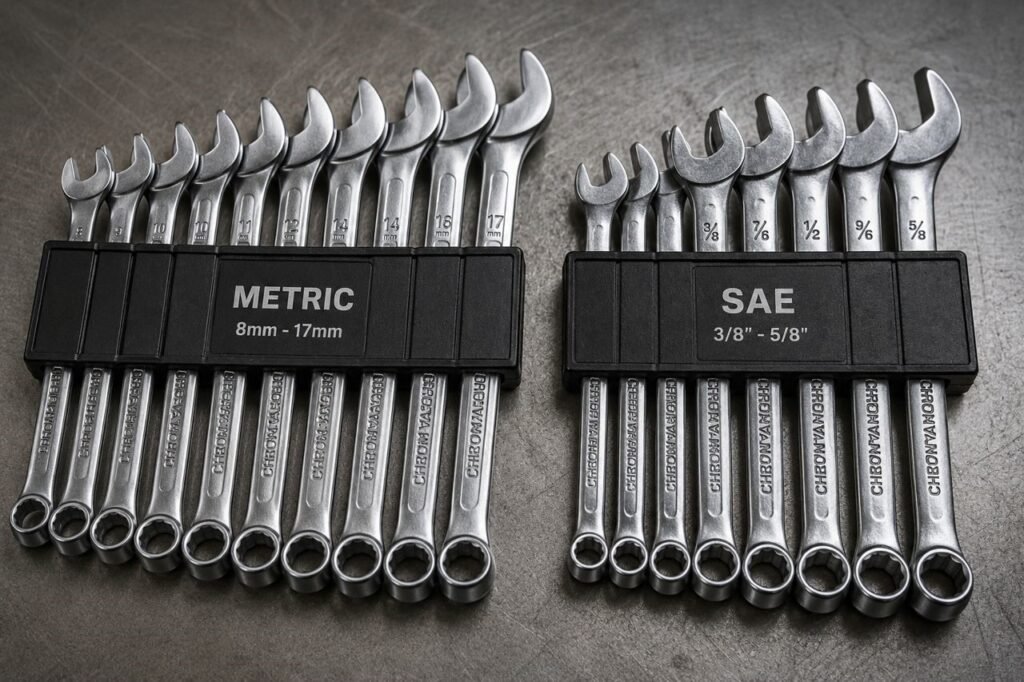
A metric socket set from 8mm to 24mm covers the vast majority of what you’ll encounter on any Japanese or European machine.
The SAE/Imperial Exception: American Cruisers
If you ride a Harley-Davidson, you’re in a different world. Most H-D models use SAE (Society of Automotive Engineers) measurements, meaning your wrenches are in fractions of an inch: 3/8″, 7/16″, 1/2″, 9/16″, 5/8″, and so on. Some modern Harleys are a blend, but don’t assume—check your owner’s manual.
Victory, Indian Motorcycle, and older American bikes are a similar story.
How to Know for Sure
Open your owner’s manual. If the torque specifications are listed in Nm (Newton-meters), you’re on a metric bike. If they’re in ft-lbs only and everything reads in fractional inches, you’re likely SAE. Some modern bikes list both—worth double-checking regardless.
Don’t mix systems out of convenience. Using a 3/8″ socket on a 10mm bolt is a recipe for rounded fasteners, and rounded fasteners on a motorcycle are far more annoying to deal with than on a car.
What Tools Should a Beginner Motorcycle Rider Carry?
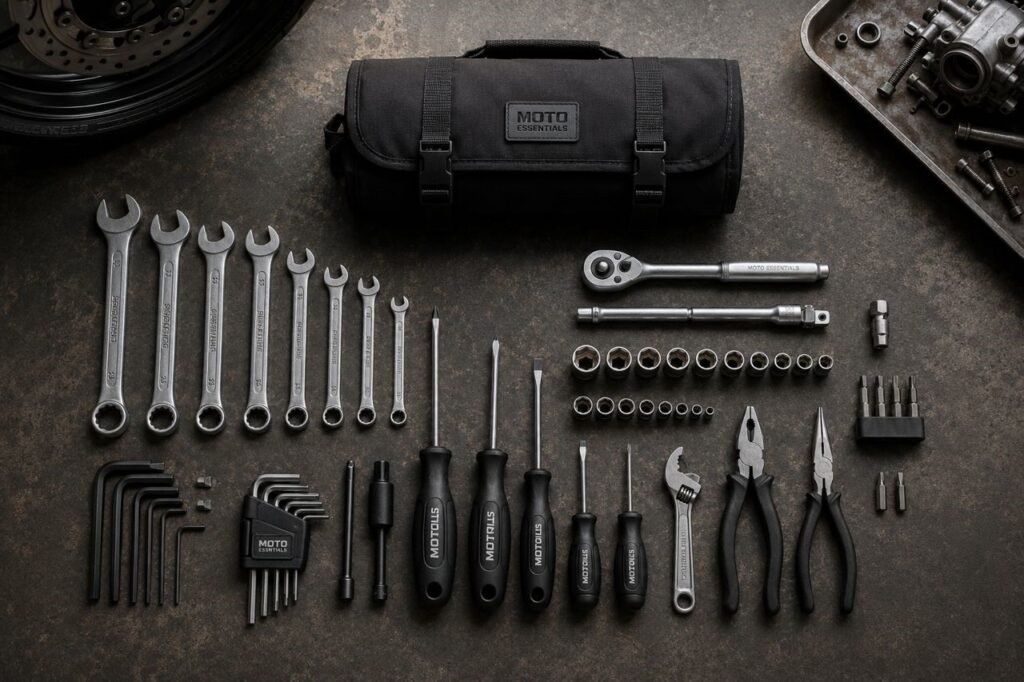
Let’s break this down clearly. Whether you’re assembling one of the best motorcycle tool kits (#4) for the road or for your garage, not every tool belongs in your tank bag. Think of it as two distinct categories: the roadside kit (lightweight, portable, emergency-focused) and the garage kit (comprehensive, bench-focused, maintenance-oriented). Many of the tools overlap—but the selection philosophy is different.
1. Combination Wrenches and Sockets
The non-negotiables for any motorcycle rider.
Recommended Socket Set
A quality metric socket set is the foundation of every motorcycle toolkit. Tekton’s chrome sockets are durable, accurate, and perfect for home maintenance. View the latest Amazon price

A combination wrench has an open end on one side and a box (ring) end on the other. The box end gives you more torque and won’t slip off rounded bolts. For roadside emergencies, you want at least 8mm, 10mm, 12mm, 14mm, and 17mm in combination wrenches. Add a 3/8″ drive ratchet and matching sockets for your garage kit.
A note on the legendary 10mm socket: it disappears into an alternate dimension with alarming frequency. Buy extras. Seriously. A pack of three is not overkill.
2. Hex/Allen Keys and Torx Bits
Modern motorcycle fairings are held together with hex bolts—especially on sport bikes and adventure tourers. You need an Allen/hex key set in metric sizes: 3mm, 4mm, 5mm, 6mm, and 8mm are the most common.
Torx bits are increasingly common on European bikes—particularly BMW and KTM. T25, T30, and T40 are the Torx sizes you’ll encounter most. A T-handle set or a Torx bit set with a 1/4″ adapter is incredibly useful.
Without hex keys and Torx bits, you literally cannot remove many motorcycle body panels. Getting stranded with a loose fairing on a highway because you don’t have a 5mm Allen key is a deeply humbling experience.
3. Screwdrivers—Including the JIS Secret
Here’s something most beginners don’t know: Japanese motorcycles don’t use standard Phillips screws. They use JIS (Japanese Industrial Standard) screws, which look almost identical to Phillips but have a slightly different cross-pattern angle.
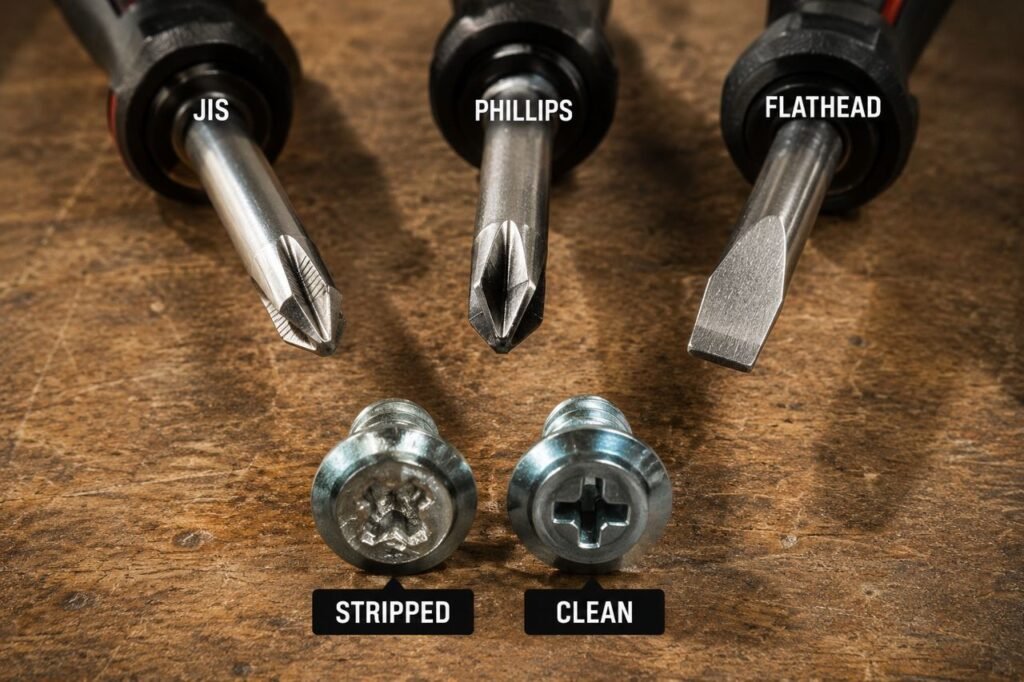
Using a regular Phillips screwdriver on JIS screws will strip the head almost immediately. If you’ve ever wondered why fasteners on Japanese bikes seem to strip so easily, that’s why.
Invest in a JIS screwdriver set (commonly labeled #1, #2, #3 JIS). Vessel and Hozan both make excellent JIS drivers. European and American bikes are fine with standard Phillips.
Also carry a flathead screwdriver in at least two sizes—they’re still used on battery terminals, clamps, and various random hardware.
Recommended for Japanese Motorcycles
If you ride a Honda, Yamaha, Kawasaki, or Suzuki, a genuine Vessel JIS screwdriver helps prevent stripped screws during maintenance. Check availability on Amazon

4. Pliers, Wire Cutters, and Electricals
A pair of needle-nose pliers and wire-cutting pliers earn their weight. For roadside emergencies they’re invaluable: pulling broken zip ties, manipulating cotter pins, dealing with loose wiring.
Electrical tape and a small coil of safety wire round out the electrical toolkit. Safety wire can temporarily secure a loose exhaust mount, wrap a cracked cable housing, or keep a detached panel in place long enough to limp to a shop.
A multimeter lives in the garage kit, not the roadside bag. But knowing how to use one for basic voltage checks—testing your battery, tracing a dead circuit—is a fundamental skill worth developing early.
5. Tire Pressure Gauge
Digital or analog, carry a tire pressure gauge always. Motorcycle tires are far more sensitive to pressure than car tires. A 5 PSI drop on a car is annoying. On a motorcycle at speed in a corner, it can get dangerous.
Small digital gauges are cheap, accurate, and fit in a jacket pocket. Get one. Check your tires cold before every significant ride.
Our Pick:
A compact digital tire pressure gauge is inexpensive and accurate enough to keep in your jacket or tank bag.

6. Emergency Items: The Save-Your-Ride Kit
These items weigh almost nothing but have saved many a stranded rider:
- Zip ties (assorted sizes): Holds cracked fairings together, secures a loose exhaust heat shield, replaces a broken luggage mount. Carry more than you think you need.
- Electrical tape: Insulates, wraps, secures, and temporarily seals minor fuel line cracks on carbureted bikes.
- Duct tape: One compact roll. Broader adhesion than electrical tape for larger surface fixes.
- Spare fuses: Check your owner’s manual for your bike’s fuse ratings and carry one spare of each type. A blown fuse is a five-minute fix—if you have a spare.
- Nitrile gloves: Working on a hot engine without gloves is a fast way to earn a painful burn or a chemical irritation from brake fluid. Pack a few pairs.
The Top Beginner-Friendly Motorcycle Tool Kits Ranked
Now let’s talk specific kits. When it comes to the best motorcycle tool kits (#5) on the market, not all of these are “kits” in the traditional boxed sense—some are thoughtfully curated systems. But each addresses a different rider need.
1. CruzTools RoadTech Series — Best Premium Roadside Kit
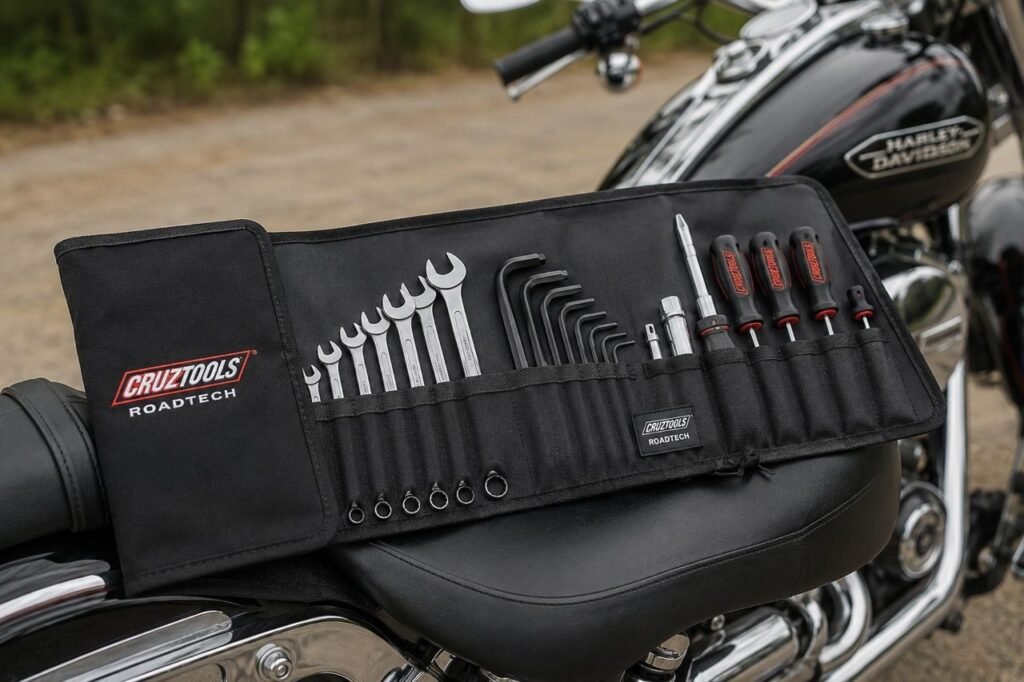
Overview: CruzTools has been making dedicated motorcycle tool kits since 1989, and the RoadTech line remains the gold standard among the best motorcycle tool kits (#6) for factory-spec portability. They make model-specific versions for Honda, Yamaha, Kawasaki, Suzuki, BMW, and Harley-Davidson—meaning the tools inside are actually calibrated for the fasteners on your specific bike. No generic filler.
What’s Typically Included:
- Combination wrenches in correct metric or SAE sizes for the target model
- Ball-end hex key set (the ball end lets you approach bolts at a 25° angle—crucial in tight spaces)
- JIS screwdrivers for Japanese models; standard Phillips for others
- Spoke wrench (on applicable models)
- Compact spark plug socket
- Tire pressure gauge
- Neatly organized, weatherproof roll bag
Pros:
- Bike-specific sizing means zero wasted space
- Noticeably higher tool quality than generic sets—chrome vanadium steel on key pieces
- The roll bag is compact enough to fit under most seats
- Excellent resale value; these kits hold up
Cons:
- Not cheap. Expect to pay $60–$120 depending on model
- Won’t expand into a garage kit—it’s a pure roadside solution
- Less useful if you ride multiple bikes of different brands
Best For: Riders who have one bike and want a serious, reliable compact motorcycle roadside tool kit that’s ready on day one. Particularly strong recommendation for sport bike and adventure bike riders who tour regularly.
2. Craftsman or Tekton Mechanics’ Set — Best Garage Starter Kit
Overview: For the beginner building out a home garage setup, a comprehensive mechanics’ set from Craftsman, Tekton, or a similar mid-range brand represents some of the best motorcycle tool kits (#7) value available. These sets typically include 100–200+ pieces covering sockets, ratchets, extensions, combination wrenches, hex keys, and screwdrivers. They’re not motorcycle-specific, but they cover the full metric and SAE range.
What to Look For:
- Full metric socket coverage: 6mm through 24mm in both 1/4″ and 3/8″ drive
- A 72-tooth or higher ratchet—more teeth means finer arc of movement, critical when working in tight spots around engine cases
- Chrome vanadium (Cr-V) steel construction—look for this explicitly on the label. Cheap kits use mystery alloys that round off or snap under load
- Blow-molded storage case with labeled cutouts so you can instantly see what’s missing
Pros:
- Exceptional value per tool—often $80–$150 for a 150-piece set
- Versatile for home and car repairs too
- Lifetime warranty on most Craftsman and Tekton tools
- Builds out a proper garage inventory
Cons:
- Not portable—this lives on a bench, not in a tail bag
- You’ll need to add JIS screwdrivers, Torx bits, and a torque wrench separately
- Not curated for motorcycle-specific tasks; some pieces you’ll never touch
Best For: The beginner who’s genuinely interested in doing their own maintenance at home—oil changes, chain adjustments, brake pad swaps, filter replacements. This is the best budget motorcycle tool kit 2026 option for riders building a home workshop from scratch.
A word on chrome vanadium steel: this is a manganese-chromium-vanadium alloy that balances hardness and toughness particularly well. Tools made from it resist deformation under torque, which is exactly what you want when putting real muscle into a stubborn bolt on an aluminum engine case. Avoid anything that vaguely says “alloy steel” without specifying the grade. If it’s dirt cheap and from an unknown brand, the steel is likely inferior.
3. Bikers’ or Oxford Micro Tool Roll — Best Under Seat Motorcycle Tool Roll
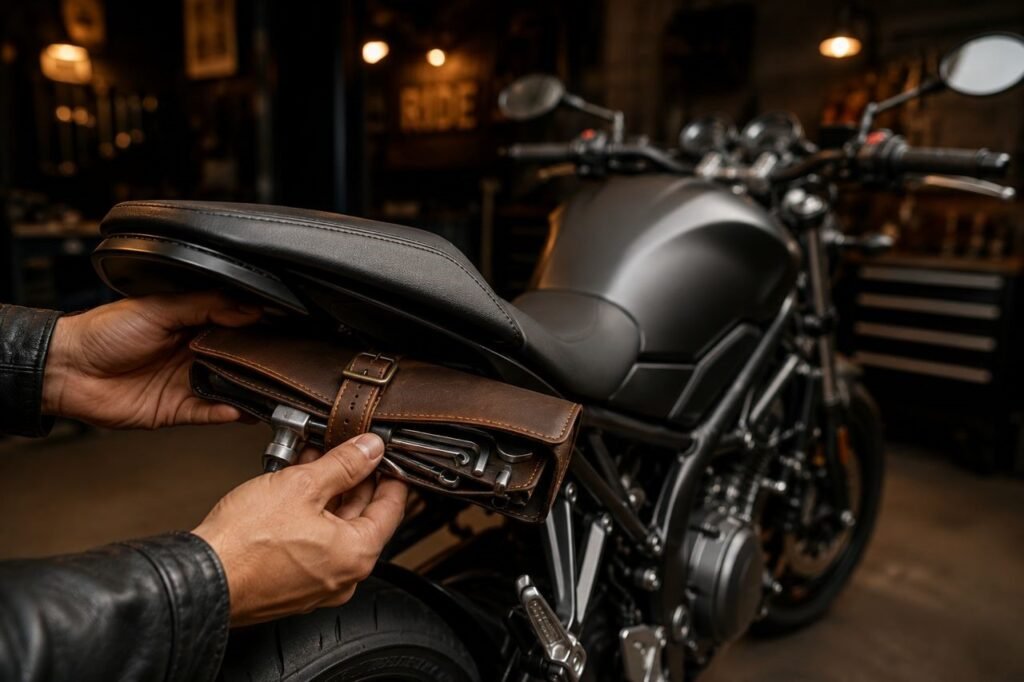
Overview: The minimalist school of thought says you carry only what you can’t live without. A compact tool roll—typically leather or waxed canvas, holding 10–15 carefully selected tools—is the best under seat motorcycle tool roll option for riders who prioritize weight and space. Brands like Oxford, Bikers, and various handcraft toolmakers sell pre-filled rolls; you can also buy an empty roll and curate your own selection.
Ideal Contents for a DIY Tool Roll:
- 8mm, 10mm, 12mm, 14mm combination wrenches
- 3mm, 4mm, 5mm, 6mm hex keys
- One JIS #2 screwdriver (if you ride a Japanese bike)
- One flathead screwdriver
- Needle-nose pliers
- Small ratchet with 10mm and 12mm sockets
- Tire pressure gauge
- Emergency items: zip ties, tape, spare fuses
Pros:
- Slim enough to replace your factory kit under the seat or in a tail bag
- Curated = no dead weight
- Canvas and leather rolls last for years and look great
- Forces you to know your bike—you only pack what it actually needs
Cons:
- Limited scope—you can’t do serious maintenance with a 10-tool kit
- Requires you to know which tools your bike actually needs before purchasing
- No torque wrench (more on that shortly)
Best For: Experienced daily commuters and touring riders who want a compact motorcycle roadside tool kit and have a separate garage setup at home. Also ideal for minimalists who’ve been riding a few years and know exactly what they need.
4. DeWalt or Milwaukee Mechanics’ Set — Best Premium Garage Kit
Overview: If you’re willing to spend more—and you plan to do comprehensive maintenance yourself—a premium mechanics’ set from DeWalt or Milwaukee represents the pinnacle of the best motorcycle tool kits (#8) for serious home wrenchers. These kits feature tighter manufacturing tolerances, better steel specs, and more satisfying ratchet mechanisms. A Milwaukee 3/8″ ratchet has the kind of smooth, tactile click that makes you want to use it just for fun.
What Sets Them Apart:
- Full-polish chrome finish — easier to clean, better corrosion resistance
- Ratchets with 90-tooth pawl mechanisms — 4° arc swing means usability in extremely tight spaces
- Flex-head ratchets included in some sets — invaluable around engine cases
Pros:
- Built to last decades, not years
- Better ergonomics reduce hand fatigue during long jobs
- Genuinely impressive socket-to-ratchet engagement
Cons:
- Significantly more expensive: $200–$400+ for a premium set
- Overkill for casual riders who only do oil changes
Best For: Riders who wrench regularly and want tools that will outlast the bike.
Do I Need a Torque Wrench for Basic Motorcycle Maintenance?
Short answer: yes, but with nuance.
Here’s the risk that nobody talks about enough. Motorcycle engines are mostly aluminum—engine cases, cylinder heads, valve covers, caliper brackets. Aluminum is light and excellent for heat dissipation, but it’s also much softer than steel fasteners. Over-tighten a bolt into an aluminum thread and you can strip it, or worse, crack the case.
Under-tighten critical fasteners—axle pinch bolts, caliper bolts, handlebar clamp bolts—and things can come loose at exactly the wrong moment.
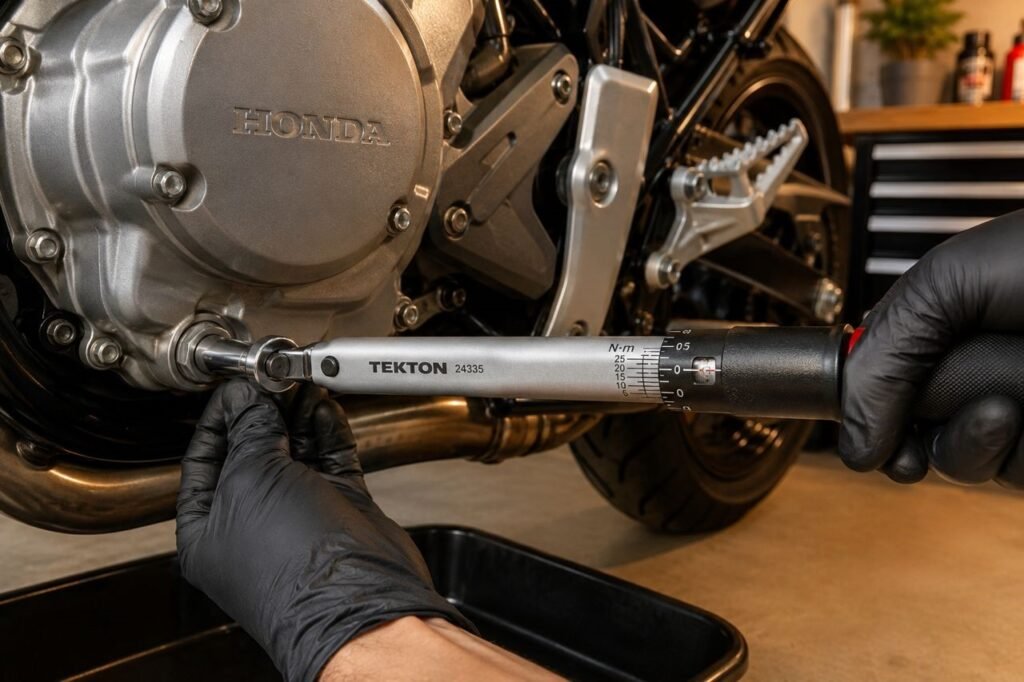
A torque wrench removes the guesswork. For tasks like:
- Oil drain plugs (typically 20–30 Nm)
- Caliper bolts (typically 25–40 Nm depending on the bike)
- Axle nuts (can be 60–120 Nm)
- Spark plugs (typically 12–18 Nm)
…a click-type torque wrench in the 5–80 Nm range covers almost everything a beginner will ever do at home. Tekton makes a well-regarded 1/2″ drive click wrench that’s accurate, well-built, and reasonably priced around $60–$80.
Torque wrenches belong in the garage, not the roadside kit. On the road, you’re tightening to “firm and not going anywhere”—the roadside mindset is “get home or get to a shop.” In the garage, you’re doing it right.
A beam-type torque wrench is equally accurate and cheaper than click-type—just less convenient to read. Either works. Avoid digital torque wrenches at budget price points; the sensors can drift.
Working on your motorcycle at home? A quality torque wrench helps you tighten critical fasteners to the manufacturer’s specifications instead of guessing. View current Amazon options before your next maintenance job.

Frequently Asked Questions About Beginner Motorcycle Tool Kits
How do I know if my motorcycle uses metric or standard tools?
Check your owner’s manual. If torque specs are listed in Nm, you’re metric. Japanese, European, and most modern Asian bikes are metric. Harley-Davidson and most classic American bikes use SAE (imperial) sizes. When in doubt, identify a known bolt diameter with a caliper.
Can I just use a standard car tool kit for my motorcycle?
Partially. A car tool kit covers the right socket sizes, but motorcycle work often requires JIS screwdrivers (for Japanese bikes), specific Torx bits for European fairings, and spoke wrenches for wire-wheel bikes. Car kits also lack the compact portability a roadside motorcycle kit needs. Start with a car kit, then supplement.
What is the single most important tool to carry on a road trip?
A quality tire plug kit with CO2 inflators. A puncture is statistically the most common roadside emergency for touring riders. A plug kit weighs almost nothing and, on a tubeless-tire bike, can get you back rolling in under 10 minutes without needing a truck or a tow.
The Bottom Line
Building a proper tool kit as a new rider isn’t about owning every socket ever made. The best motorcycle tool kits (#9) are the ones actually suited to your bike, your riding style, and your mechanical goals. It’s about understanding your bike, knowing what it needs, and having the right quality tools when it matters. Start with a curated roadside roll or a model-specific kit like CruzTools, build toward a proper garage set from Craftsman or Tekton, and eventually add a torque wrench once you’re doing real maintenance at home.
The rider who knows their tools—and actually carries them—is the rider who gets home.
Disclaimer: Tool prices and kit availability may vary by region. Always verify specific torque values for your motorcycle model in the manufacturer’s official service manual before performing maintenance.