
Disclosure: This article contains Amazon affiliate links. If you make a purchase through these links, we earn a small commission at absolutely no extra cost to you. This helps support the site and allows us to continue creating detailed motorcycle maintenance guides. Thank you for your support!
A flat motorcycle tire rarely happens at a convenient time. It happens at sunset on a deserted highway, halfway through a mountain pass, or twenty miles from the nearest fuel station with no cell signal. One sharp screw or roofing nail can instantly turn a perfect ride into a long push on the shoulder.
That’s why experienced riders obsess over carrying the best motorcycle tire repair kit they can realistically fit on their bike. The right kit is not just about fixing rubber. It’s about preserving momentum, reducing stress, and keeping a bad situation from turning into an expensive tow bill or a dangerous roadside wait.
The difference between a cheap repair kit and a properly engineered one becomes obvious the first time you try to jam a plug into a stiff sport-touring carcass with freezing hands and trucks blasting past at 70 mph. Tool ergonomics matter. Plug material matters. Inflation speed matters. Storage size matters even more if you ride a supersport with almost no under-seat room.
This guide breaks down what actually works in the real world, why some plug systems fail, and which kits make sense depending on your riding style.

The Anatomy of a Roadside Puncture
Most repairable motorcycle punctures happen in the center tread area. Nails, screws, wire fragments, and construction debris typically create small penetrations that can safely accept a temporary roadside repair.
Sidewall damage is a completely different story.
A puncture in the tread area usually leaves the tire carcass structurally intact. A sidewall tear compromises flex zones that constantly deform during riding. No plug system — sticky strings, mushroom plugs, or mechanical plugs — should be trusted for serious sidewall damage.
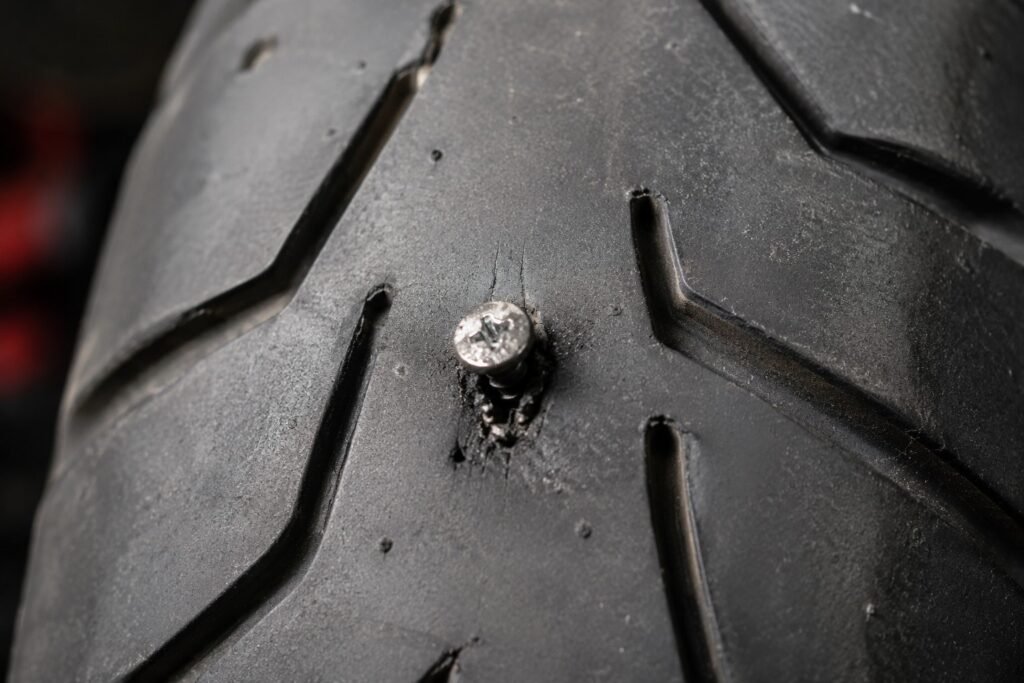
That distinction is why carrying the best motorcycle tire repair kit is considered essential touring equipment by experienced riders. Even if you eventually replace the tire, a quality roadside repair kit can get you safely to a workshop instead of leaving you stranded.
There’s another factor riders underestimate: motorcycle tires are dramatically stiffer than car tires. Modern hypersport and ADV tires have reinforced carcasses that resist deformation under heavy loads and aggressive cornering. That same rigidity makes roadside repairs physically harder than many first-time riders expect.
A weak insertion tool bends. Cheap rasp tools snap. Poor-quality plugs dry out after months under the seat.
The difference between a successful repair and a miserable roadside experience often comes down to the engineering quality of the kit itself.
Technical Breakdown: Mushroom Plugs vs Sticky Strings vs Mechanical Plugs
The debate around best motorcycle tire repair kit designs usually centers on one question: which plug style actually performs best under real riding conditions?
That leads directly into the biggest discussion in roadside tire repair: motorcycle tire mushroom plug kit vs string repair systems.
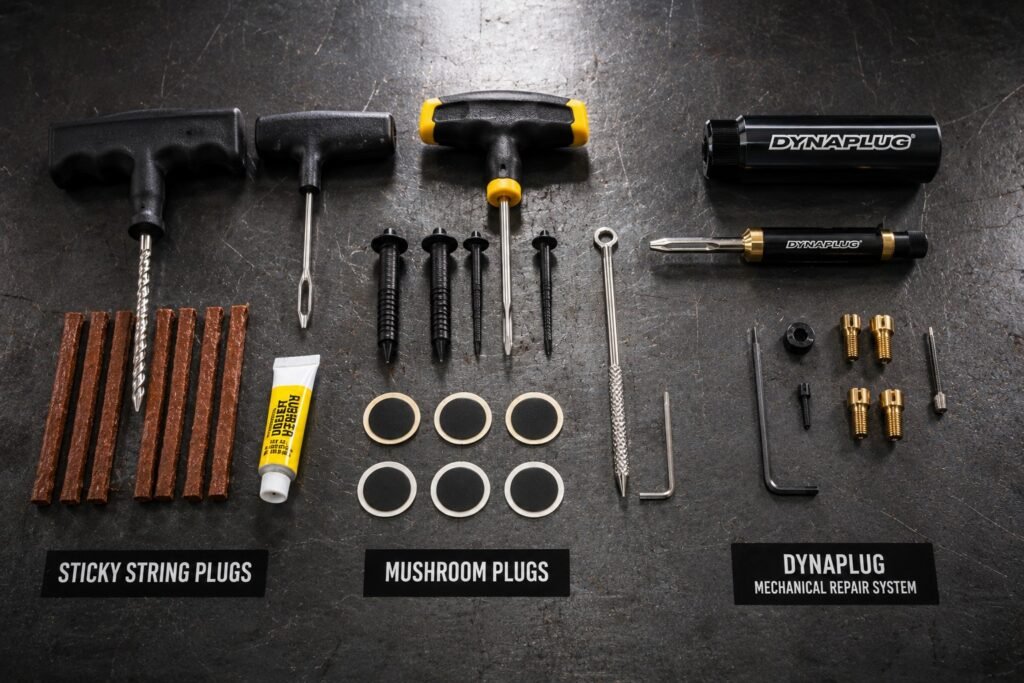
Sticky String Repairs
Sticky string plugs remain the industry standard because they’re simple, compact, and highly adaptable.
They work by forcing a tacky rubber cord through the puncture channel using an insertion tool. Once compressed inside the tire, the material expands and seals the opening.
Advantages
- Extremely compact
- Affordable
- Works on irregular puncture shapes
- Easy to carry multiple spare plugs
- Excellent for aggressive tread compounds
Weaknesses
- Requires significant insertion force
- Messy during roadside repairs
- Rubber cement can dry out over time
- Cheap insertion tools bend easily
String repairs are especially effective for adventure riders because they tolerate rough puncture geometry better than rigid plug systems.
Mushroom Plug Systems
Mushroom plugs use a stem-and-cap design where the internal “mushroom head” seals against the inner tire surface.
Brands like Stop & Go popularized this approach among touring riders.
The Stop & Go Pocket Tire Plugger is one of the best-known mushroom plug systems on the market. Riders appreciate its clean installation and excellent sealing performance for everyday touring.
👉 See the Stop & Go Kit on Amazon https://amzn.to/3T2xGRE
Advantages
- Cleaner installation
- Excellent air retention
- More professional internal seal
- Lower chance of plug pullout
Weaknesses
- Larger insertion systems
- More complex roadside procedure
- Less forgiving on jagged punctures
- Bulkier storage footprint
The biggest tradeoff in the motorcycle tire mushroom plug kit vs string repair debate is versatility versus refinement. Mushroom systems feel more engineered and controlled, while sticky strings are brutally simple and effective in ugly real-world punctures.
Mechanical Plug Systems
Mechanical plug kits like those from Dynaplug use metal-tipped insertion technology.
Instead of aggressively reaming the tire, the plug slides into the puncture with surprisingly little effort.
If storage space is your priority, the Dynaplug Pro Xtreme is one of the most compact premium repair kits available. It installs plugs incredibly quickly without aggressive reaming, making it popular among sportbike riders.
👉 Check Dynaplug Pro Xtreme on Amazon https://amzn.to/4b9C2N2
Advantages
- Extremely fast installation
- Minimal carcass damage
- Compact premium design
- Excellent for sportbike tires
Weaknesses
- Expensive refill plugs
- Less effective on large punctures
- Premium price point
- Smaller plug inventory
Mechanical systems are particularly attractive for riders seeking a compact motorcycle tire repair kit for sportbikes because they prioritize portability and speed.
The Ultimate All-in-One Pick
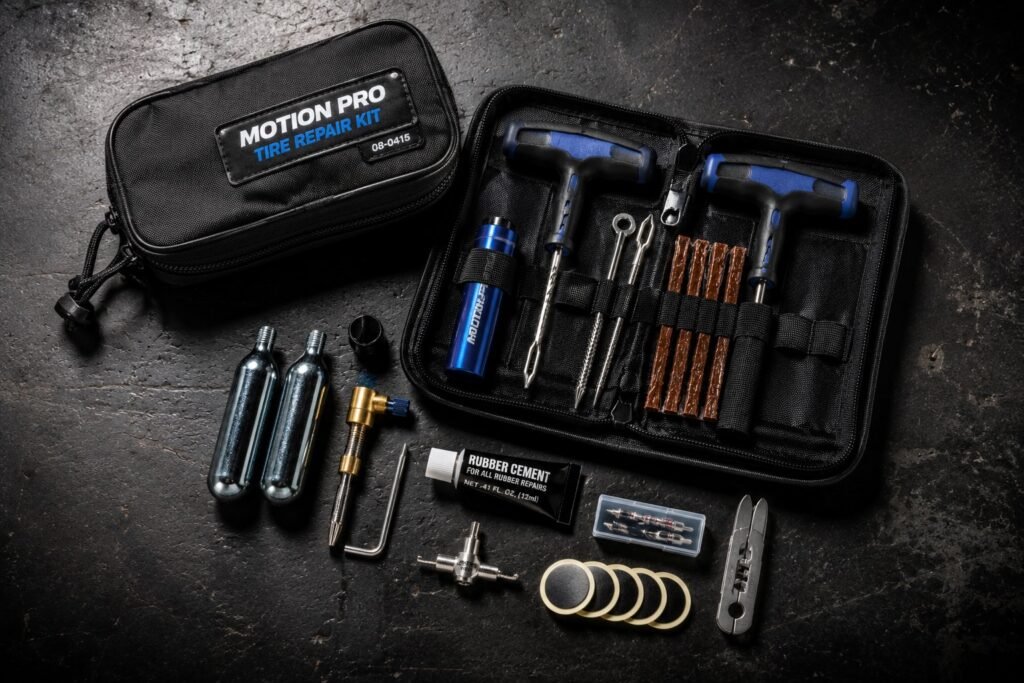
If your priority is the best tubeless motorcycle tire repair kit with co2, the sweet spot usually combines three elements:
- Durable metal insertion tools
- High-quality sticky string plugs
- Reliable inflation cartridges
Many riders underestimate how critical inflation speed becomes during roadside repairs. A poorly sealed CO2 inflator head can waste your entire cartridge inventory in seconds.
The best all-in-one kits use machined aluminum inflator heads with positive locking systems instead of cheap threaded plastic connectors.
Look closely at handle ergonomics too.
T-handle tools provide dramatically better leverage when dealing with stiff radial motorcycle tires. Screwdriver-style handles save space but become painful under high insertion force.
Premium kits from Motion Pro and Stop & Go stand out because they prioritize usable roadside ergonomics rather than simply cramming components into a tiny pouch.
The strongest kits also include:
- Valve core tools
- Spare valve cores
- Razor blades
- Multiple plug diameters
- Sealed rubber cement containers
These details matter when you’re repairing a puncture at night in bad weather instead of in a clean garage.
The Adventure & Remote Touring Choice

Adventure riders have different priorities than urban commuters.
A lightweight tubeless tire repair kit for remote touring must survive vibration, moisture, dust, and extended storage periods without components degrading.
This is where the heavy duty motorcycle tire plug kit for adventure riders category becomes important.
ADV bikes place enormous stress on tires due to:
- Heavy luggage loads
- Lower tire pressures off-road
- Sharp rock impacts
- Heat buildup during long-distance touring
Cheap plug tools fail quickly under those conditions.
For remote travel, hardened steel tools are worth the extra weight. Aluminum tools save grams but can deform under repeated use on thick ADV carcasses like the Michelin Anakee or aggressive rally tires.
Adventure riders should also prioritize:
- Waterproof storage cases
- Redundant plug inventory
- Compact air pumps
- High-visibility tool handles
- Gloves included in the kit
A quality lightweight tubeless tire repair kit for remote touring should still be functional after months bouncing around inside panniers through heat, dust, and rain.
That durability separates premium kits from disposable emergency packs.
The Space-Saver / Sportbike Choice
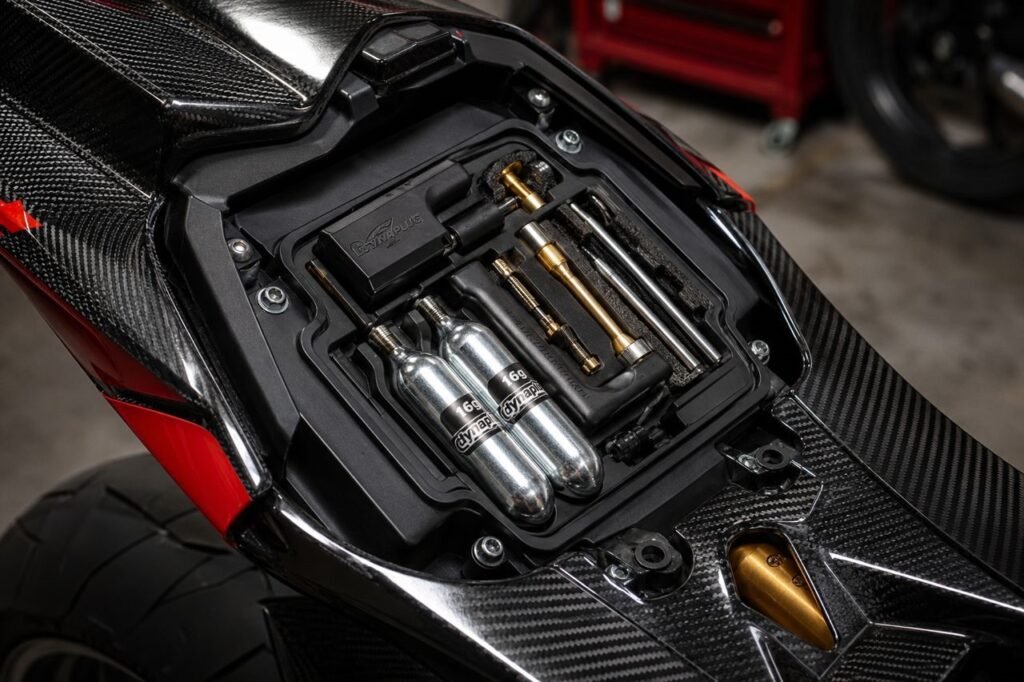
Sportbike riders live in constant conflict with storage space.
Manufacturers keep shrinking under-seat compartments, forcing riders to prioritize every cubic inch of gear. That’s why the demand for a compact motorcycle tire repair kit for sportbikes keeps growing.
The best designs avoid bulky molded cases and oversized T-handles. Instead, they use:
- Folding insertion tools
- Minimalist inflators
- Vacuum-sealed plug sleeves
- Compact CO2 storage systems
This is also where the search for the best motorcycle tire repair kit for under seat storage becomes highly specific.
Some repair kits technically fit under a seat but become impossible to organize once combined with registration papers, tool rolls, and electronic accessories.
Mechanical plug systems from Dynaplug dominate this category because they eliminate bulky rasp tools and large insertion handles.
For supersport riders, packability matters almost as much as repair performance.
A compact motorcycle tire repair kit for sportbikes should ideally:
- Fit beside factory tool kits
- Resist vibration damage
- Avoid rattling metal cases
- Include enough inflation capacity for at least one full rear tire refill
CO2 systems work well for sportbike applications because they minimize bulk, though riders doing long-distance travel may still prefer miniature compressors.
The Heavy-Duty Overlander Pick
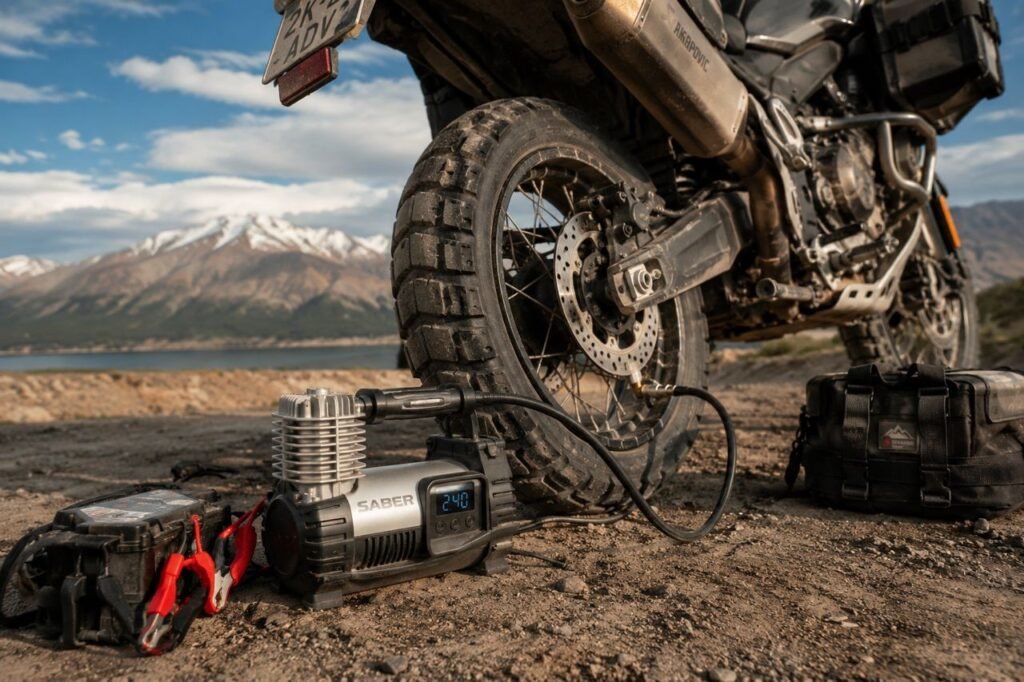
Long-range touring riders and overlanders often prefer a motorcycle tire emergency repair kit with mini air compressor instead of relying entirely on CO2 cartridges.
There’s a practical reason for that.
Large ADV tires require substantial air volume, especially after multiple repair attempts or pressure adjustments during off-road riding.
Mini compressors from MotoPumps and CyclePump provide consistent inflation without worrying about running out of cartridges.
A proper overland setup should prioritize:
- Heat-resistant compressor housings
- Long power cables
- SAE or battery clamp compatibility
- Accurate pressure gauges
- Duty-cycle durability
Compressors are heavier, but they offer psychological reassurance during remote travel. Riders crossing deserts, forests, or isolated highways often prefer the reliability of unlimited inflation capacity over compactness.
How to Use a Motorcycle Tire Repair Kit on the Road
Knowing how to use the best motorcycle tire repair kit matters just as much as buying one.
A roadside repair becomes much easier if you stay methodical.
1. Find the Leak
Rotate the wheel slowly and inspect the tread carefully.
If the object is still embedded, mark the location before removing it.
2. Stabilize the Bike
Use the center stand if available. If not, position the bike safely away from traffic on stable ground.
Avoid repairing tires on soft gravel shoulders whenever possible.
3. Remove the Object
Use pliers to extract the nail or screw in the same direction it entered.
Twisting sideways can enlarge the puncture.
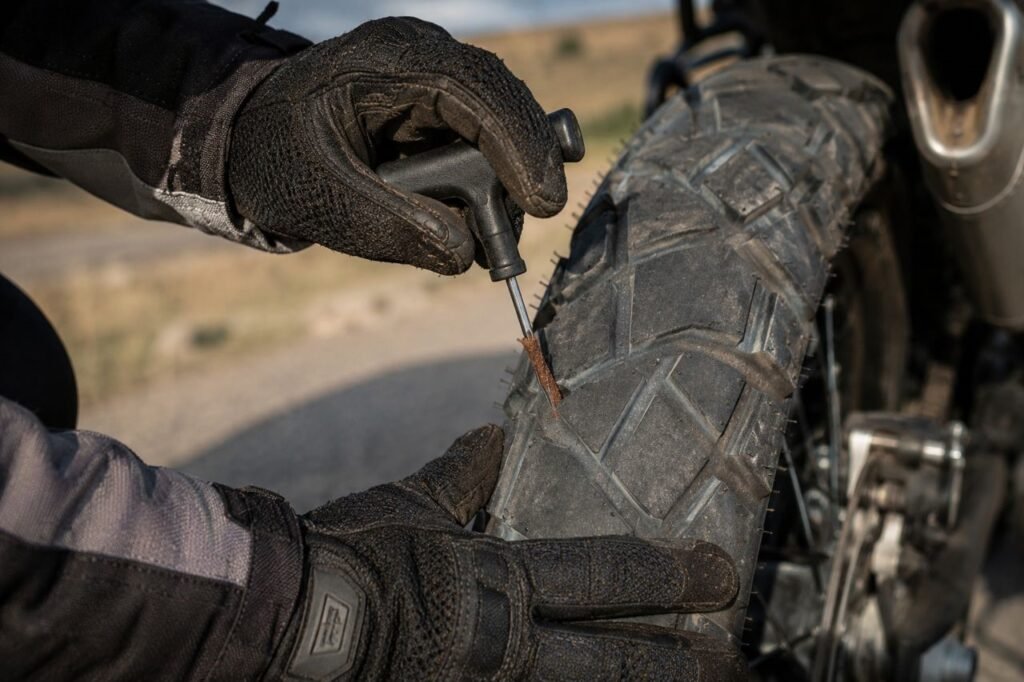
4. Ream the Hole
This is the step most riders underestimate.
Motorcycle tires are stiff. Reaming cleans and sizes the puncture channel so the plug can seat properly.
Use controlled force rather than aggressive stabbing motions.
5. Insert the Plug
This is the core process in learning how to use a motorcycle tire repair kit on the road effectively.
Push the plug firmly until only a small amount remains exposed. Remove the insertion tool carefully without pulling the plug back out.
6. Inflate Slowly
Bring the tire back up to pressure gradually while checking for leaks.
A little saliva or water around the plug can help identify escaping air bubbles.
7. Ride Conservatively
A roadside repair is exactly that — a roadside repair.
Avoid sustained high-speed riding until the tire has been professionally inspected or replaced.
Buyer’s Guide: What Actually Matters
Shopping for the best motorcycle tire repair kit is less about marketing and more about understanding how and where you ride.
Tool Material Quality
Hardened steel tools last dramatically longer than soft alloy tools.
Cheap kits often fail during the first real puncture.
Inflation Method
CO2 systems are compact and fast.
Mini compressors provide unlimited inflation capability.
Your riding style determines which makes more sense.
Plug Storage
Rubber plugs dry out over time, especially in hot climates.
Vacuum-sealed storage dramatically improves shelf life.
Handle Ergonomics
T-handles provide better leverage.
Compact screwdriver handles save space.
Adventure riders usually prefer leverage. Sportbike riders prioritize compactness.
Kit Size
The ideal kit should actually fit your motorcycle consistently.
The best motorcycle tire repair kit for a touring bike may be completely impractical for a supersport with minimal storage space.
Final Thoughts
The reality is simple: every rider eventually faces a puncture.
The difference between a manageable delay and a ruined trip usually comes down to preparation. Some riders need compact CO2 systems that disappear under a sportbike seat. Others need heavy-duty compressor setups capable of supporting multi-day ADV travel far from civilization.
There is no universal solution for every motorcycle or every rider. The right setup depends entirely on your storage limitations, riding environment, tire type, and travel distance.

But carrying the best motorcycle tire repair kit for your specific riding style is one of the smartest upgrades you can make — because the only thing worse than getting a flat tire is realizing you were completely unprepared for it.