
Every kilometer you ride on a poorly lubed chain is a kilometer of accelerated wear. A motorcycle chain under load experiences enormous tension — street bikes generate chain forces exceeding 1,000 kgf during hard acceleration. Without an adequate lubricant film between the side plates, rollers, and sprocket teeth, that force translates directly into metal-on-metal abrasion. Replacing a chain and sprocket set on a mid-size motorcycle costs anywhere from $150 to $400. On a large-displacement adventure bike, that figure climbs higher. The lube you choose determines how fast you reach that bill.
The debate around dry vs wet chain lube is not about brand preference. It is a mechanical question with a real answer, and that answer changes depending on where and how you ride.
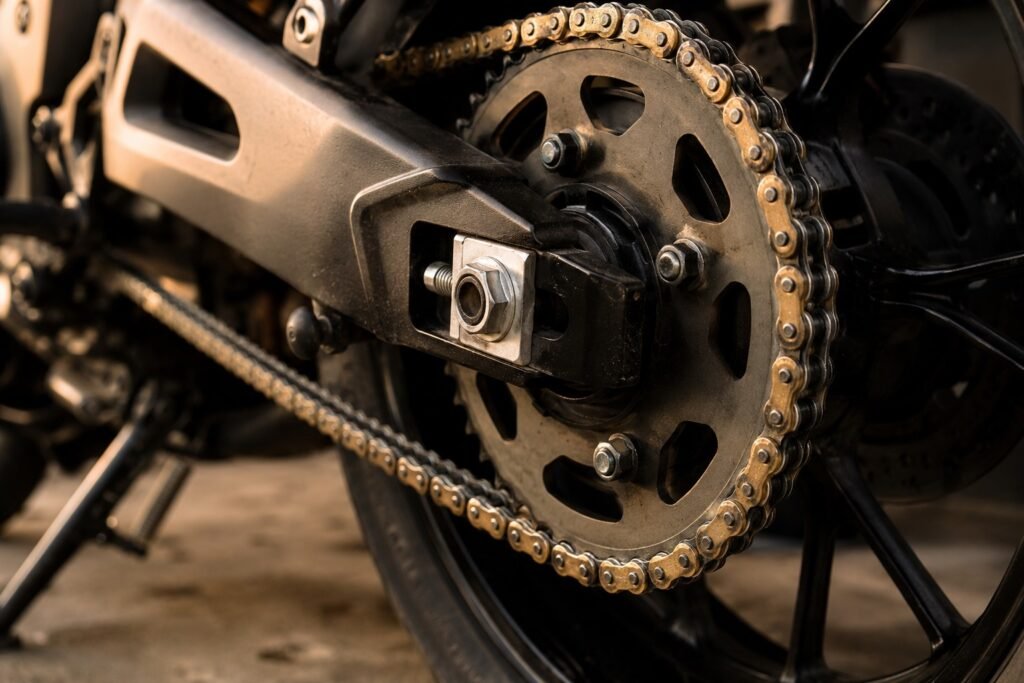
The Chemistry Behind Chain Lube
To choose intelligently, you need to understand what happens inside a motorcycle chain. An O-ring or X-ring chain seals grease around each pin at the factory. That internal grease does not wash out and does not need supplementing. What external lube actually protects is the outer surface — the roller-to-sprocket interface, the side plate edges, and the exposed pin ends on non-sealed chains.
Wet lubes use a mineral oil or synthetic base that stays fluid after application. That fluid film clings to metal surfaces and resists water penetration effectively. Consequently, wet lube survives rain, puddle spray, and high-humidity riding better than any dry alternative. However, that same fluid character acts as a particulate magnet. Road grit, dust, and sand adhere to the lube film on contact and remain embedded there throughout the ride.
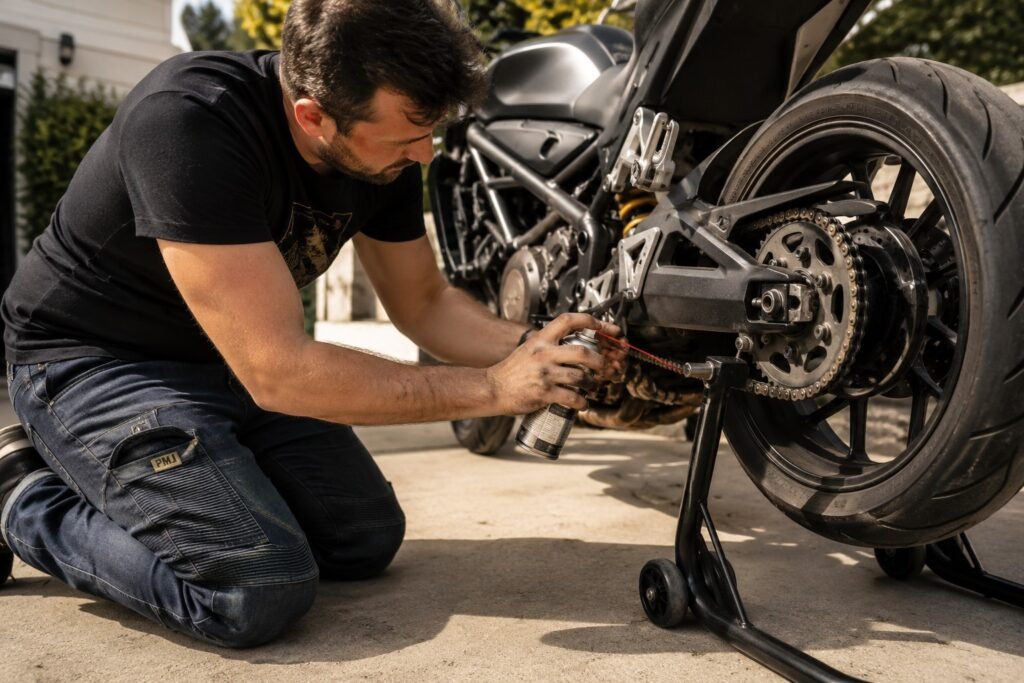
Dry lubes work on a fundamentally different principle. They use a volatile carrier solvent — typically a naphtha or light alcohol base — that penetrates into the chain’s outer contact surfaces on application. The carrier evaporates within 20 to 30 minutes, leaving behind a solid or semi-solid lubricant film. That film is usually built around PTFE particles, ceramic compounds, or a combination of both. Because the cured surface is dry to the touch, contamination pickup in dusty or gritty conditions is dramatically lower than with wet lube. That difference is the mechanical core of the dry vs wet chain lube decision.
What the Carrier Fluid Actually Does
Surface tension determines how well a lube penetrates the tight clearances between chain components. Lower-viscosity carriers flow faster and reach deeper into contact zones before evaporating. Higher-viscosity wet lubes rely on capillary action and application pressure. Specifically, proper application to a motorcycle chain means rotating the rear wheel slowly while applying lube to the inner edge of the chain — where it contacts the sprocket — not to the outer plates. The outer plates carry no load. The roller-to-sprocket interface is where lubrication matters.
Riding Style Breakdown
Street and Sport Riding: Heat, Speed, and Cleanliness
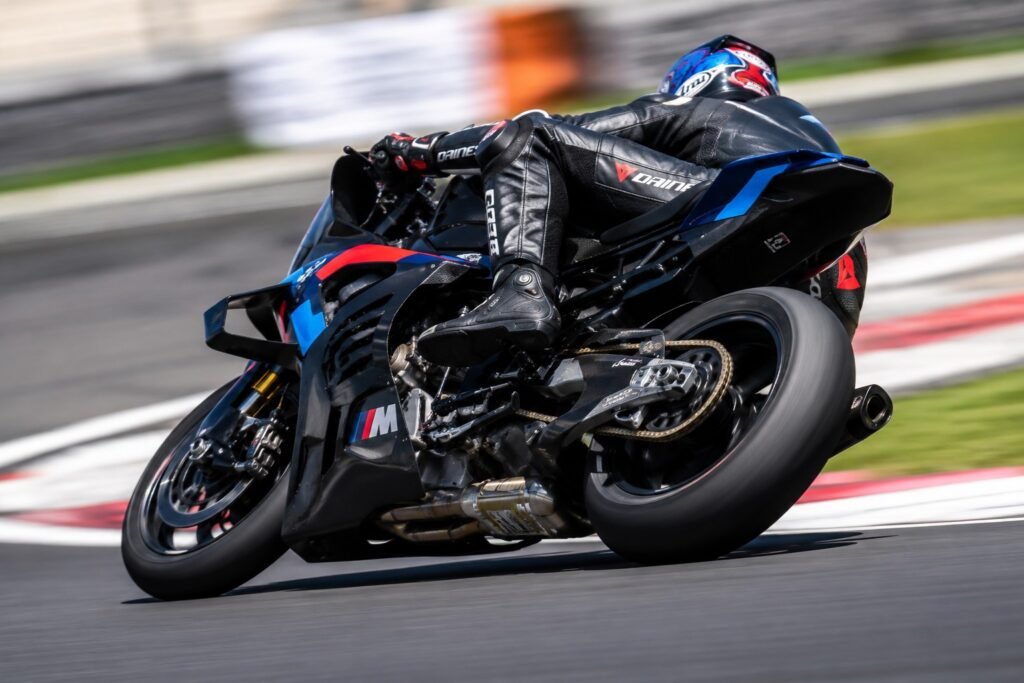
Street riders — particularly sport and naked bike riders — operate at sustained high speeds with significant drivetrain heat. At highway speeds, centrifugal force flings excess lube off the chain and onto the rear wheel and swingarm. Over-lubing with a heavy wet formula creates a fling-off problem that contaminates the rear tyre sidewall and brake disc. As a result, street riders benefit from a dry or light wet lube that applies thinly and cures to a controlled film.
In dry urban and highway conditions, dry vs wet chain lube testing consistently favors dry PTFE or ceramic formulas for street use. They fling less, attract less road grime, and keep the chain and surrounding components cleaner between service intervals.
Adventure and Dual-Sport Riding: The Toughest Test
Adventure riders face the most demanding lubrication challenge of any motorcycle discipline. A single day of dual-sport riding can take a chain through dry dirt roads, river crossings, mud sections, and sealed tarmac — sometimes within the same hour. No single lube chemistry handles all of those conditions perfectly.
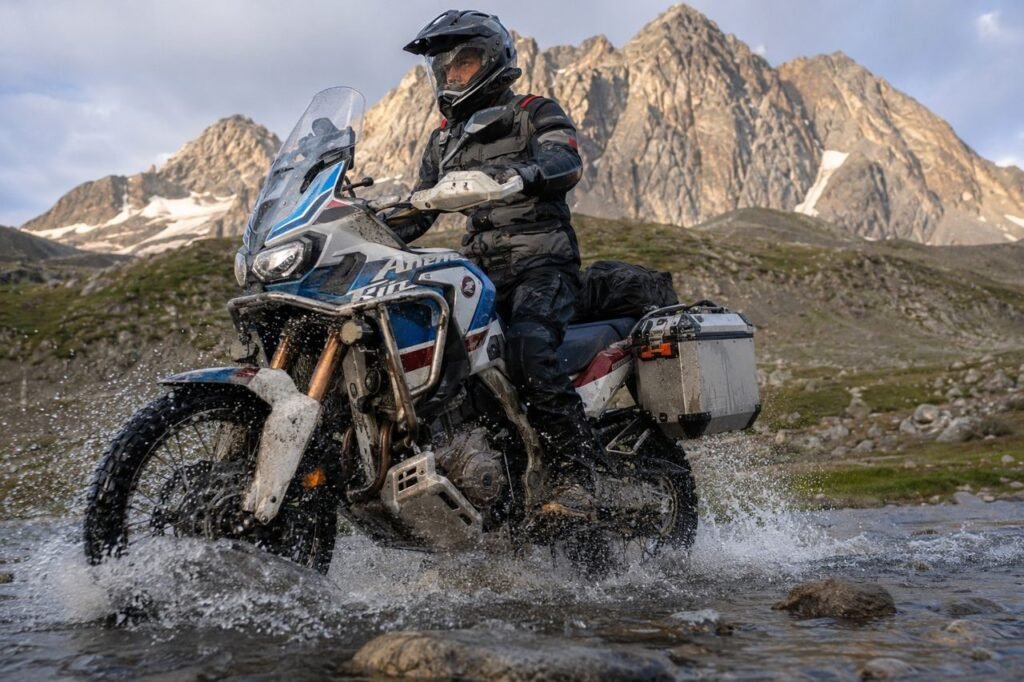
Wet lube wins on survival. It withstands water crossings and sustained rain without washing off. However, does wet chain lube attract dirt in off-road conditions? Yes, aggressively. Fine dust and mud particles embed into the wet film within kilometers of dirt riding. For adventure riders who prioritize chain longevity over cleanliness, a heavy-duty wet lube with a tackifier additive provides the best overall protection across mixed terrain.
Gravel and Dirt Road Commuting: The Abrasive Dust Problem
Riders who regularly use unsealed roads face a specific threat: fine silica dust. That dust is chemically abrasive, and it is relentless. The best chain lube for dusty gravel roads must minimize contamination pickup while still providing adequate film strength between service intervals.
Dry lube is the correct answer under one condition — the ride stays dry. When rain arrives unexpectedly, a dry-lubed chain on gravel begins to wear faster than a wet-lubed alternative. Riders on predominantly dry dirt roads should use a dry PTFE formula and accept the need for more frequent reapplication. How often to reapply dry chain lube in genuinely dusty conditions depends on mileage — most PTFE-based formulas require reapplication every 500 to 800 kilometers on unsealed roads.
Commuting: Variable Weather and Practical Maintenance
Urban commuters deal with a challenge competitive riders rarely face — a bike that sits unused for days, exposed to temperature swings and condensation, then gets ridden through unexpected rain without advance preparation. A commuter’s chain lube needs to tolerate neglect better than a product designed for daily maintenance routines.
Wet lube generally wins for commuters. It does not require a cure window before riding, survives an unexpected downpour, and stays effective across a working week of variable weather without intervention. Meanwhile, the contamination trade-off is lower in a clean urban environment than on a dirt road. For riders who are honest about their maintenance frequency, a medium-viscosity wet lube is the most practical single choice.
The Grinding Paste Phenomenon
This is where the wrong lube choice stops being a maintenance inconvenience and becomes a mechanical failure. When wet lube accumulates on a motorcycle chain in dusty or gritty conditions, the particulates do not simply sit on the surface. They embed into the fluid lube film and begin circulating through the chain and sprocket interface under load.
Warning: A contaminated wet lube film on a chain ridden through dust or grit is mechanically equivalent to a lapping compound. The grit-lube mixture grinds through sprocket teeth, chain rollers, and side plates at a rate that can halve component lifespan. Never apply fresh lube over a contaminated chain — clean the chain thoroughly first. Adding new lube over old contaminated lube seals the grinding paste in place and accelerates wear.
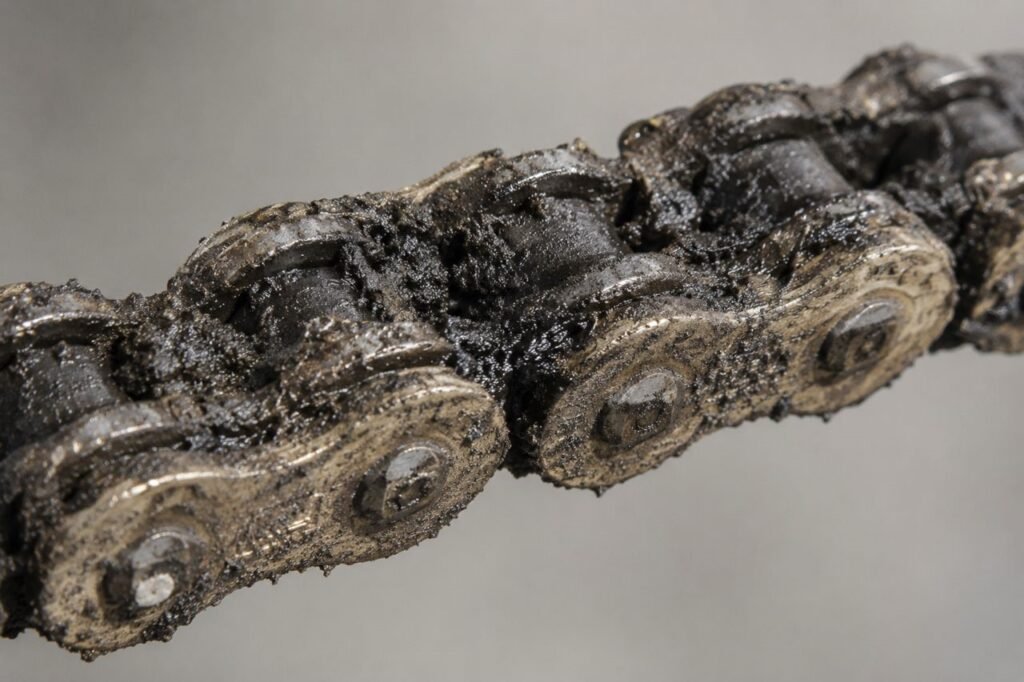
The grinding paste problem explains why chain and sprocket wear rates vary dramatically between identical setups ridden in different environments. A chain on a dusty adventure route with heavy wet lube may reach replacement specification in 8,000 kilometers. The same chain on sealed roads with appropriate dry lube may last 15,000 kilometers or longer. That difference represents hundreds of dollars in parts and labor.
The Modern Disruptor: Wax-Based Chain Lube
The dry vs wet chain lube binary has been complicated by the emergence of wax-based motorcycle chain lubes, which now represent a genuine third category. Understanding where wax fits in the drip wax vs traditional chain lube comparison is increasingly relevant for performance-conscious riders.
Wax-based chain lubes apply as a liquid but cure into a solid wax film that behaves differently from both traditional wet and dry formulas. The cured wax surface is extremely dry to the touch. It picks up significantly less contamination than wet lube in dusty conditions and produces less fling-off than heavy wet formulas at speed. Independent testing has consistently shown wax lubes delivering lower friction losses than traditional alternatives — relevant for riders focused on drivetrain efficiency wet vs dry lube performance.
The trade-off is preparation. Wax lube requires a thoroughly clean, degreased chain as a starting point. Applying wax over a contaminated chain produces a wax-contamination matrix that performs worse than either traditional lube type. For riders willing to add a proper degreasing step to their service routine, however, wax represents the best currently available combination of low contamination pickup and low friction loss.
| Metric | Dry Lube | Wet Lube | Wax Lube |
|---|---|---|---|
| Friction loss | Low | Moderate | Very Low |
| Longevity per application | 500–800 km | 800–1,200 km | 600–1,000 km |
| Contamination pickup | Low | High | Very Low |
| Fling-off at speed | Minimal | Moderate–High | Minimal |
| Ease of cleaning | Easy | Moderate | Moderate |
Buyer’s Guide: The Right Lube for Your Riding Profile
The All-Weather Urban Commuter
Rider profile: Rides five days a week in mixed city conditions, parks outdoors or in a shared garage, and services the chain realistically once a month.
Conditions: Unpredictable rain, sealed roads, light road grime, irregular maintenance windows, temperature variation across seasons.
Spec priorities: Long reapplication interval, water resistance, forgiving of missed service dates, low fling-off on sealed roads.
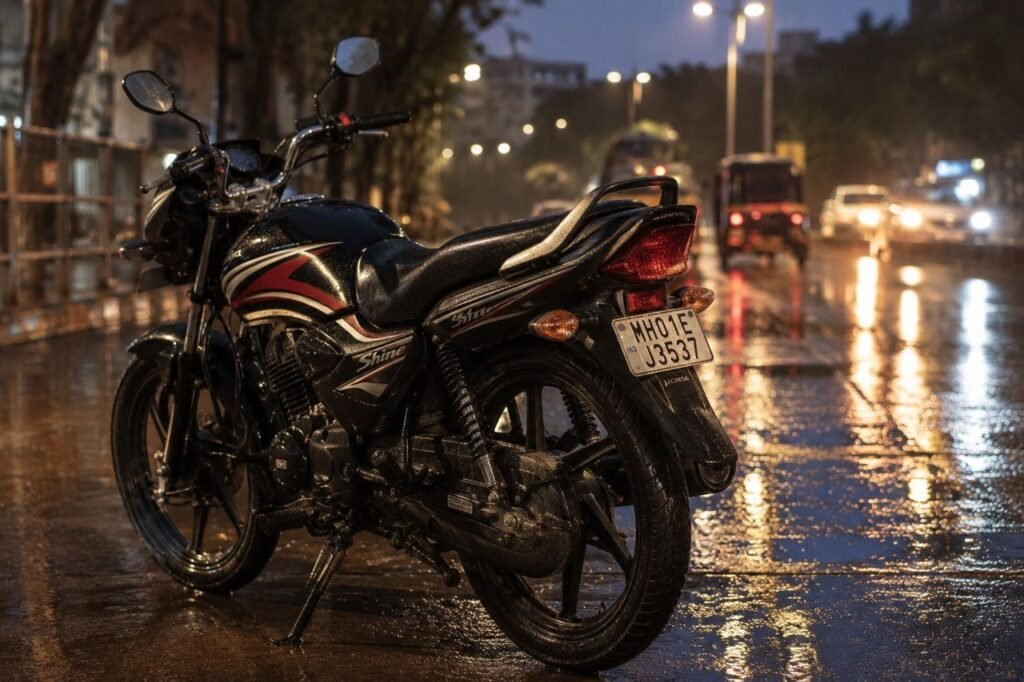
Why wet lube wins here: A medium-viscosity synthetic wet lube provides reliable film protection through wet and dry days without demanding a cure window before riding. For urban commuters, the contamination trade-off is acceptable in a low-dust sealed-road environment. Look for formulas labeled as all-conditions or all-weather with a synthetic — not mineral oil — base. Synthetic carriers resist breakdown across wider temperature ranges and provide better protection during cold-start riding in winter months.
The Adventure and Dual-Sport Rider
Rider profile: Rides mixed terrain including dirt roads, gravel passes, river crossings, and sealed highways. Services the chain every 500 kilometers or after every serious off-road day.
Conditions: Highly variable — dust, mud, water, heat, and sealed road sections within a single ride. High chain load during off-road climbing and technical sections.
Spec priorities: Film durability through water exposure, resistance to fling-off on highway sections, adequate performance in dusty trail conditions, practical reapplication in remote locations.
Why a heavy-duty wet lube with tackifier wins here: Is wet or dry chain lube better for adventure and dual-sport riding? For riders who regularly cross water and mud, a heavy-duty wet lube with a tackifier additive outperforms dry alternatives on raw durability. The tackifier reduces fling-off at highway speeds while maintaining the water-resistant film that dry lube loses immediately in a river crossing. Clean and reapply after every serious dirt day. Avoid ultra-light wet lubes — they wash off too quickly under sustained water exposure.
The Street and Sport Rider
Rider profile: Rides primarily on sealed roads, covers high weekly mileage, cares about chain and tyre cleanliness, and services the bike regularly.
Conditions: Dry tarmac, highway speeds, moderate heat from sustained riding, minimal water exposure except occasional rain.
Spec priorities: Minimum fling-off, low contamination pickup from road dust, clean appearance between services, compatibility with O-ring and X-ring chain seals.
Why dry ceramic or wax lube wins here: For this rider, the dry vs wet chain lube decision is straightforward — dry or wax is the only rational choice. A ceramic-particle dry lube delivers a hard-wearing, low-friction film that stays clean and flings minimally at speed. Specifically, look for products that list ceramic content alongside PTFE, as the combination provides better film hardness than PTFE alone under the sustained high-load conditions of sport riding. For riders willing to degrease the chain properly before application, a wax lube reduces friction further and keeps the chain, swingarm, and rear wheel noticeably cleaner.
Conclusion: Maintenance Rules Every Rider Should Follow
The dry vs wet chain lube choice comes down to matching chemistry to environment. Dry and wax formulas suit sealed roads and dry conditions. Heavy wet lubes suit water, mud, and mixed terrain. No single product bridges both environments perfectly — but the right choice for your primary riding conditions will extend chain and sprocket life significantly.
Regardless of which lube you choose, four habits determine whether your drivetrain lasts 8,000 kilometers or 20,000 kilometers.
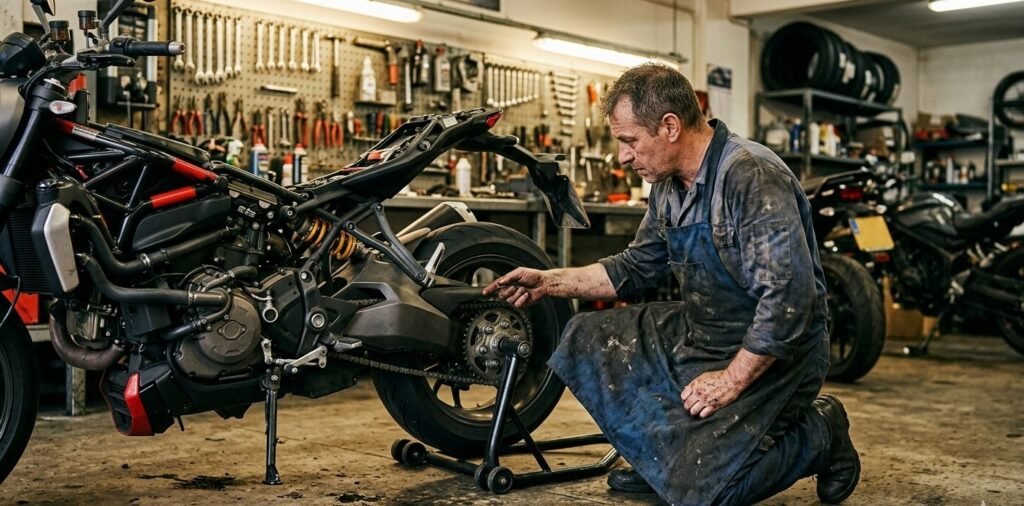
Clean before you lube. Applying new lube over accumulated contamination seals grinding paste in place. Wipe the chain with a clean rag before every reapplication and degrease fully when black buildup appears between the link plates.
Apply to the inner edge, not the outer plates. The roller-to-sprocket interface is where lubrication matters. Apply to the inner edge of the lower chain run while rotating the rear wheel, then wipe away excess from the outer plates and surrounding surfaces.
Do not over-lube. Excess lube flings onto the rear tyre sidewall and brake disc at speed. One thin, even pass around the full chain length is sufficient. More lube does not mean more protection — it means more contamination and more cleaning.
Check chain tension and stretch regularly. No lube prevents wear entirely — it only slows it. A stretched chain accelerates sprocket wear dramatically. Check tension every 500 kilometers and measure stretch with a chain wear tool. Catching wear early saves the cost of a full chain and sprocket set replacement.
Follow these habits consistently, match dry vs wet chain lube to your actual riding conditions, and your drivetrain will reward you with thousands of additional kilometers before the next replacement bill arrives.
Written by Chris Mchenga
hello world