
Disclosure: This article contains Amazon affiliate links. If you make a purchase through these links, we earn a small commission at absolutely no extra cost to you. This helps support the site and allows us to continue creating detailed motorcycle maintenance guides. Thank you for your support!
If you want your motorcycle to run strong for years, choosing the best motorcycle engine oil is one of the most important decisions you will make as a rider. Engine oil is not just a lubricant. It is the lifeblood of your engine — cooling metal surfaces, flushing away contaminants, and keeping every moving part gliding smoothly under extreme heat and pressure. Pick the wrong oil and you pay for it in worn bearings, clutch slippage, and expensive rebuilds. Pick the right one and your engine rewards you with crisp throttle response, smooth shifts, and a long, healthy service life.
This guide covers everything you need to know about motorcycle oil types explained — from the difference between mineral and full synthetic, to decoding viscosity grades, to understanding why your wet clutch demands motorcycle-specific oil. Whether you are a first-time rider doing your maiden oil change or a seasoned enthusiast chasing peak performance, this guide gives you the knowledge to make the right call every single time.
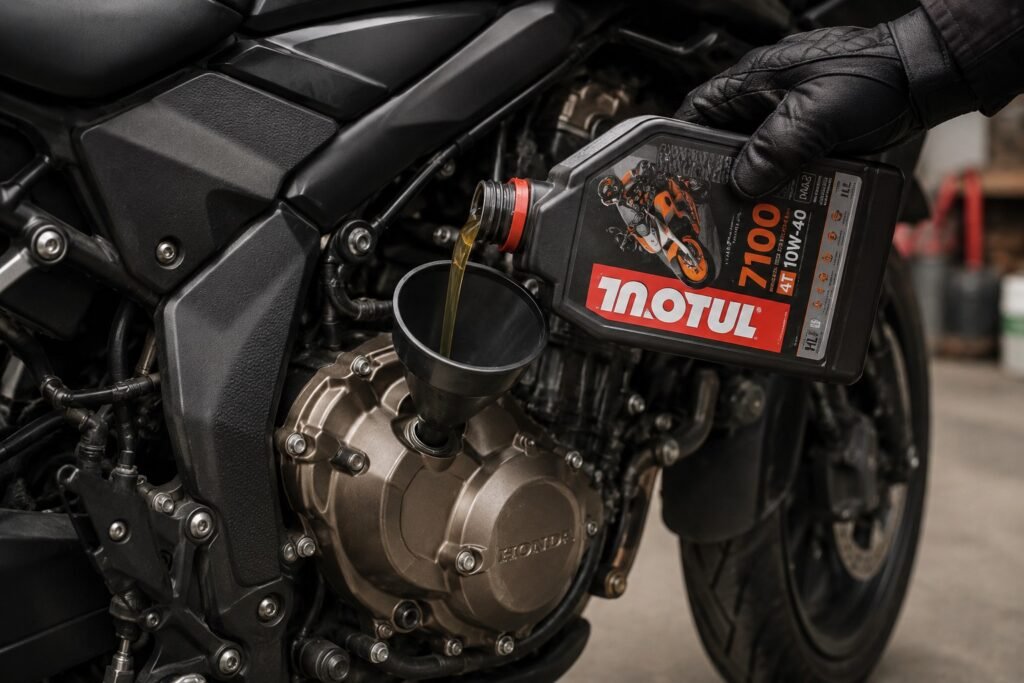
Why Engine Oil Is the Most Critical Fluid in Your Motorcycle
Think of engine oil the way a cardiologist thinks about blood. Your heart pumps blood to every organ, delivering oxygen and carrying away waste. Your engine does the same thing with oil — circulating it to every bearing, journal, cam lobe, and piston at pressures sometimes exceeding 80 psi. When oil breaks down, thickens, or runs low, the consequences are just as serious as cardiovascular failure.
Unlike car engines, motorcycle engines typically spin faster — often exceeding 10,000 RPM — and run hotter relative to their displacement. Many bikes also share oil between the engine, gearbox, and wet clutch, which means one fluid is doing three different jobs simultaneously. That is why best motorcycle engine oil is not just marketing language. The specific formulation genuinely matters.
What good engine oil does for your motorcycle:
- Forms a thin, protective film between metal surfaces to prevent direct contact
- Transfers heat away from critical components like pistons and camshafts
- Suspends combustion byproducts and carries them to the oil filter
- Maintains consistent viscosity across a wide temperature range
- Protects wet clutch plates from slipping under load
Can You Use Car Engine Oil in a Motorcycle?
This is one of the most common questions new riders ask, and the honest answer is: not if you have a wet clutch. Here is why this matters so much.
The Friction Modifier Problem
Modern car engine oils — particularly those meeting the API SN, SP, or ILSAC GF-6 specifications — contain friction modifiers. These are chemical additives designed to reduce energy loss inside a car engine. They work extremely well for that purpose. The problem is that your motorcycle’s wet clutch relies on controlled friction between the clutch plates to engage cleanly and transfer power to the gearbox.
When you pour car oil into a wet-clutch motorcycle, those friction modifiers coat the clutch plates the same way they coat your engine’s piston skirts. The result? Clutch slip. Power from the engine no longer transfers cleanly to the transmission. You feel it as a spongy, uncertain clutch engagement, sometimes accompanied by the engine revving higher than expected without a corresponding increase in speed.
In mild cases, this is annoying. In aggressive riding — pulling away from a stop in traffic, for example — it can be genuinely dangerous.
The Exception: Dry Clutch Motorcycles
Some bikes, notably certain older Ducati models and some BMW R-series motorcycles, use a dry clutch. On these, the clutch is isolated from the engine oil, so friction modifiers are not a concern. Many riders of these bikes do use car oils with good results. But unless your owner’s manual explicitly confirms a dry clutch design, always use oil formulated for motorcycles.
Bottom line: Never use car engine oil in a wet-clutch motorcycle. Always choose oil labeled for motorcycle use, ideally with a JASO MA or JASO MA2 rating (more on this below).
Motorcycle Oil Types Explained: Mineral, Semi-Synthetic, and Full Synthetic
Motorcycle oil types explained simply: there are three main categories, each with a distinct base stock and performance profile. Understanding these differences is the foundation of making the right oil choice.
Mineral Oil
Mineral oil — also called conventional oil — is refined directly from crude petroleum. It has been the standard motorcycle lubricant for decades and still works perfectly well in older bikes with wider manufacturing tolerances and less demanding performance envelopes.
Pros:
- Lowest cost
- Widely available worldwide
- Adequate for older engines and low-stress riding
Cons:
- Less thermally stable than synthetic alternatives
- Breaks down faster under high heat and sustained high RPM
- Requires more frequent change intervals (typically every 2,000–3,000 km)
- Less effective at protecting cold-start metal surfaces
If you are riding a classic or vintage bike and changing oil regularly, mineral oil is a legitimate choice. For modern, high-revving engines, it is the weakest option available.
Semi-Synthetic Motorcycle Oil
Semi-synthetic oil — sometimes called part-synthetic — blends a mineral base stock with synthetic base oils. The synthetic portion typically makes up 20–30% of the total blend. This gives semi-synthetic oils meaningfully better performance than straight mineral oil without the premium price tag of a fully synthetic product.
Pros:
- Better thermal stability than mineral oil
- Improved cold-start protection
- Longer change intervals than mineral (typically 4,000–5,000 km)
- Better value than full synthetic for moderate riding
Cons:
- Does not match full synthetic performance at temperature extremes
- Change intervals still shorter than full synthetic
- Performance gap widens under sustained hard riding or extreme heat
Want the best-reviewed semi-synthetic without stepping up to full-synthetic pricing? 👉 Check the current price of Motul 5100 4T 10W-40 on Amazon
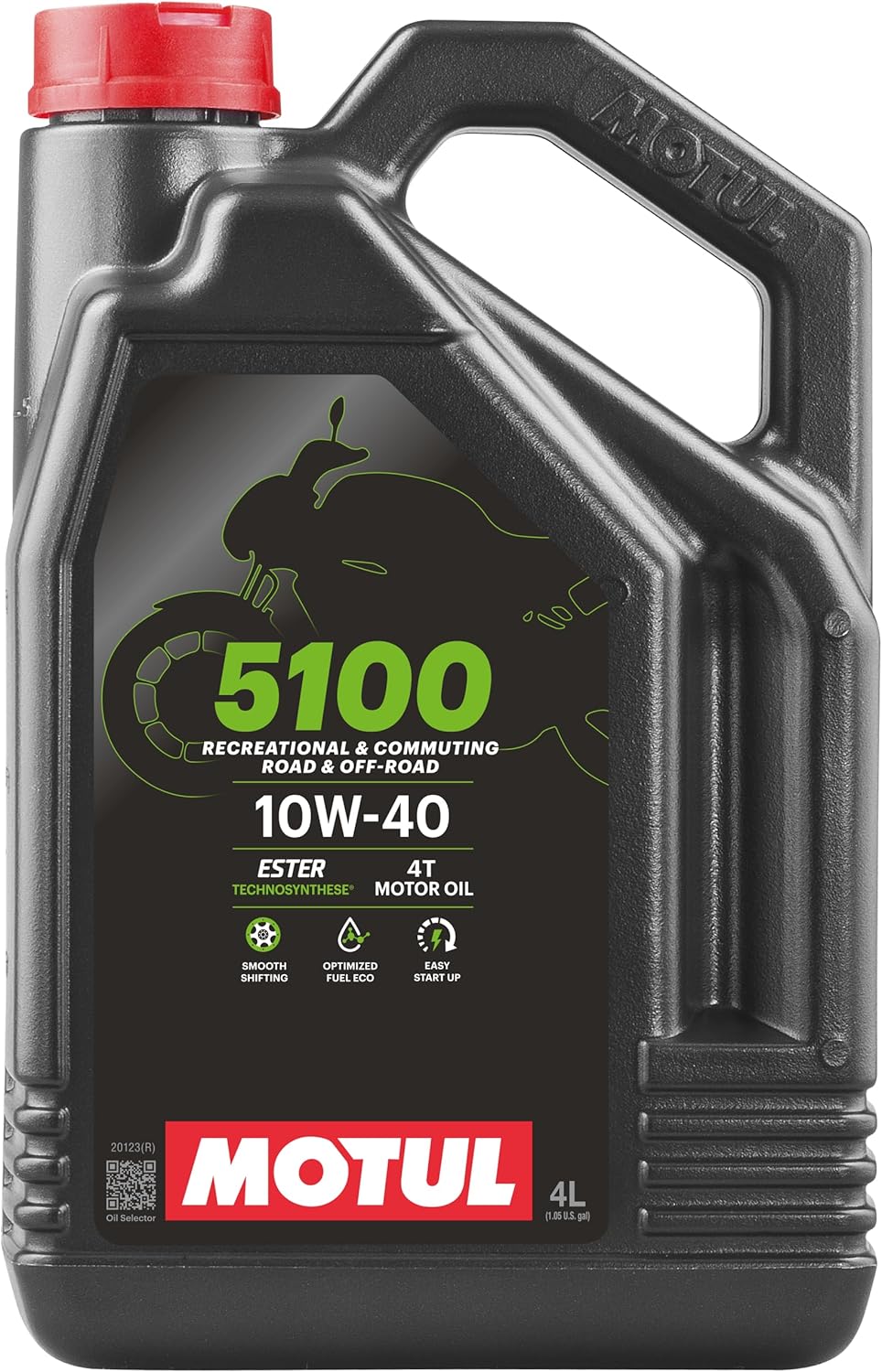
Semi-synthetic oils are a solid middle ground for riders who put moderate mileage on reliable, mid-displacement bikes under everyday riding conditions.
Full Synthetic Motorcycle Oil
Full synthetic motorcycle oil is engineered from the ground up rather than refined from crude petroleum. Synthetic base stocks are purpose-built molecules with consistent chain lengths, which gives them exceptional chemical stability, a predictable viscosity response across temperatures, and superior resistance to oxidation and thermal breakdown.
Pros:
- Outstanding thermal stability at sustained high temperatures
- Excellent cold-start flow to protect bearings before the engine warms up
- Longest change intervals — often 8,000–10,000 km or more, per manufacturer specifications
- Best shear stability, meaning the oil resists thinning under high mechanical stress
- Cleaner combustion and reduced sludge buildup
Cons:
- Higher purchase price (though longer intervals offset much of this cost)
- Not necessary for low-stress applications like short commutes on older bikes
For modern, high-revving motorcycles — especially sport bikes, performance nakeds, and adventure tourers ridden hard — full synthetic motorcycle oil is the clear best choice. The performance benefits are real, and the longer drain intervals mean you are not changing oil as often, which partially offsets the higher cost per litre.
Top Pick #1: Motul 7100 4T 10W-40 — Best Full Synthetic Overall

Motul’s 7100 4T is one of the most trusted full synthetic motorcycle oils on the market, and for good reason. It carries JASO MA2 certification, API SN approval, and uses Motul’s ester-based synthetic technology for exceptional film strength even at sustained high RPM. It is the go-to choice for sport bikes, performance nakeds, and any four-stroke engine where you demand the best.
Before you head out on your next ride, make sure your engine is running on the best. Click the link below to check the current price and read real customer reviews on Amazon:
Understanding Viscosity: What Do Motorcycle Oil Numbers Mean?
The numbers on your oil bottle — 10W-40, 20W-50, 15W-50 — confuse a lot of riders. Once you understand the system, it is straightforward and genuinely useful.
What Do Motorcycle Oil Numbers Mean?
Every multi-grade oil carries two numbers separated by a “W.” The W stands for Winter, not weight. The number before the W describes how the oil flows at cold temperatures. The number after the W describes its viscosity at operating temperature (typically measured at 100°C).
A practical example:
- 10W-40: Flows like a thin 10-weight oil when cold (good for cold starts), then behaves like a 40-weight oil at full operating temperature.
- 20W-50: Flows like a 20-weight oil when cold, then behaves like a 50-weight at operating temperature.
Lower cold numbers mean better cold-start protection. Higher hot numbers mean thicker film at operating temperature — more protection under load, but slightly more mechanical resistance.
10W-40 vs 20W-50 Motorcycle Oil Differences
This is one of the most common specification questions riders face when choosing between oils. The 10W-40 vs 20W-50 motorcycle oil differences come down to where and how you ride.
| Specification | 10W-40 | 20W-50 |
|---|---|---|
| Cold-start flow | Excellent | Good |
| Operating film thickness | Moderate | Thicker |
| Best for | Most modern bikes, year-round riding | High-displacement engines, hot climates |
| Typical applications | Sport bikes, naked bikes, adventure tourers | V-twins, cruisers, classic bikes |
10W-40 is the most universally recommended viscosity for modern motorcycles. It flows quickly on cold starts, protecting bearings before the engine reaches operating temperature, and maintains adequate film strength at normal running temperatures.
20W-50 is the better choice for large-displacement engines — particularly V-twin cruisers and big-bore singles — especially in hot climates. These engines run hotter, have wider component clearances by design, and benefit from the extra film thickness that 20W-50 provides at temperature.
Best Motorcycle Oil Viscosity for Hot Weather
If you regularly ride in ambient temperatures above 35°C — common in tropical climates, the Middle East, or during summer in hot continental regions — the best motorcycle oil viscosity for hot weather is generally a higher hot-grade number.
Recommendations for hot-weather riding:
- Sport bikes and modern parallel twins: 10W-50 or 15W-50 full synthetic — retains film strength at high temperature without sacrificing cold-start flow
- V-twin cruisers: 20W-50 — the classic choice for large, air-cooled or lightly liquid-cooled engines in the heat
- Adventure tourers running hard: 15W-50 full synthetic — handles sustained high speeds and engine loads in hot conditions
One important note: always check your owner’s manual first. Manufacturers specify viscosity grades based on engine clearances and oil system design. Going dramatically outside those recommendations — using 20W-50 in an engine designed for 10W-30, for example — can actually impede oil flow through narrow oil passages and cause more harm than good.
Top Pick #2: Mobil 1 Racing 4T 20W-50 — Best for Heavy Cruisers and V-Twins
Mobil 1 Racing 4T 20W-50 is engineered specifically for the demands of large-displacement, high-torque engines. It meets JASO MA2 and API SN specifications, and its full synthetic formulation holds its viscosity far better than conventional 20W-50 oils under sustained heat. If you are riding a big V-twin in a hot climate, this is one of the best motorcycle engine oil choices available.
Before you head out on your next ride, make sure your engine is running on the best. Click the link below to check the current price and read real customer reviews on Amazon:
Decoding Specifications: JASO, API, and Why They Matter
The certification codes on an oil bottle are not just marketing decoration. They are standardized test results that tell you exactly what the oil will and will not do in your engine.
Difference Between JASO MA and JASO MB
The difference between JASO MA and JASO MB is critical for riders with wet-clutch motorcycles, and it is the clearest indicator of whether an oil is safe for your bike.
JASO stands for the Japanese Automotive Standards Organization, and these ratings were specifically developed because existing API car oil ratings did not address wet-clutch compatibility.
JASO MA and MA2: These ratings indicate that the oil has passed friction tests confirming it will not cause wet clutch slip. The MA2 classification is the newer, more stringent standard — it requires the oil to pass at higher friction thresholds than the original MA rating. Either rating is safe for wet-clutch motorcycles; MA2 simply means the oil has been tested more rigorously.
JASO MB: This rating indicates an oil formulated for scooters and motorcycles with separate engine and gearbox lubrication systems — or for dry-clutch applications. JASO MB oils contain more friction modifiers than MA-rated oils and will cause clutch slip in wet-clutch motorcycles. Never use a JASO MB oil in a bike with a wet clutch.
Quick reference:
| Rating | Friction Modifier Level | Safe for Wet Clutch? |
|---|---|---|
| JASO MA | Low-moderate | ✅ Yes |
| JASO MA2 | Low-moderate (stricter test) | ✅ Yes |
| JASO MB | High | ❌ No |
API Ratings: SN and SP
The API (American Petroleum Institute) rating system classifies oils for performance and engine protection quality. For motorcycles:
- API SN is the previous standard and is widely accepted for most modern motorcycle engines.
- API SP is the current standard, with improved high-temperature deposit control and better protection against low-speed pre-ignition.
Both are acceptable for motorcycle use, provided the oil also carries a JASO MA or MA2 rating confirming wet-clutch compatibility. An oil with API SP and JASO MA2 represents the current state of the art in four-stroke motorcycle lubrication.
Semi-Synthetic vs Full Synthetic Motorcycle Oil: Which One Do You Actually Need?
The semi synthetic vs full synthetic motorcycle oil debate comes down to one question: how hard do you ride, and how much heat does your engine generate?
Choose semi-synthetic if:
- You ride a commuter bike with a moderate-displacement engine
- You do mostly urban stop-and-go riding at low to moderate speeds
- Your budget is a priority and you are willing to change oil more frequently
- Your manufacturer does not specifically recommend full synthetic
Choose full synthetic if:
- You ride a high-revving sport bike or performance naked
- You regularly push your bike hard — canyon roads, track days, sustained highway riding
- You live in a climate with extreme hot or cold temperatures
- You want maximum engine protection and are comfortable paying a bit more per litre
- Your engine uses titanium valve retainers, DLC-coated components, or other precision internals that demand the cleanest, most stable lubrication
For most modern motorcycles built in the last decade, full synthetic motorcycle oil is simply the better choice. Engine tolerances are tighter, power outputs are higher, and oil change intervals are longer than ever. Full synthetic is designed for exactly this environment.
Top Pick #3: Castrol Power1 Ultimate 10W-40 — Best High-Performance Value
Castrol Power1 Ultimate 10W-40 delivers genuine full synthetic performance at a price point that makes it accessible for everyday use. It carries JASO MA2 and API SN ratings, uses Castrol’s TRIZONE Technology for simultaneous protection of the engine, clutch, and gearbox, and consistently receives strong reviews from riders running it in everything from naked bikes to adventure tourers. It is one of the best motorcycle engine oil options for riders who want full synthetic quality without paying a premium brand premium.
Before you head out on your next ride, make sure your engine is running on the best. Click the link below to check the current price and read real customer reviews on Amazon:
Step-by-Step Checklist: How to Choose the Right Oil for Your Motorcycle
Follow this checklist every time you select engine oil, whether for a routine change or a new bike purchase.
Step 1: Check your owner’s manual
Always begin with your motorcycle’s owner’s manual. It specifies the correct viscosity grade along with any required industry certifications. Those recommendations should take priority over any general oil advice.
Step 2: Identify your clutch type
The type of clutch determines which JASO specification is appropriate.
- Wet clutch: use oil that meets JASO MA or JASO MA2.
- Dry clutch or motorcycles with a separate gearbox: JASO MB may be suitable.
- Unsure which applies? Choose JASO MA or MA2, as they are compatible with the vast majority of motorcycles that use a wet clutch.
Step 3: Match viscosity to your climate
Select your oil viscosity according to the temperatures you ride in most often.
- Cold climates or year-round riding: choose a lower winter rating such as 5W or 10W for easier cold starts.
- Hot climates: use a higher operating-temperature rating like 40, 50, or even 60 in extremely hot conditions.
- Mixed climates: 10W-40 or 10W-50 provides an excellent balance for most riders.
Step 4: Choose the right oil type
Your riding style and engine demands should determine the oil formulation.
- Daily commuting or older motorcycles: mineral or semi-synthetic oil is usually sufficient.
- Modern motorcycles used for everyday riding: semi-synthetic offers a good balance of protection and value.
- Aggressive riding, high-performance engines, or track days: full synthetic oil delivers the highest level of protection under extreme conditions.
Step 5: Buy a quality motorcycle oil
Before purchasing, verify that the bottle carries JASO MA2 and API SN or API SP certification. Once the specifications match your motorcycle, choose a trusted manufacturer with a proven reputation. Well-known options include Motul, Castrol, Mobil 1, Shell Advance, and Liqui Moly.
Step 6: Set your change interval based on oil type and riding conditions
- Mineral: 2,000–3,000 km
- Semi-synthetic: 4,000–6,000 km
- Full synthetic: 7,000–10,000 km (always follow manufacturer guidance)
Motorcycle Oil Maintenance Tips Every Rider Should Know
Choosing the best motorcycle engine oil is only half the job. Maintaining it properly is what actually protects your engine.
Doing the change yourself? A no-spill drain pan and funnel make it mess-free — 👉 Check the FloTool or Lumax Drain Pan Kit on Amazon
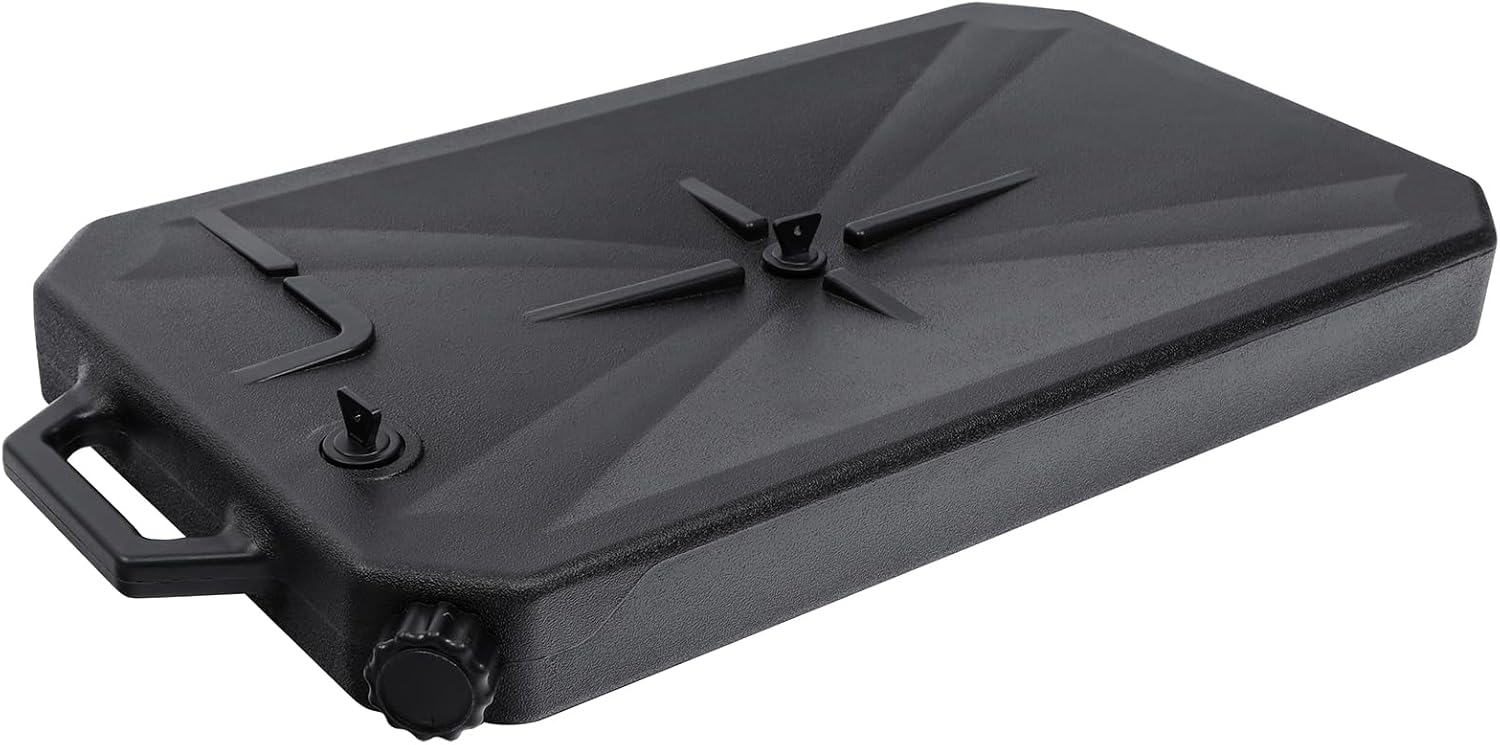
Always Change the Oil Filter
The oil filter is not optional. Old oil carries combustion byproducts, metal particles, and degraded additive packages. A new oil going through an old, clogged filter picks up contaminants immediately. Change the filter with every oil change — it costs very little relative to the protection it provides.
Check Oil Level with the Bike Upright
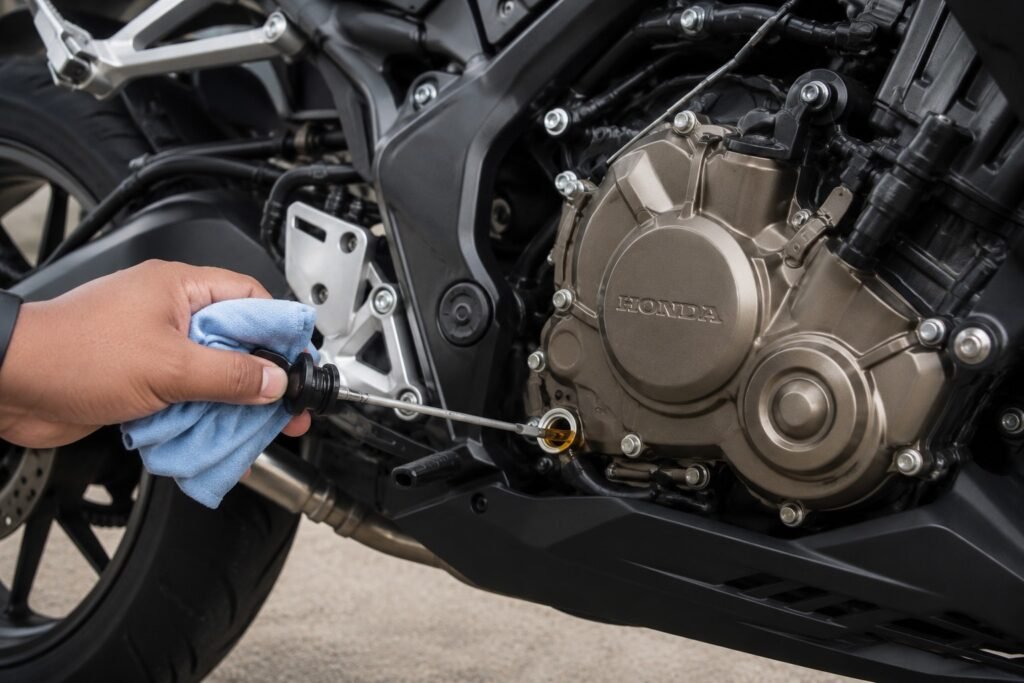
Many motorcycles specify that you check the oil level with the bike on level ground and held upright — not on the side stand. A bike leaning on its side stand can show a false low reading. Some bikes use a sight glass; others use a dipstick. Either way, make the check within a few minutes of shutting the engine off while oil temperature is consistent.
Warning Signs of Low or Dirty Oil
Low oil:
- Oil warning light illuminates
- Unusual ticking or tapping from the top of the engine (valve train noise)
- Engine temperature running hotter than usual
Dirty or degraded oil:
- Oil appears very dark or black on the dipstick (some darkening is normal — jet-black and viscous is not)
- Metallic flakes visible in the oil (seek professional diagnosis immediately)
- Gearbox shifting feels notchy or imprecise
Do Not Mix Oil Types If You Can Avoid It
Topping up a full synthetic oil with semi-synthetic or mineral oil in an emergency is acceptable to get you home safely. But this dilutes the additive package of the superior oil. At your next scheduled service, do a full drain and refill.
Warm Up the Engine Before Riding Hard
Cold oil is significantly more viscous than warm oil. Even full synthetic motorcycle oil with a low cold-grade number flows better warm than cold. Give your engine two to three minutes of gentle warm-up before riding aggressively, especially in cold morning temperatures. This lets oil pressure stabilize and ensures full lubrication reaches the cam lobes and valve train before you start loading the engine hard.
Keep your hands (and grip on the wrench) oil-free — 👉 Grab a 100-pack of Nitrile Mechanic Gloves on Amazon

Conclusion: The Best Motorcycle Engine Oil Is the Right One for Your Machine
There is no single oil that is universally best for every motorcycle, every climate, and every riding style. But there is always a best choice for your specific combination of bike, environment, and riding behavior — and now you have the knowledge to find it.
To summarize the key takeaways:
- Never use car engine oil in a wet-clutch motorcycle. Friction modifiers cause clutch slip. Always choose JASO MA or MA2 certified oil.
- Full synthetic motorcycle oil provides the best protection for modern, high-revving engines and hard riding — choose it whenever your bike and budget allow.
- Viscosity matters. Match your grade to your climate and your engine’s displacement. 10W-40 covers most modern bikes; 20W-50 suits large-displacement cruisers and hot-weather riding.
- Read the label. JASO MA2 and API SN or SP together on one bottle is the gold standard for current four-stroke motorcycle lubricants.
- Stick to a schedule. Even the best motorcycle engine oil breaks down eventually. Regular changes are cheaper than engine repairs, every single time.
Your engine works harder than you probably realize, every single ride. Give it the protection it deserves, choose the right best motorcycle engine oil, and it will reward you with thousands of reliable, powerful kilometres of riding.
— Chris Mchenga | MotoGearsPro
Always consult your motorcycle owner’s manual for manufacturer-specific oil specifications before performing any service.