
You check your oil, swap your tires, and lube your chain regularly. But when was the last time you thought about your brake fluid? For most riders, the answer is probably “never” — and that hidden neglect can slowly turn into a serious problem every time you ride.
The industry standard motorcycle brake fluid change interval is every one to two years, regardless of how many miles you’ve ridden. That’s the answer. Right there, up front. But if you want to understand why — and avoid a $1,000+ mistake with your ABS module — keep reading.
The Science of Brake Degradation
Why Brake Fluid Goes Bad Just Sitting There
Brake fluid isn’t passive. It’s hungry.
Most motorcycle brakes run on glycol-based fluid — DOT 3, DOT 4, or DOT 5.1. These fluids are hygroscopic, which means they actively absorb moisture from the surrounding air. The dominant chemical at work here is polyethylene glycol, a compound that bonds to water molecules through a process called hydrogen bonding. Your rubber seals, your reservoir cap, the microscopic pores in your brake lines — water finds a way in through all of them.
This isn’t a slow drip. In a humid climate, glycol-based brake fluid can absorb 1–2% of its volume in water within the first year. Hit 3.7% water contamination, and everything changes.
Dry vs. Wet Boiling Point: The Number That Saves Your Life
Every DOT-rated fluid has two boiling points. Fresh, uncontaminated fluid has a dry boiling point — the temperature at which it vaporizes before any water absorption. Once the fluid hits that 3.7% water contamination threshold, it has a wet boiling point, which is dramatically lower.
DOT 4 fluid, for example, has a dry boiling point around 230°C (446°F). Its wet boiling point drops to roughly 155°C (311°F). That’s a 75-degree cliff.
Why does that matter on the road? Hard braking generates enormous heat at the caliper. If your contaminated fluid boils inside the brake line, it creates steam bubbles. Gas compresses; fluid doesn’t. You grab the front brake lever and it goes soft, then spongy, then — in a worst-case scenario — it goes to the bar.
This is exactly what “spongy motorcycle brakes old fluid” describes. That mushy lever feel isn’t a caliper problem or a pad problem. It’s vapor lock. Boiled water. And it happens because nobody changed the fluid.
DOT Fluid Comparison: Know What’s In Your System
Brake Fluid Types Side by Side
| Fluid Type | Base Chemistry | Dry Boiling Point | Wet Boiling Point | Change Frequency |
|---|---|---|---|---|
| DOT 3 | Glycol-ether | 205°C / 401°F | 140°C / 284°F | Every 1–2 years |
| DOT 4 | Glycol-ether (enhanced) | 230°C / 446°F | 155°C / 311°F | Every 1–2 years |
| DOT 5 | Silicone | 260°C / 500°F | 180°C / 356°F | Every 3–4 years* |
| DOT 5.1 | Glycol-ether (high-perf) | 270°C / 518°F | 191°C / 375°F | Every 1–2 years |
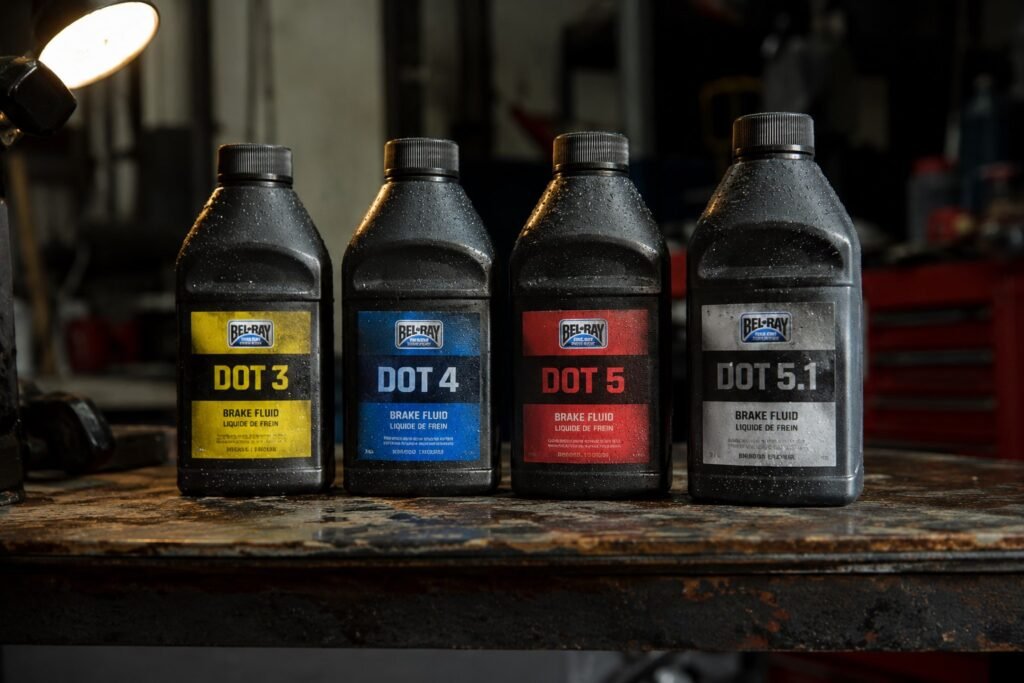
*DOT 5 doesn’t absorb moisture — but water that does enter pools in low spots and causes localized corrosion. It’s not magic.
Can You Mix DOT 3 and DOT 4 Brake Fluid on a Motorcycle?
Yes — with caveats. DOT 3 and DOT 4 share the same glycol-ether base chemistry. Mixing them won’t destroy your system. The blended result will simply perform to the lower spec. That said, mixing is still a temporary measure. Flush the whole system properly at your next service.
DOT 5 is completely different. Silicone and glycol do not play together. Pour DOT 5 into a system designed for DOT 4 and you get a gelatinous, sludgy mess. Seals swell. Passages clog. Calipers seize. It’s a full system rebuild — potentially thousands of dollars. Never mix DOT 5 with any glycol-based fluid. The color coding (DOT 5 is typically purple) exists precisely to prevent this mistake.
Time vs. Mileage: The Silent Killer in Your Garage
Motorcycle Brake Fluid Change Every 2 Years: Why Time Beats Miles
Here’s something most riders get wrong. They think fluid degradation is about how hard the brakes work — that high-mileage bikes need changes more urgently than low-mileage ones.
That’s only half true.
A correct motorcycle brake fluid change interval accounts for both time and usage. But time is the sneakier enemy. Your bike sitting in a humid garage for 24 months is absorbing moisture every single day it’s parked. The fluid isn’t resting — it’s reacting.
How Often to Change Brake Fluid on a Motorcycle by Mileage
When you factor in mileage, the picture gets more nuanced. Hard-ridden sport bikes with track days see intense caliper temperatures. Every heat cycle accelerates chemical breakdown. For those machines, a one-year interval makes more sense than two.
Touring bikes logging 20,000+ miles per year generate their own wear. But a weekend cruiser sitting mostly parked in a coastal city? The motorcycle brake fluid change interval for that bike is still 24 months — even if the odometer barely moved.
Think of it this way: a bike ridden hard for 15,000 miles needs fresh fluid. So does the same bike sitting in a humid garage for 18 months with 3,000 miles on it. The water doesn’t care about your riding schedule.
Inspection Guide: Signs Your Fluid Has Gone Bad
Signs Motorcycle Brake Fluid Needs Changing
Before you wrench, learn to read what the fluid tells you. Here are the real-world signs:
Lever feel has changed. A slightly spongy, less firm pull on the brake lever is your first warning. Don’t dismiss it as air in the line until you’ve ruled out old fluid. Spongy motorcycle brakes from old fluid feel identical to air — and the fix is the same anyway.
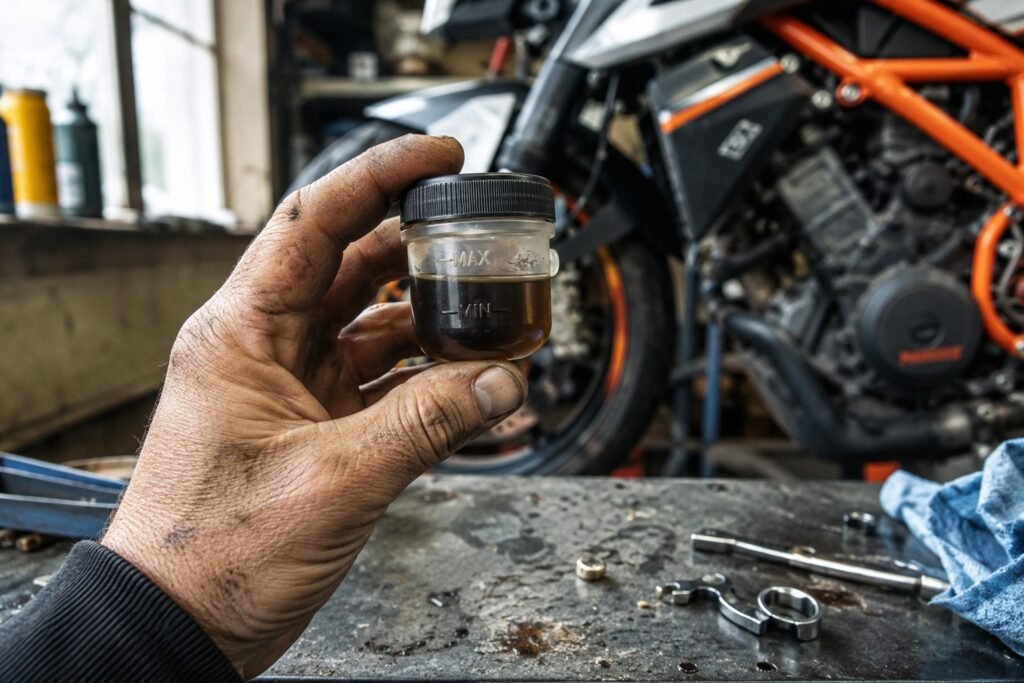
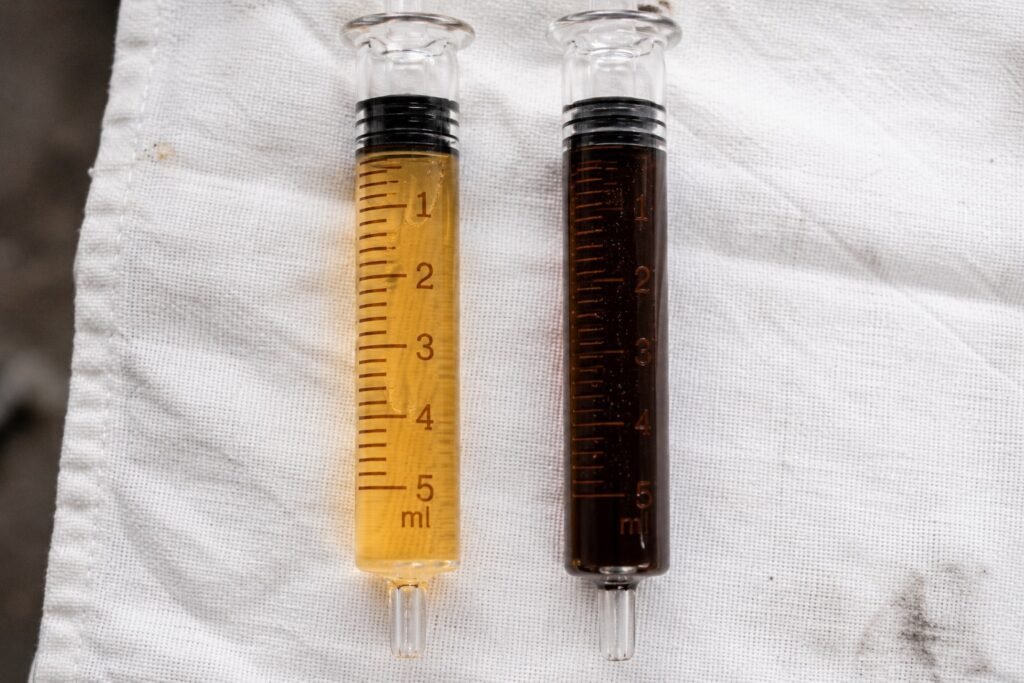
The fluid has darkened. Fresh, healthy fluid ranges from water-clear to very light amber — like diluted honey. Once you see brown, you’ve already waited too long.
It’s been more than two years. If you can’t remember the last change, it’s time. That’s the whole rule.
What Color Should Motorcycle Brake Fluid Be?
Fresh glycol-based brake fluid should look nearly clear, at most the lightest pale yellow. Think: bottled spring water with a faint straw tint.
Dark brown motorcycle brake fluid tells you the fluid has oxidized and absorbed significant moisture. The brown color comes from two sources: metallic particles worn off internal components and rubber degradation from your seals. Dark fluid isn’t just old — it’s actively carrying contaminants through your master cylinder and calipers.
How to Test Brake Fluid Moisture Content
Don’t rely on eyesight alone. A digital brake fluid moisture tester costs $15–30 and takes five seconds to use. Dip the probe into the reservoir, and it reads the water percentage by measuring the fluid’s boiling point characteristics.
Any reading above 3% water content means flush now. Don’t wait for the two-year mark if your meter is already showing 2.8%. The numbers are the truth.
Pro Tips for the Garage and the Saddle
Brake Fluid Will Eat Your Paint — Immediately
Brake fluid is an aggressive solvent. Spill even a few drops on your fuel tank, fairing, or frame and you’ll watch the paint bubble in real time. Keep a rag under the reservoir when you open it. Have paper towels ready. Wipe any spill with water immediately — brake fluid dilutes and neutralizes quickly with water, but only if you catch it fast.
How Long Does Motorcycle Brake Fluid Last in an Open Bottle?
Once you crack the seal on a bottle of DOT 4, the clock starts. Glycol-based fluid absorbs moisture from the air even in the bottle. An open bottle kept in a shop environment is generally compromised within one year, sometimes less in humid conditions.
Never top off your reservoir using fluid from a half-empty bottle that’s been sitting on the shelf since last summer. Buy fresh, sealed bottles. Use the whole bottle or toss the rest.
ABS Modules and Old Fluid: A $1,000 Mistake
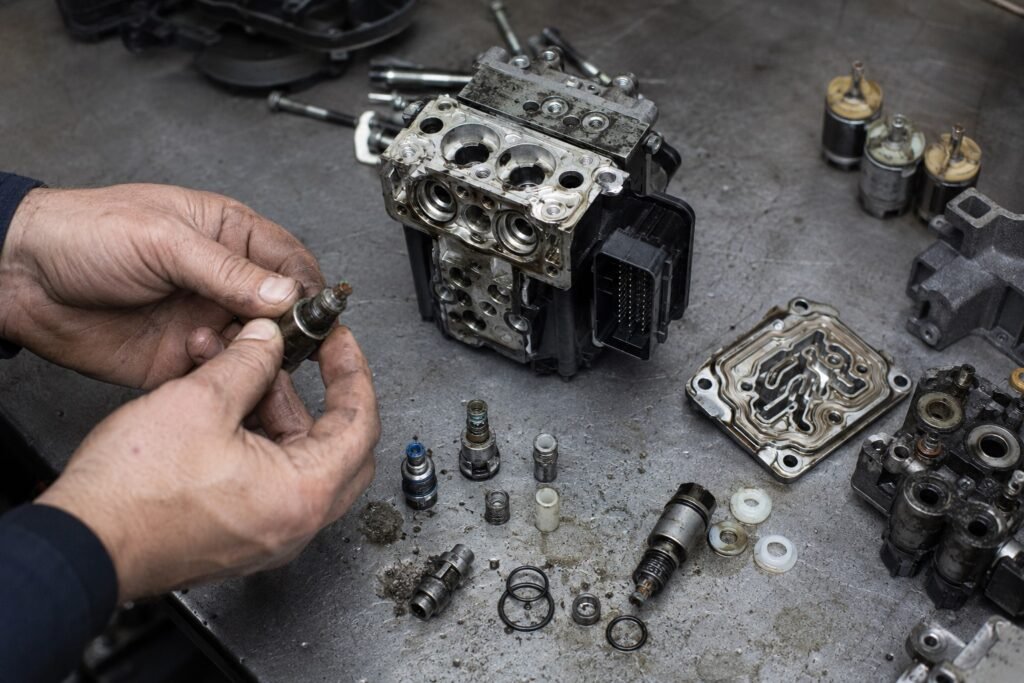
This is the one that hurts the most. Modern ABS modules contain tiny solenoids, ball bearings, and precision passages measured in microns. Contaminated fluid — thick with moisture, metallic particles, and rubber degradation products — clogs those passages.
An ABS module replacement on a mid-range motorcycle runs $800 to $1,500 in parts alone, not counting labor. The correct motorcycle brake fluid change interval costs you about $20 in fluid and an hour of your Saturday. The math isn’t complicated.
One more overlooked factor: the dot 4 motorcycle brake fluid change frequency matters even more on bikes with cornering ABS and linked brake systems. These systems cycle the fluid under pressure during ABS events. Contaminated fluid under pressure accelerates component wear geometrically.
Final Checklist: Don’t Ignore Your Stopping Power
The motorcycle brake fluid change interval isn’t bureaucratic caution — it’s physics. Glycol absorbs water. Water drops the boiling point. Heat boils contaminated fluid. Vapor lock kills lever feel. And your front brake provides roughly 70% of your total stopping power.
Here’s what to take away:
- Change brake fluid every one to two years, regardless of mileage.
- Use a digital moisture tester — don’t guess by color alone.
- Dark brown motorcycle brake fluid means you’re overdue.
- Never use fluid from an open bottle more than a year old.
- DOT 5 silicone is never compatible with DOT 3 or DOT 4 systems.
- Protect your ABS module — it’s the most expensive casualty of neglected fluid.
- The correct motorcycle brake fluid change interval costs $20. Neglecting it can cost $1,500.
You wouldn’t ride on bald tires. Don’t ride on two-year-old brake fluid either. The machine will stop when you need it to — but only if you do your part.