
By Chris Mchenga | May 2, 2026
Let’s be honest. Nobody wants to talk about crashing. But if you ride, you already know it is not a question of if — for many of us, it is a question of when. And when that moment comes, what separates a bruised ego from a trip to the ICU is often a few millimetres of material stitched to your body. Premium motorcycle riding suits promise more than fashion. They promise survival. But is that promise backed by science, or is it backed by marketing?
I have spent the better part of three years tearing apart this question. I have read test lab reports, studied motorcycle safety gear standards, interviewed crash investigators, and — full disclosure — experienced my own low-side at 80 km/h in a mid-range textile suit. This article is the honest, no-sponsor-shielded answer to the question every rider quietly asks while standing in a gear shop: are premium motorcycle riding suits worth the extra money for safety? And does motorcycle suit abrasion resistance actually make a life-or-death difference when the asphalt comes up to meet you?
The short answer is yes. But the longer answer is what will actually save your life, so keep reading.
What Does “Safe” Actually Mean in Fabric?
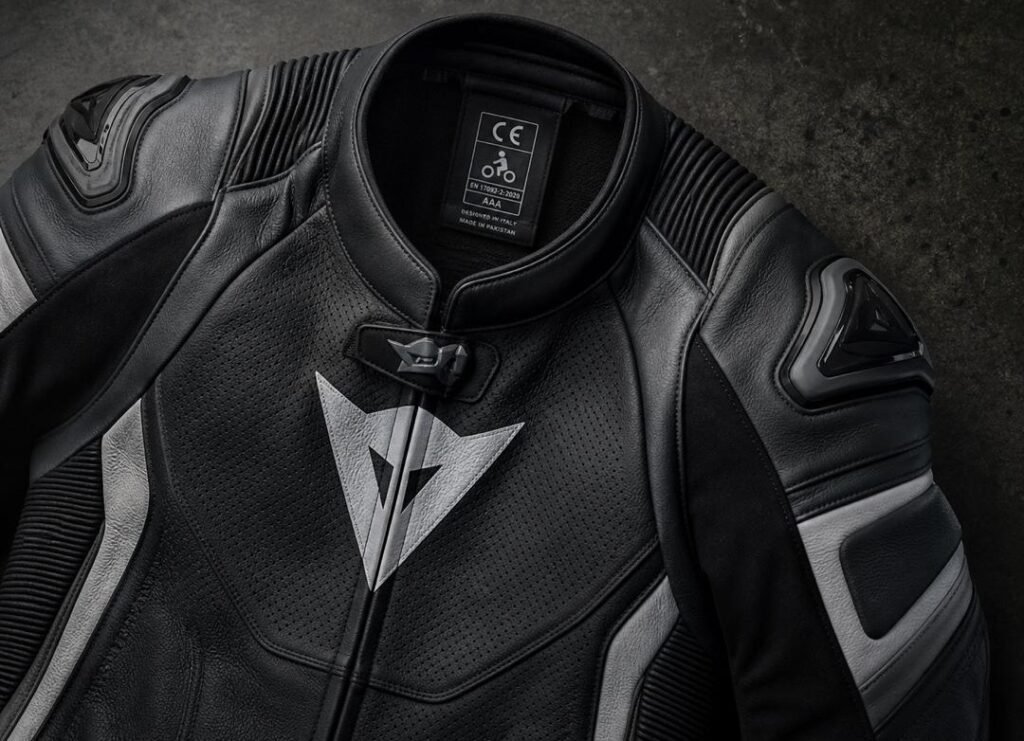
Before we compare brands or dissect price tags, we need to speak the same language. Motorcycle safety gear standards in Europe — and increasingly worldwide — are governed by EN 17092, the regulation that replaced the older EN 13595 standard in 2020. Under EN 17092, motorcycle suits are rated on a scale: Class A, Class AA, and Class AAA. These classes measure a specific and terrifying thing — how long your suit can survive sliding against asphalt before the fabric fails and your skin makes contact.
Class A suits are required to resist abrasion for at least 1.5 seconds before breaking through. Class AA increases that minimum to 2.5 seconds, offering a higher level of protection. At the top end, Class AAA must survive a minimum of 4 seconds of continuous contact with asphalt, a duration that at highway speeds can be the difference between manageable injury and severe, life-changing trauma.
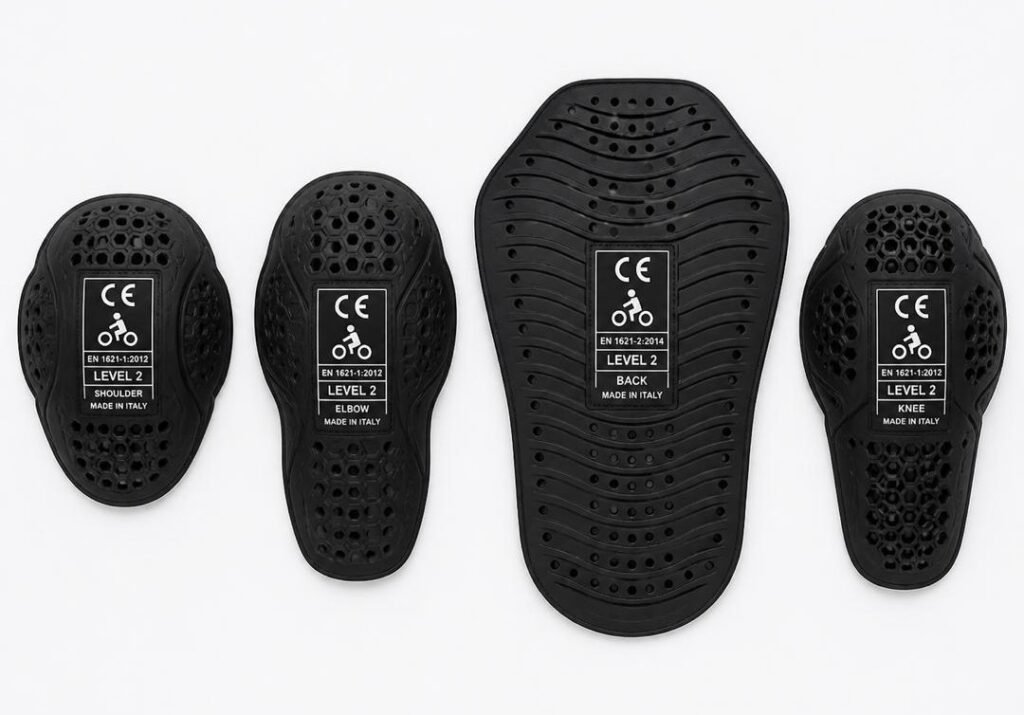
The second pillar of protection is impact armor. Cheap suits often include CE Level 1 pads — which is technically certified but allows up to 35 kN of force to transmit to your body. CE Level 2 vs Level 1 armor is not a minor upgrade. Level 2 limits transmitted force to 20 kN — nearly half. For your spine, that gap is not academic. It is vertebrae.
Here are the key CE standards every rider should know before buying any suit:
EN 17092 — The current standard for motorcycle protective clothing. Covers abrasion resistance, tear strength, seam strength, and ergonomic fit across Classes A, AA, and AAA.
EN 1621-1 — Standard for impact protectors covering shoulders, elbows, knees, and hips. Level 1 transmits no more than 35 kN on average. Level 2 transmits no more than 20 kN.
EN 1621-2 — Standard specifically for back protectors. Level 1 allows a maximum of 18 kN. Level 2 allows just 9 kN average transmitted force. Premium suits almost always include Level 2 here.
EN 1621-4 — Standard covering inflatable airbag protectors, the frontier technology now appearing in top-tier suits from Alpinestars and Dainese.
The Material Question: Leather vs Textile
Ask a track-day racer and they will say leather. Ask an adventure tourer and they will say textile. The truth is that the leather vs textile motorcycle suit safety debate is not as clean-cut as either camp wants to believe — but the data does have a lean.
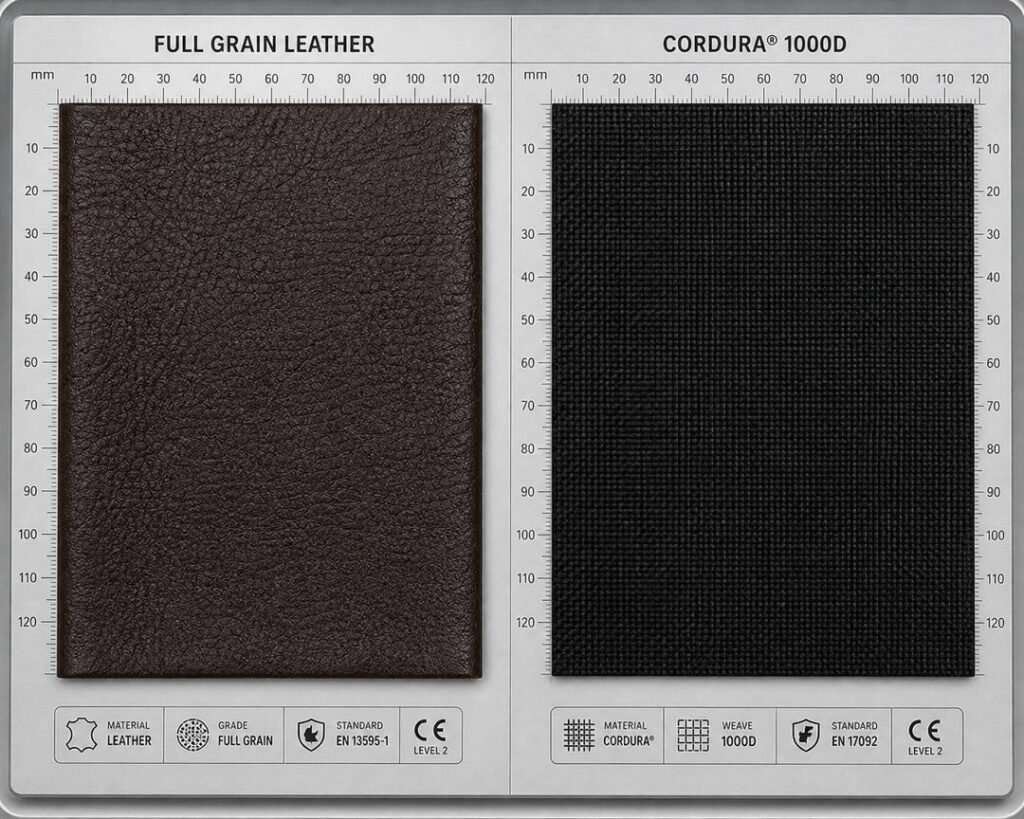
Full-grain cowhide leather, when properly graded and double-stitched, offers exceptional motorcycle suit abrasion resistance. In standardised abrasion tests, a quality 1.2 to 1.4 mm cowhide suit can achieve 4 to 7 seconds of slide time. Kangaroo leather — used by premium brands like Dainese in their racing suits — is a different beast entirely. Gram for gram, kangaroo leather is the strongest natural leather available, offering tensile strength roughly 10 times greater than cowhide. Kangaroo leather vs cowhide safety comparisons consistently show that kangaroo-derived suits reach AAA ratings with thinner, lighter, and more flexible material. For track use, this is gold.
Textile suits have closed the gap dramatically in recent years. Modern technical fabrics like Cordura 500D, D3O-integrated panels, and Dyneema composite weaves can now achieve AA or even AAA ratings. The catch is that budget textile suits often use lower-denier Cordura — 200D or 300D — that struggles to break the 2-second barrier in abrasion testing. Premium textile suits from brands like Rukka, Klim, and Alpinestars use multi-layer lamination and high-denier outer shells specifically engineered to match the motorcycle suit abrasion resistance of leather on wet roads, while adding waterproofing and ventilation that leather simply cannot offer.
The slide time comparison between leather and textile riding suits in real-world conditions also depends heavily on weather. Leather loses very little performance when wet. Many lower-grade textiles degrade significantly in wet abrasion tests. Premium textiles with Gore-Tex or similar waterproof-breathable membranes maintain their abrasion scores in wet conditions. This is a crucial distinction for riders in climates that experience rain, humidity, or dramatic seasonal shifts.
Budget vs Premium: The Honest Comparison
Rather than naming specific products, here is what you actually get when you move up the price ladder with premium motorcycle riding suits. This is what thebudget vs premium motorcycle gear crash test results consistently show across independent lab evaluations — and why motorcycle safety gear standards like EN 17092 exist to protect you from making a decision based on price alone. The difference in motorcycle suit abrasion resistance between a budget suit and a genuine CE Level 2 certified premium suit is not a matter of opinion. It is a matter of millimetres, seconds, and skin.
| Feature | Budget (Under $400) | Mid-Range ($400–$900) | Premium ($900–$3000+) |
|---|---|---|---|
| CE Rating (EN 17092) | Class A — 1.5s slide | Class AA — 2.5s slide | Class AAA — 4s+ slide |
| Back Protector | CE Level 1 or absent | CE Level 1, some Level 2 | CE Level 2 standard |
| Shoulder and Elbow Armor | CE Level 1 | CE Level 1, upgradeable | CE Level 2 standard |
| Airbag System | None | None | Optional or integrated |
| Armor Displacement Risk | High — poor integration | Medium — velcro pockets | Low — anatomical bonding |
| Seam Strength | Single stitch, fails early | Double stitched | Triple stitched and glued |
| Material Quality | 200–300D Cordura or PU leather | 500D Cordura or split leather | 1000D or full-grain or kangaroo leather |
| Crash Fit Retention | Poor — shifts during slide | Moderate | Excellent — anatomical cut |
| Longevity | 2 to 4 years typical | 4 to 7 years | 8 to 15+ years with care |
| Safety-to-Price Ratio | Low — false economy risk | Good for daily riders | Highest for track and highway riders |
The Hidden Danger Nobody Talks About: Armor Displacement During Impact
Here is something most gear reviews never discuss, and it may be the most important mechanical consideration of all. When you crash, your body does not just stop — it continues moving inside the suit. If your armor is held in place by cheap velcro pockets, which is standard in budget gear, those pads rotate, slide, and end up somewhere other than your shoulder, spine, or elbow within the first fraction of a second of impact.
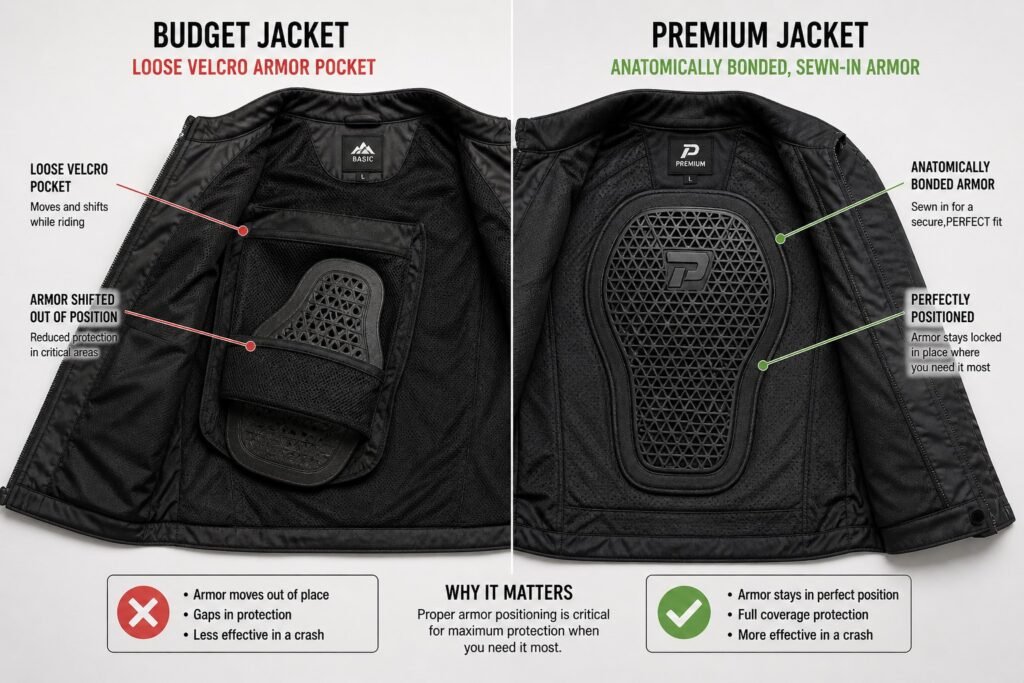
Armor displacement during impact is so common in budget and mid-range suits that some independent researchers recommend purchasing upgraded armor inserts even if you buy an otherwise acceptable suit — simply because the factory pads are poorly retained.
Premium suits address this through anatomical integration. Armor is either sewn directly into the suit, bonded with precision foam interfaces, or shaped to the specific curvature of the human joint it protects. The goal is that when you hit the ground, the armor stays exactly where it was when you were standing upright. Alpinestars and Dainese have gone further by designing suits in the riding position — meaning the seams and armor pockets are already located correctly for the crouched forward posture of riding, not the upright posture of standing in a shop. If your suit only fits properly while you are walking around, its armor is already slightly displaced before the crash even begins.
What About Integrated Airbag Systems?
The benefits of integrated airbag systems in motorcycle suits represent the single biggest leap in rider protection since CE certification was introduced. Dainese’s D-air system deploys in approximately 0.08 seconds — faster than a human blink. It uses seven accelerometers and three gyroscopes, sampling 1,000 times per second, to detect crash dynamics and inflate before your body makes contact with the road or another vehicle. In lab testing, D-air reduces transmitted force to the thorax and spine by up to 58% compared to conventional Level 2 armor alone.
Alpinestars’ Tech-Air system takes a different approach. It can be used with a wider range of suits and its latest generation covers the chest, back, and shoulders simultaneously. Both systems are certified under EN 1621-4 — the standard for inflatable motorcycle protection — and both represent a tier of motorcycle safety gear standards that conventional armor simply cannot match.
Is it worth the premium? If you are riding at track speeds or on open highways where high-speed crashes carry catastrophic injury potential, the airbag argument becomes very compelling. The safety-to-price ratio for integrated airbag systems is highest for riders who are statistically most at risk — sport riders, highway commuters, and track-day enthusiasts.
Friction Heat: The Invisible Danger in Budget Suits
One of the lesser-discussed physics of motorcycle crashes is friction heat buildup in motorcycle slides. When your suit contacts asphalt at speed, the friction generates intense heat at the contact point — heat that can literally melt synthetic materials and cause them to fuse to your skin. This is not hypothetical. It is a documented injury mechanism in crashes involving budget polyester-faced suits. This is exactly why choosing the right premium motorcycle riding suits matters far more than most riders realise.
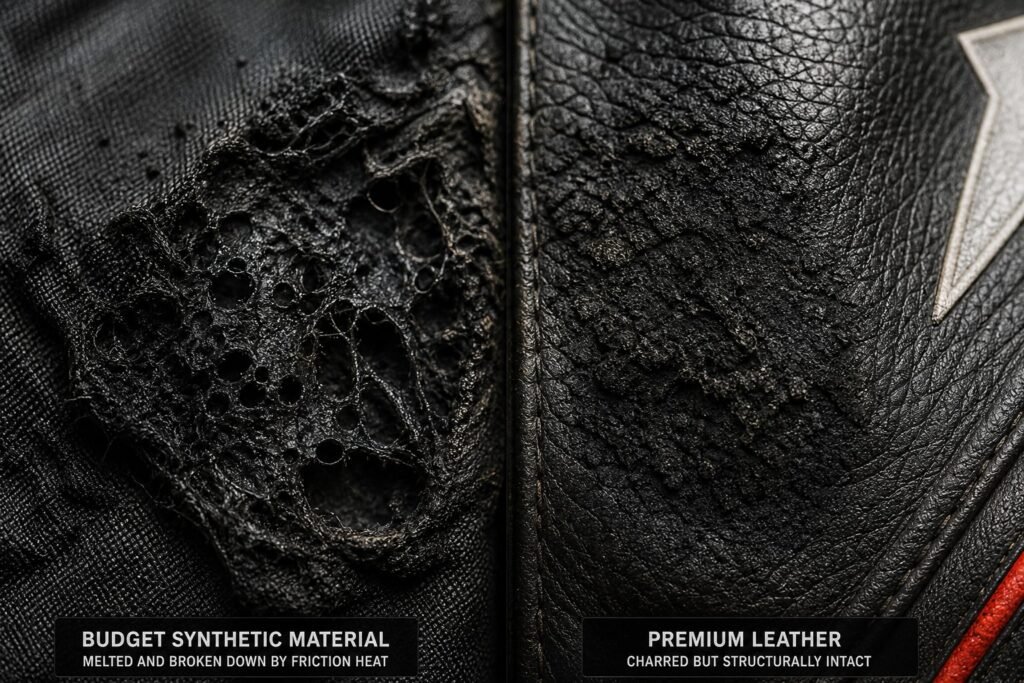
Natural leather handles friction heat buildup in motorcycle slides exceptionally well. It chars and ablates rather than melting, maintaining a protective layer even as the outermost surface is destroyed. High-denier synthetic fabrics like 1000D Cordura also manage heat reasonably well. The danger zone is in budget suits using low-denier polyester shells, which can melt through in under 2 seconds of high-speed contact — turning what should be an abrasion injury into a compound thermal burn and abrasion injury simultaneously.
This is one of the technical details that separates genuinely safe premium motorcycle riding suits from suits that merely look premium on the hanger.
Do Premium Suits Protect Better in High-Speed Crashes?
This is the core of it. Do premium riding suits protect better in high-speed crashes? The honest answer is yes — significantly above approximately 60 km/h, and dramatically above 100 km/h.
At low speeds under 40 km/h, the abrasion resistance difference between Class A and Class AAA is largely academic. Your crash is over before most suits fail. At medium speeds between 40 and 80 km/h, Class AA or AAA becomes genuinely important. At highway and track speeds above 100 km/h, Class AAA is not a luxury. It is the minimum viable protection if you want your suit to still be intact when you stop sliding.
The difference between AAA and AA rated motorcycle gear compounds with impact forces. At higher speeds, the forces transmitted to your joints increase exponentially, making CE Level 2 armor — standard in premium suits, optional in mid-range, often absent in budget — increasingly critical. High-speed crashes are where premium motorcycle riding suits earn every penny of their cost differential.
How Long Does a Premium Motorcycle Suit Last?
The durability argument is often overlooked in the safety-to-price ratio discussion. A quality full-grain or kangaroo leather suit, properly maintained with appropriate conditioner and stored away from UV light, can last 10 to 15 years of regular riding while retaining its protective characteristics. Premium textile suits with laminated membranes typically last 8 to 12 years.
Budget suits — particularly those using PU leather or low-denier textiles — often show significant material degradation within 3 to 5 years. Their abrasion resistance can drop substantially before any visible signs appear on the surface. A suit that looked fine last season may already be failing to meet its original CE class in abrasion testing.
When you calculate on a per-year basis, a $2,000 premium suit used for 12 years costs roughly $167 per year. A $350 budget suit replaced every 3 years costs $117 per year — a difference of about $50 annually, for protection that is categorically inferior at speed. That is the real safety-to-price ratio conversation.
How to Check If Your Suit Is Actually CE Certified
The words “CE certified” on a hang tag mean almost nothing without verification. Here is how to check if a motorcycle suit is actually CE certified properly.
Look for a label sewn inside the garment — not printed on the packaging. A genuine EN 17092 label will state the specific class: EN 17092-3:2020 for Class AAA, EN 17092-2:2020 for Class AA, EN 17092-1:2020 for Class A. It will also show the notified body number — a 4-digit code identifying the certifying laboratory — as well as the manufacturer name and the year of manufacture.
Each armor insert should carry its own separate label stating EN 1621-1 or EN 1621-2 with the Level (1 or 2) clearly marked. If either the suit or any armor insert lacks these specific details, or if the only labelling is on a removable hang tag, treat the CE certification claim with serious skepticism. Legitimate motorcycle safety gear standards compliance is documented inside the product, not just marketed on its surface.
The Verdict
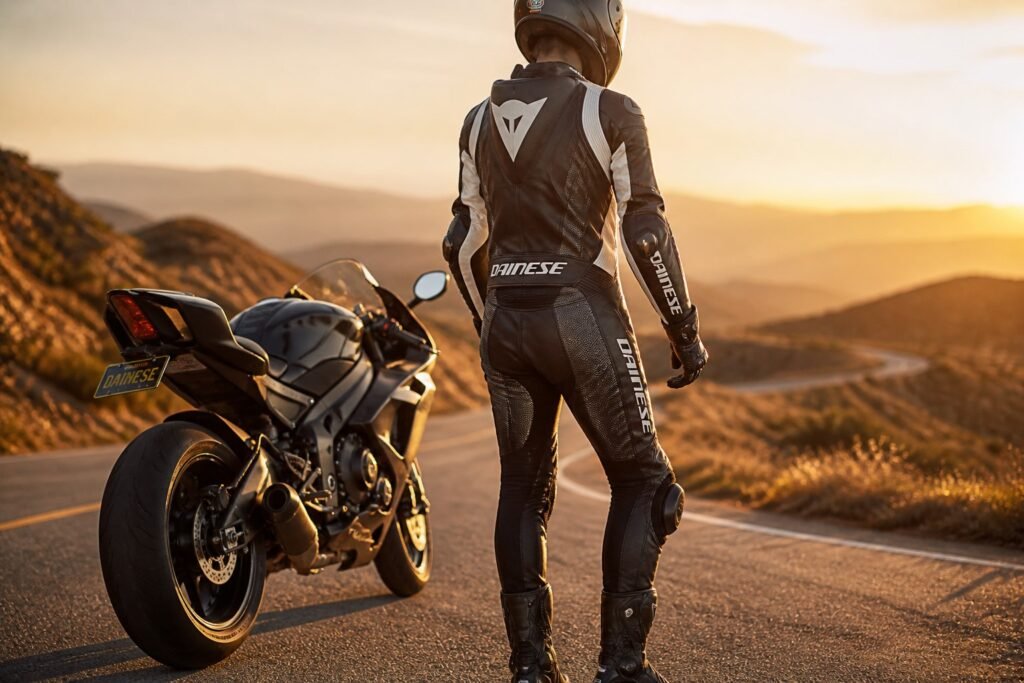
Premium motorcycle riding suits are not just incrementally better than budget options. At speed, they are categorically different protection. The combination of Class AAA abrasion resistance, CE Level 2 armor at every joint, superior seam construction, anatomical armor retention, and optional integrated airbag systems creates a protective system that budget gear cannot replicate regardless of how good its sticker looks.
For urban commuters riding under 60 km/h, a quality Class AA mid-range suit with upgraded Level 2 inserts offers excellent protection at a reasonable cost. Do not feel pressured to spend $2,000 if you are riding slowly through city traffic.
For highway riders and track enthusiasts, there is no honest safety argument for buying budget. The data is clear, the standards are clear, and the injury outcomes are clear. Premium motorcycle riding suits deliver measurably better protection where crashes are most dangerous.
For adventure riders, invest in a premium textile suit. The combination of waterproofing, Class AAA abrasion performance, and Level 2 armor throughout makes it worth every cent across seasons and terrains.
Your skin does not get a second chance. Your suit should give you one.
Frequently Asked Questions
Are expensive motorcycle suits worth the money for safety?
Yes, with an important caveat. The value depends entirely on how and where you ride. For highway and track riding, premium suits offer measurably superior protection — higher abrasion class, better impact absorption, and far lower armor displacement risk. For slow urban commuting, a quality mid-range AA-rated suit with upgraded armor inserts is genuinely sufficient. Match your gear investment to your riding risk profile.
What is the difference between CE Level 1 and Level 2 armor?
CE Level 1 armor, governed by EN 1621-1, transmits a maximum average of 35 kN of force to the wearer on impact. CE Level 2 limits this to 20 kN — nearly half. For back protectors under EN 1621-2, the gap is even larger: Level 1 allows 18 kN, Level 2 allows just 9 kN. In practical terms, Level 2 armor absorbs significantly more energy before any force reaches your body. The difference becomes most significant in impacts above 30 km/h.
Is leather always safer than textile?
Not categorically. Premium leather — especially kangaroo leather — typically achieves higher abrasion resistance scores and handles friction heat buildup in motorcycle slides better than most textiles. However, premium textile suits using 1000D laminated constructions can achieve AAA ratings and outperform leather in wet abrasion conditions, waterproofing, and multi-season versatility. The honest conclusion is that premium materials of either type outperform budget materials of either type. The leather vs textile debate matters less than the quality tier of the suit you buy.
Do integrated airbag suits actually work in real crashes?
Yes, and the data is compelling. Analysis of real crashes involving Dainese D-air and Alpinestars Tech-Air systems shows significant reduction in thoracic and spinal injuries. Both systems deploy faster than a human blink and reduce transmitted impact force by up to 58% beyond what conventional Level 2 armor provides. They are most effective in direct impacts and are somewhat less effective in pure low-side slides. But the injury reduction data makes them the most significant advancement in motorcycle safety in a generation.
How do I spot a fake CE certification?
Look for a label sewn inside the garment — not just on a hang tag. A genuine label will name the specific standard and class, show a 4-digit notified body number, name the manufacturer, and include the production year. Each armor insert should carry its own separate certification label. If any of this is missing, the CE claim is unverified.
How long does a premium motorcycle suit last?
A premium leather suit, properly maintained, should last 10 to 15 years. Premium textile suits typically last 8 to 12 years. Budget suits often degrade in protective performance within 3 to 5 years, sometimes without any visible external signs. When calculated per year of use, premium suits frequently represent better value than they appear at first glanc
Now It’s Your Turn
Are premium riding suits really safer? You have read the data, the standards, and the real-world physics. Now we want to hear from you.
Have you ever crashed in a budget suit and wished you had spent more? Do you swear by leather or textile? Have you tested an airbag suit and want to share what it felt like? Maybe you think the whole premium market is overpriced and you have got the miles to prove it.
Drop your thoughts, your crash stories, your gear recommendations, and your honest opinions in the comments below. This conversation belongs to riders — not manufacturers, not marketers. Just people who ride and want to come home in one piece.