
Disclosure: This article contains Amazon affiliate links. If you make a purchase through these links, we earn a small commission at no extra cost to you. This helps support the site and allows us to keep creating detailed motorcycle gear guides. Thank you for your support!
You can find the toughest fabric and the best coating on the market, but a cover that doesn’t fit will still let you down. Choosing the right motorcycle cover size is the single most important step in protecting your bike, and it’s the one most riders rush through.
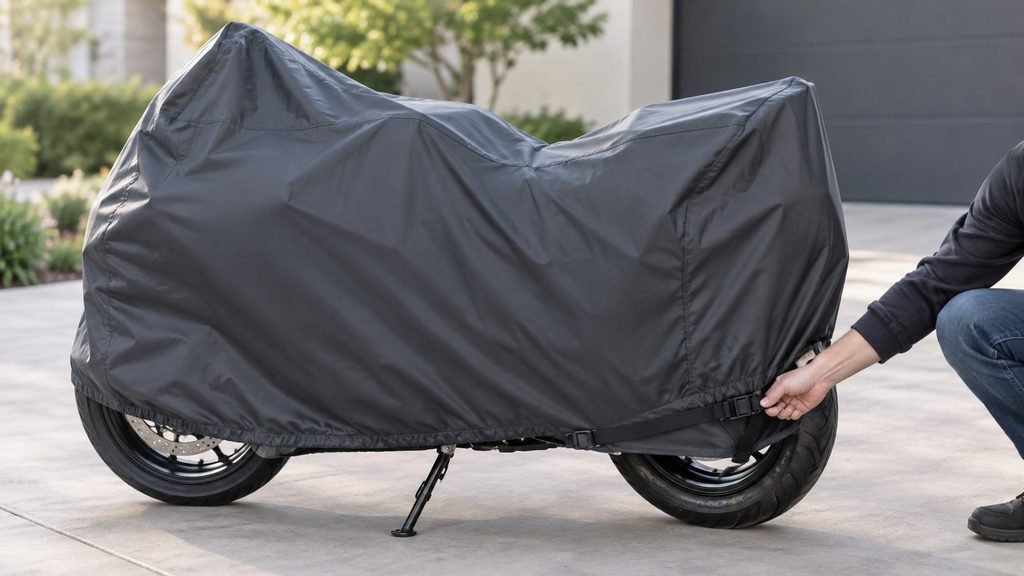
A cover that’s too small leaves the wheels, exhaust, or mirrors exposed. A cover that’s too big flaps in the wind, rubs the paint, and lets rain and dirt blow underneath. Either way, you’ve spent money on protection you’re not really getting.
In this guide, we’ll show you how to measure your bike, read a size chart, and pick the correct motorcycle cover size for your setup. We’ll also cover what to do if your bike has luggage, a tall windshield, or other add-ons that change the numbers.
Why Motorcycle Cover Size Matters
Most riders focus on fabric, waterproofing, and price, and treat cover size as an afterthought. That’s a mistake, because fit affects how well every other feature works.
A cover that fits properly:
- Stays in place in the wind, so it doesn’t flap or scuff the paint
- Keeps rain, dust, and debris from blowing up underneath
- Protects the whole bike, including mirrors, handlebars, and rear bodywork
- Lasts longer, because it isn’t constantly rubbing against itself
- Looks cleaner and is easier to put on and take off
An oversized cover acts like a sail in strong gusts. Even with straps, the loose fabric can slap against the tank and fairings and wear the finish over time. An undersized cover is just as bad. It strains at the seams, pulls off the bike in the wind, and leaves parts of the motorcycle uncovered.
Getting the size right the first time saves you from returns, wasted money, and a damaged finish.
What Size Labels Actually Mean
Most covers are sold in sizes like S, M, L, XL, and XXL. Some brands use numbers or list a maximum length instead, such as “fits up to 96.5 inches.”
The problem is that these labels aren’t standardized. An “L” from one brand may be noticeably different from an “L” from another. That’s why you should never pick a cover based on the letter alone.
Instead, look at the stated dimensions in the product listing or manufacturer size chart. Most charts list the maximum length the cover can handle, and many also give width and height. Compare those numbers to your bike’s real measurements, not just the size category.
Also check the wording. “Fits up to” means the cover is designed for bikes at or below that length. If your bike is right at the limit, you may want to size up.
How to Measure Your Bike for the Right Motorcycle Cover Size
Measuring takes about five minutes and removes most of the guesswork. Grab a soft tape measure, which is gentler on the paint than a metal one, and a notepad.
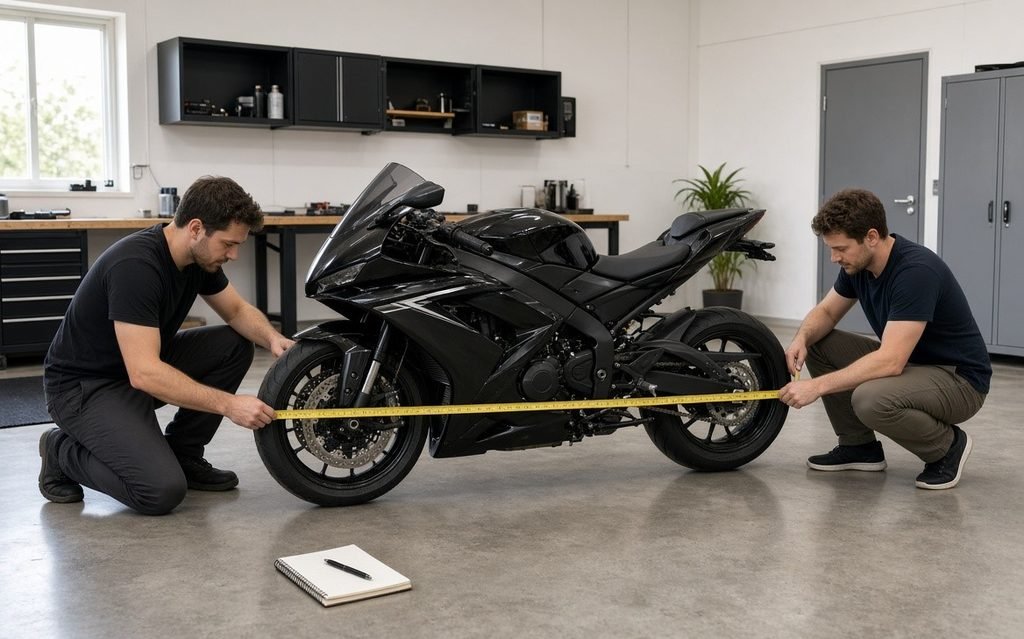
Step 1: Measure the length. Measure from the front edge of the front tire or fender to the rear edge of the tail section or rear tire, whichever sticks out farthest. This is the most important number when choosing a motorcycle cover size.
Step 2: Measure the width. Measure across the widest point of the bike. That’s usually from mirror tip to mirror tip or handlebar end to handlebar end.
Step 3: Measure the height. Measure from the ground to the highest point. On most bikes that’s the top of the windshield, mirrors, or backrest.
Step 4: Include your accessories. Measure the bike as it will be covered. If you leave saddlebags, a top case, or a tall windshield on, include them in all three measurements.
Step 5: Write it all down. Record each number and compare it to the size chart before you shop.
A quick tip: if your bike’s measurements fall between two sizes, choose the larger one. A slightly roomy cover with a good strap system is easier to manage than one that’s too tight.
Match Your Measurements to the Size Chart
Once you have your numbers, compare them to the manufacturer’s chart. Here’s a general idea of how cover size categories often line up with bike types. Treat these as rough guides only, since every brand is different.
| Cover Size | Typical Bike Type |
|---|---|
| Small | Small commuters, scooters, and lightweight bikes |
| Medium | Standard and naked bikes, smaller sport bikes |
| Large | Larger standards, sport tourers, many cruisers |
| XL | Big cruisers, touring bikes without luggage |
| XXL and up | Fully loaded touring bikes and large cruisers |
Always trust the listed dimensions over the category name. If a cover says it fits up to 96.5 inches and your bike measures 92 inches with accessories, you’re in good shape. If your bike measures 97 inches, move up a size.
Choosing the Right Fit by Bike Type
Different bikes have different shapes, and that changes how you should think about cover size.
Sport bikes. These are usually compact but have aggressive tail sections and tall, narrow profiles. Measure the length carefully, since the tail can stretch farther back than it appears.
Cruisers. Cruisers are long and low, so length is the key number. Many have large rear fenders, saddlebags, or sissy bars that add to the measurement.
Touring bikes. These are the trickiest. Windshields, fairings, and top cases make the bike both taller and longer than its stock dimensions. Always size for the bike as you actually ride it.
Adventure bikes. Tall seats, high windshields, and luggage racks mean height matters as much as length. Check that the cover’s listed height range works for your setup.
Scooters and small commuters. These are easy to fit, but avoid choosing a cover that’s far too large. Excess fabric will flap and may drag on the ground.
Don’t Forget Accessories When Choosing Motorcycle Cover Size
This is where many riders go wrong. The stock dimensions of your bike aren’t the same as the dimensions of your bike with accessories on it.
Common add-ons that change the cover size you need include:
- Tall or touring windshields
- Top cases and saddlebags
- Passenger backrests
- Luggage racks and tail bags
- Crash bars and highway pegs
- Aftermarket mirrors and handlebar risers
Even a few inches of extra height or length can push you into the next size category. If you take your luggage off every time you park, measure without it. If it stays on, measure with it.
When in doubt, put the accessories on, measure the bike, and then pick the cover. It’s a small step that prevents the most common sizing mistakes.
Signs Your Cover Size Is Wrong
Even after careful measuring, you may end up with a cover that doesn’t feel right. Here’s how to tell if the motorcycle cover size is off.
Signs the cover is too small:
- It doesn’t reach the ground or leaves the wheels exposed
- The fabric strains at the seams or around the mirrors
- It pulls up or slides off in light wind
- It’s hard to get over the windshield or backrest
Signs the cover is too large:
- Excess fabric hangs well below the wheels or drags on the ground
- The cover billows and flaps even with the straps tight
- Loose folds collect water and debris
- It rubs against the bike and wears the paint
If the cover is only slightly large, a good strap and buckle system can often fix the problem. If it’s too small, though, there’s usually no solution except returning it for a bigger size.
Fit Features That Help a Cover Stay Secure
A properly chosen cover size gets you most of the way there, but certain design features help the cover stay put and fit more snugly.
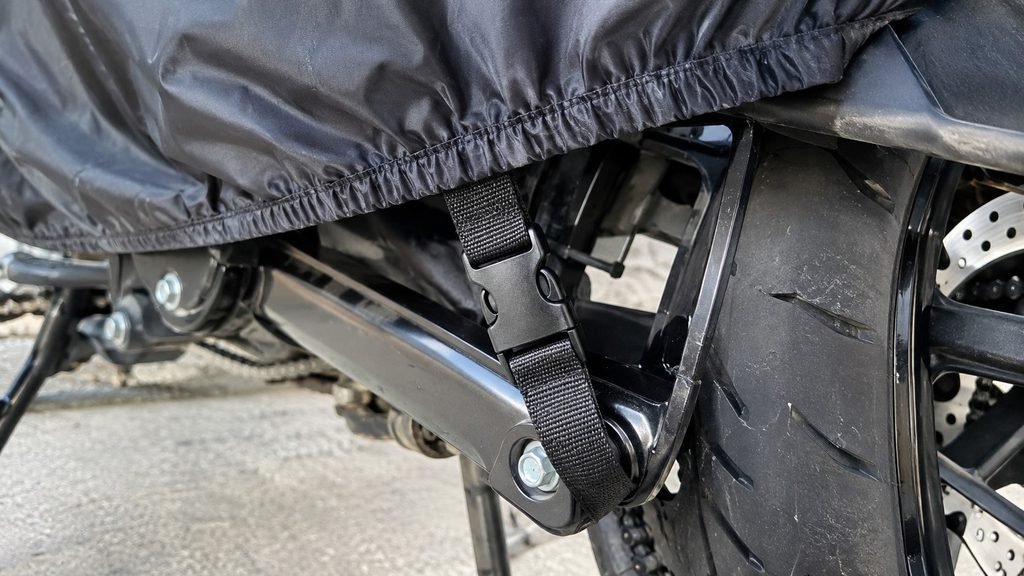
- Elastic hems. These grip the lower edges around the wheels and keep the cover from lifting.
- Windproof straps and buckles. Belly straps secure the cover under the bike and prevent wind from getting underneath.
- Lock holes. These let you secure the cover and bike together with a cable or chain.
- Vents. Vents let humid air escape so moisture doesn’t get trapped against the paint and metal.
- Soft inner lining. A smooth lining protects paint, mirrors, and clear plastics from scuffs.
- Reflective strips. These make a parked bike easier for drivers to see at night.
None of these features replaces the right size, but they make a well-sized cover work even better.
Fabric Still Matters, But Size Comes First
Fabric weight is worth considering once you’ve settled on a size. As we explained in our guide to the 210D vs 300D motorcycle cover, 210D is lighter and easier to handle, while 300D is thicker and better for long-term outdoor storage.
But thick fabric won’t make up for a bad fit. A well-fitted 210D cover will protect your bike better than a poorly fitted 300D cover every time. Get the size right first, then choose the fabric that matches your climate and parking situation.
Two Popular Covers to Consider
Once you know your measurements, you can shop with confidence. Here are two covers that many riders look at.
The ROWYEET 210D is a lightweight, affordable option with lock holes, a storage bag, and a night reflective design. It’s listed to fit bikes up to 96.5 inches, so it’s worth checking against your length measurement.

Want to see if the ROWYEET 210D fits your bike? Click the button below to check the current price and read real customer reviews on Amazon:
The EcoZoro 300D is a heavier-duty cover with windproof buckle straps, lock holes, reflective strips, and a storage bag. It’s also listed to fit up to 96.5 inches, and it suits bikes that sit outside for long stretches.
If your bike lives outdoors, a heavier-duty cover may be worth it. Click the link below to check the current price and read real customer reviews on Amazon:

Whichever you choose, compare the listed motorcycle cover size to your own measurements before you buy. Don’t assume it will fit just because the category sounds right.
Quick Checklist Before You Buy
Run through this list to confirm you’ve chosen the correct size:
- Measure the length, width, and height of your bike
- Include luggage, windshields, and other accessories in your numbers
- Compare your measurements to the manufacturer’s size chart, not just the S/M/L label
- Size up if you fall between two sizes
- Check for elastic hems, straps, and vents
- Read reviews from owners of bikes similar to yours
Final Thoughts
Choosing the right motorcycle cover size comes down to measuring carefully and trusting the numbers over the labels. Measure the length, width, and height of your bike with its accessories, then match those numbers to the manufacturer’s size chart. If you’re between sizes, go larger and rely on straps and elastic hems to keep things secure.
A cover that fits well stays in place, keeps out moisture and dust, and protects your paint instead of scuffing it. Get the size right, and you’ll get far more value out of whichever fabric and features you choose.