
I’ve crashed in gear rated CE Level 1, and I’ve crashed in gear rated CE Level 2. The difference showed up the next morning, not in the moment. Choosing between CE Level 1 vs Level 2 motorcycle armor isn’t a spec-sheet exercise — it’s a decision that shapes how your body absorbs the next hit, whether that’s a low-speed tip-over in a parking lot or a 60mph highside on track. Too many riders buy armor based on how thick it looks or how a jacket feels in the shop, and that’s a dangerous way to choose protection. Specifically, thickness tells you almost nothing about how much force actually reaches your body. What matters is the number behind the label: how many kiloNewtons of force get transmitted to your skin and bone on impact.
That number comes from CE — Conformité Européenne, the European conformity mark that certifies personal protective equipment sold across the EU and widely adopted as the global benchmark for motorcycle gear. In this guide, we’ll break down exactly what separates the two protection levels, translate the lab numbers into something you can actually feel, and walk through the armor we’ve tested and trust. By the end, you’ll know precisely which protection level fits your riding — commuting, touring, track days, or ADV — and why “more padding” isn’t the same thing as “more protection.”
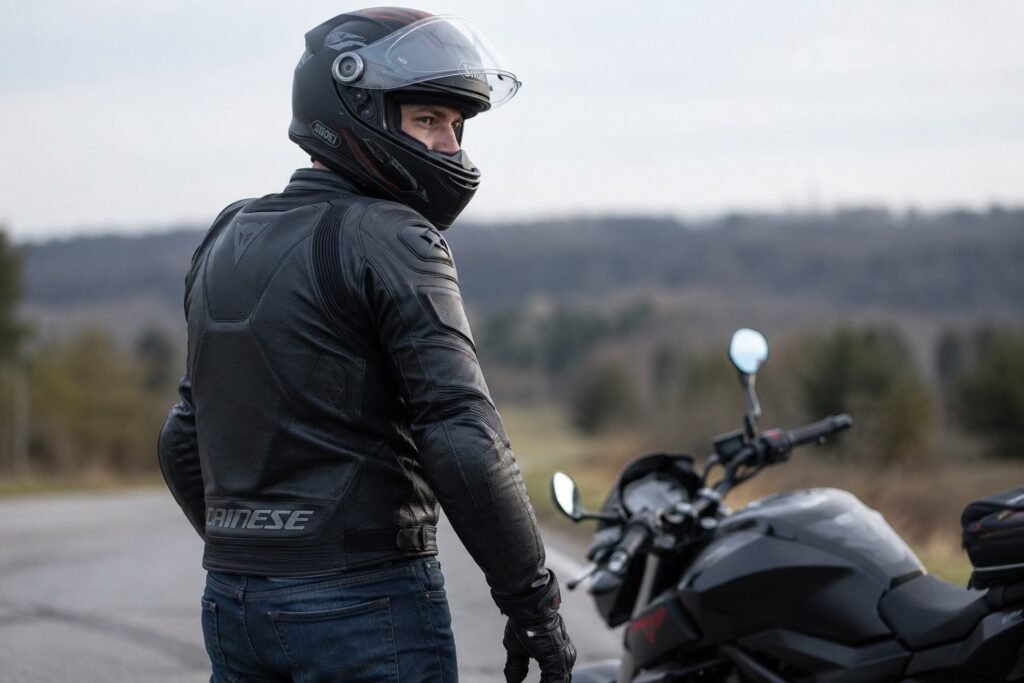
Motorcycle Armor Standards Explained: The Science Behind CE Level 1 vs Level 2 Motorcycle Armor
Every piece of certified motorcycle armor gets tested the same brutal way. A lab drops a 5kg weight from a set height so it strikes the armor with exactly 50 Joules of kinetic energy — think of a joule as a rough measure of “how hard something hits.” The weight lands on an anvil shaped like a hardened dome, mimicking the concentrated force of tarmac or a curb. Sensors underneath measure how much of that force actually punches through the armor into whatever sits below it. That transmitted force is what earns armor its rating.
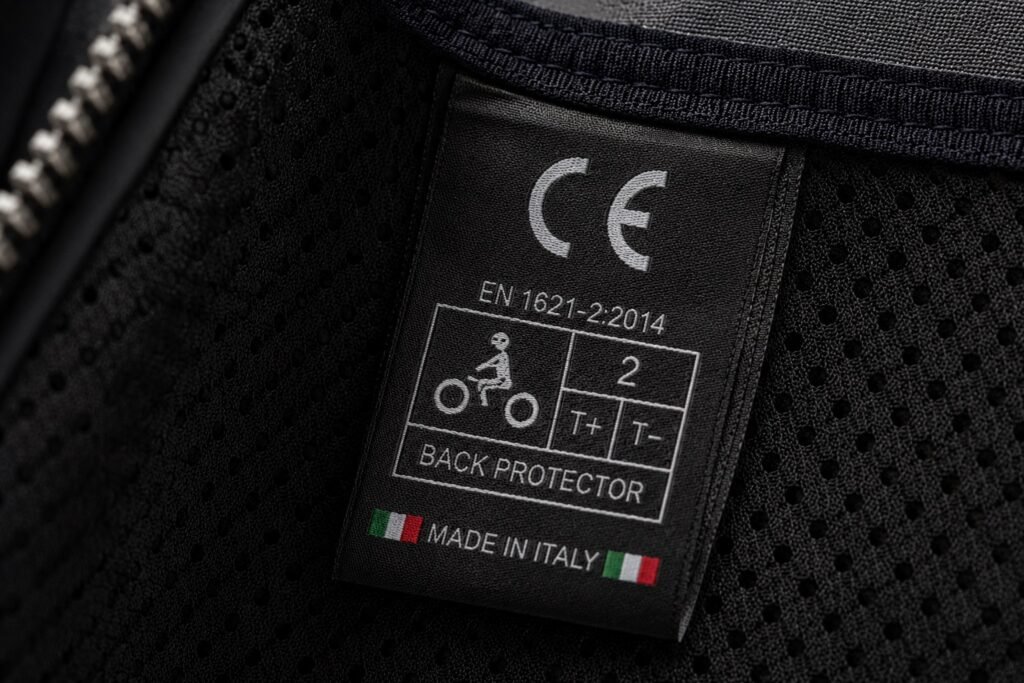
This is where motorcycle armor standards explained gets specific. EN 1621-1 covers limb armor — shoulders, elbows, hips, knees — and sets two thresholds. CE Level 1 armor must keep transmitted force under 35 kilonewtons (kN), and no single test result can exceed 50kN. CE Level 2 tightens that ceiling dramatically, capping transmitted force at 20kN. For back protectors, EN 1621-2 runs the same drop test with stricter numbers across the board: Level 1 allows up to 18kN, while Level 2 demands 9kN or less.
What Those kN Numbers Actually Feel Like
Here’s how to actually feel those numbers. Research on human bone fracture generally puts the threshold somewhere around 4 to 6kN for smaller bones under concentrated impact, though the real figure depends heavily on bone density, angle, and where the force lands. Consequently, even Level 1 armor, sitting at 35kN transmitted force, is nowhere close to “safe” in an absolute sense — it simply reduces catastrophic force to something survivable rather than something that guarantees zero injury. Level 2 armor cuts that transmitted force roughly in half again, which in a real crash can mean the difference between deep bruising and a fractured hip or spinal compression.
As a result, the CE rating isn’t a pass/fail badge — it’s a sliding scale of how much energy your body absorbs versus how much the armor eats first. Understanding that scale is the foundation for comparing CE Level 1 vs Level 2 motorcycle armor honestly, instead of relying on marketing language like “impact-rated” or “CE approved,” which technically applies to both levels and tells you nothing about which one you’re actually getting.
The Difference Between CE Level 1 and Level 2 Armor
Numbers aside, when we set CE Level 1 vs Level 2 motorcycle armor side-by-side, the difference comes down to three things: material, thickness, and how the armor behaves in the split second before impact. Here’s the comparison at a glance.
| Spec | CE Level 1 | CE Level 2 |
|---|---|---|
| Transmitted Force (limbs, EN 1621-1) | Under 35kN | Under 20kN |
| Transmitted Force (back, EN 1621-2) | Under 18kN | Under 9kN |
| Typical Thickness | 8–12mm | 10–15mm |
| Flexibility / Airflow | Generally more flexible, better ventilation | Historically stiffer, though modern materials close this gap |
| Weight | Lighter | Slightly heavier, though top materials minimize this |
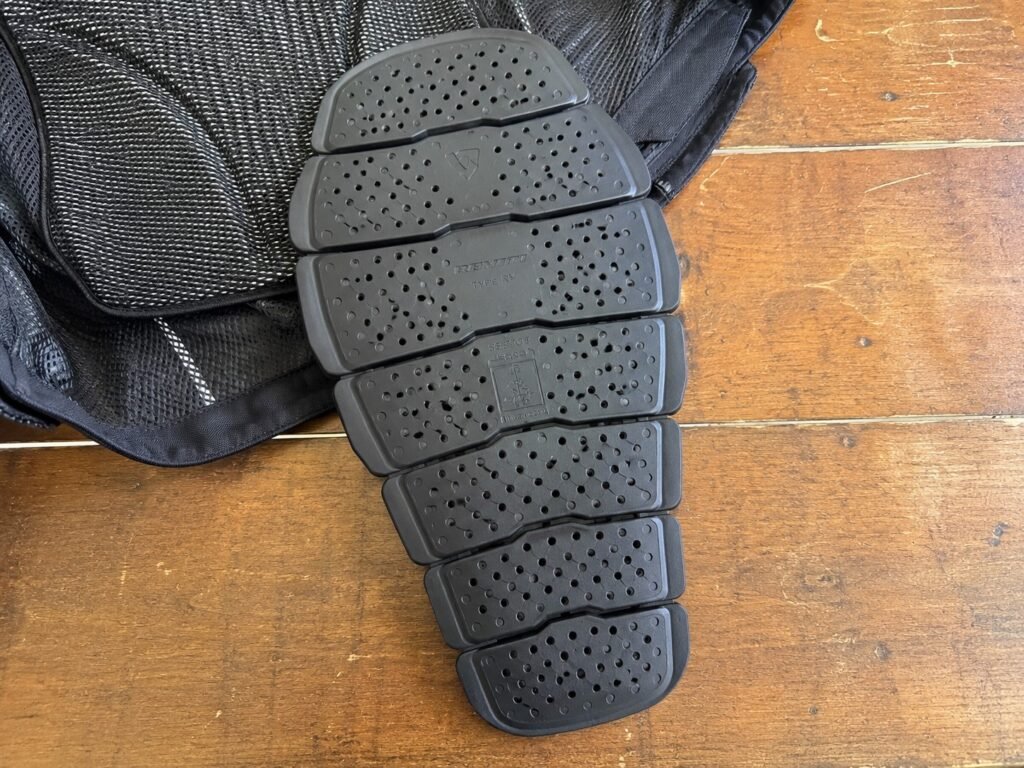
Thickness alone used to be a reliable shortcut — Level 2 armor was simply denser foam or harder plastic shells. That’s changed. Modern materials absorb more force without adding bulk, which is exactly why the difference between CE Level 1 and Level 2 armor has become less about size and more about engineering.
D3O, SAS-TEC, and the Materials Doing the Real Work
D3O and SAS-TEC lead that shift. Both use non-Newtonian materials — molecules that flow freely and stay soft under normal movement, then lock rigid the instant they’re struck with force. Ride all day and the armor moves with your elbow or spine; crash, and it hardens in milliseconds to spread and absorb the impact. Viscoflex works on a similar principle, using a viscoelastic gel-foam blend tuned for temperature stability. Traditional foam-and-plastic armor, by contrast, holds a fixed shape — it doesn’t adapt to the size or speed of the hit, so manufacturers compensate by making it thicker and stiffer to hit Level 2 numbers, which is exactly the trade-off that used to make Level 2 gear feel like wearing a hardback book down your spine.
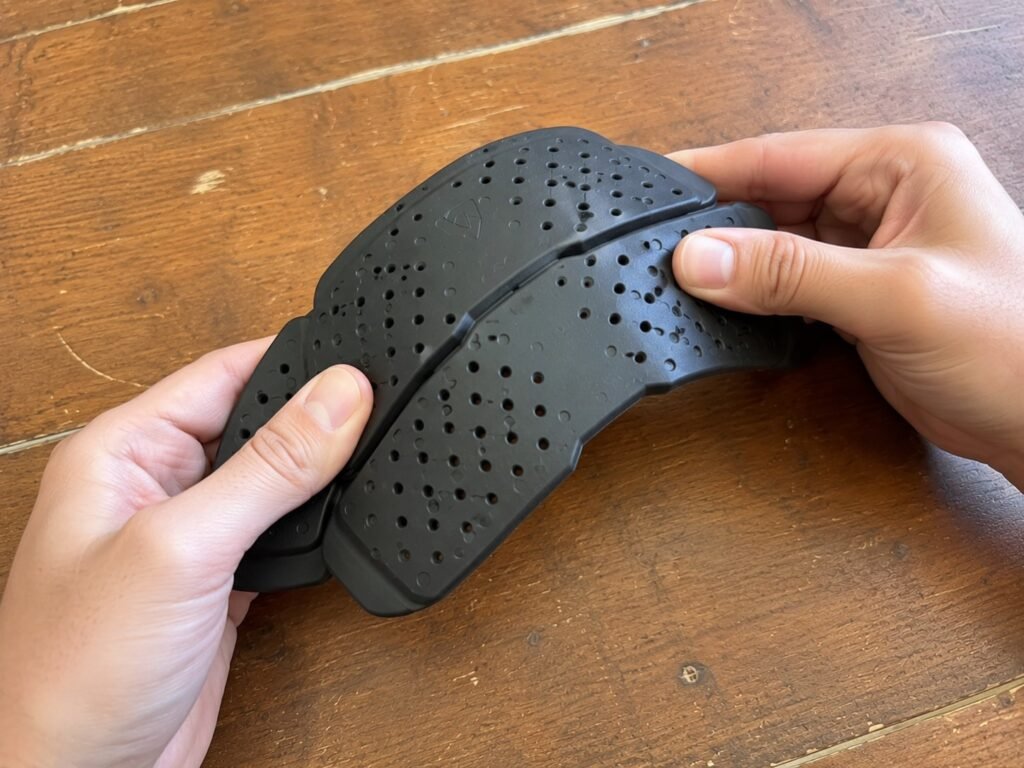
Thermal stability separates the good materials from the average ones, too. Non-Newtonian armor needs to lock up reliably whether you’re riding in 40°F morning fog or 100°F desert heat, and cheaper foam blends can get noticeably stiffer in cold weather — or softer, and less protective, when it’s baked on hot asphalt all day. That’s why the T+ and T- temperature ratings on premium armor matter more than most riders realize; they’re a proxy for how consistent that protection stays across real riding conditions, not lab conditions.
Ultimately, when you compare CE Level 1 vs Level 2 motorcycle armor side by side, you’re weighing a meaningful jump in force reduction against a smaller — but real — cost in flexibility and weight. The gap has narrowed enough that for most riders, it’s no longer much of a trade-off at all.
Product Showcases: Market Leaders Compared
We’ve worn, crashed in, and swapped out enough back protectors to have real opinions here, not just spec-sheet comparisons.
Alpinestars Nucleon Plasma Back Protector Insert is a CE Level 2 insert built from a bio-based, perforated foam that stays remarkably flexible for something this protective, and its low-profile shape slides into nearly any jacket or vest pocket without adding bulk under a backpack. Airflow is genuinely good for a Level 2 piece, which matters if you commute in heat. It’s worth checking current pricing before your next ride.
Klim D3O Viper Stealth Level 2 Back Protector uses D3O’s non-Newtonian material in a universal-fit shape designed to work across multiple jacket brands, not just Klim’s own gear. It stays pliable enough to forget you’re wearing it on a long tour, then locks rigid on impact — the kind of protection that disappears until you need it. If you split time between touring and commuting, this one’s worth a look before you head out.
Dainese Pro-Armor G2 2.0 Back Protector takes a different approach with a fractal, segmented design built from carbo-elastomer plates that flex independently, so the armor follows your spine’s movement instead of fighting it. Roughly 43% of the surface is perforated, which noticeably improves airflow on hot track days without sacrificing the Level 2 rating. Track-day riders in particular tend to gravitate toward this one, and it’s worth checking availability before your next session.
Each of these hits CE Level 2 numbers, yet none of them feel like the stiff, bulky Level 2 armor from a decade ago — proof that the gap in comparing CE Level 1 vs Level 2 motorcycle armor has as much to do with material science as it does with raw thickness.
Is CE Level 2 Armor Worth It? The Real-World Verdict
This is the question that actually matters, and the honest answer is: it depends on how and where you ride.
For city commuters doing short, low-speed trips, CE Level 1 armor is a legitimate, safe choice. Crashes in stop-and-go traffic tend to happen at lower speeds, and comfortable CE Level 2 motorcycle armor, while better, adds cost and sometimes bulk that isn’t always necessary for a five-mile ride to work. That said, if your commute includes any highway riding, the calculus shifts toward Level 2 fast.
Tourers should lean Level 2, especially for back protection. Long days in the saddle mean more hours of exposure, more miles at higher average speeds, and — statistically — more opportunity for something to go wrong on unfamiliar roads. The good news is that modern materials mean comfortable CE Level 2 motorcycle armor no longer means sacrificing all-day wearability the way it did with older foam-and-plastic designs.
Track day riders shouldn’t even consider Level 1 a serious option. Speeds are higher, impacts are harder, and the entire point of a track day is pushing closer to the limit — which is precisely when transmitted force numbers matter most. When we weigh CE Level 1 vs Level 2 motorcycle armor for track riders specifically, Level 2 back protectors and limb armor are close to non-negotiable.
ADV and off-road riders sit in an interesting middle ground. Speeds can be lower than track riding, but impacts often involve rocks, ruts, and unpredictable terrain rather than flat tarmac, so Level 2 armor’s extra force reduction is worth the marginal weight penalty. As a result, when we’re asked point-blank whether CE Level 2 armor is worth it, our answer is almost always yes — the remaining question is just which jacket or pants let you wear it comfortably.
Critical Buyer’s Guide & Fit Framework
Fit determines whether armor works at all, regardless of its CE rating. Spinal protectors come in two basic shapes: Type CB (central back), which covers the spine only, and Type FB (full back), which extends over the kidneys and shoulder blades for broader coverage. If you’re shopping for the best CE Level 2 back protector insert, start with shape — a protector that shifts or rides up in a crash isn’t doing its job, no matter how good its lab numbers look.
One more distinction trips up a lot of buyers: EN 1621 measures impact protection, while EN 17092 measures abrasion resistance and rates garments AAA, AA, or A. These aren’t competing standards — they’re measuring completely different things, and a jacket can carry both an EN 17092 abrasion rating and an EN 1621 armor rating without one telling you anything about the other. Whichever way you land on CE Level 1 vs Level 2 motorcycle armor, fit is what makes it actually work in a crash.
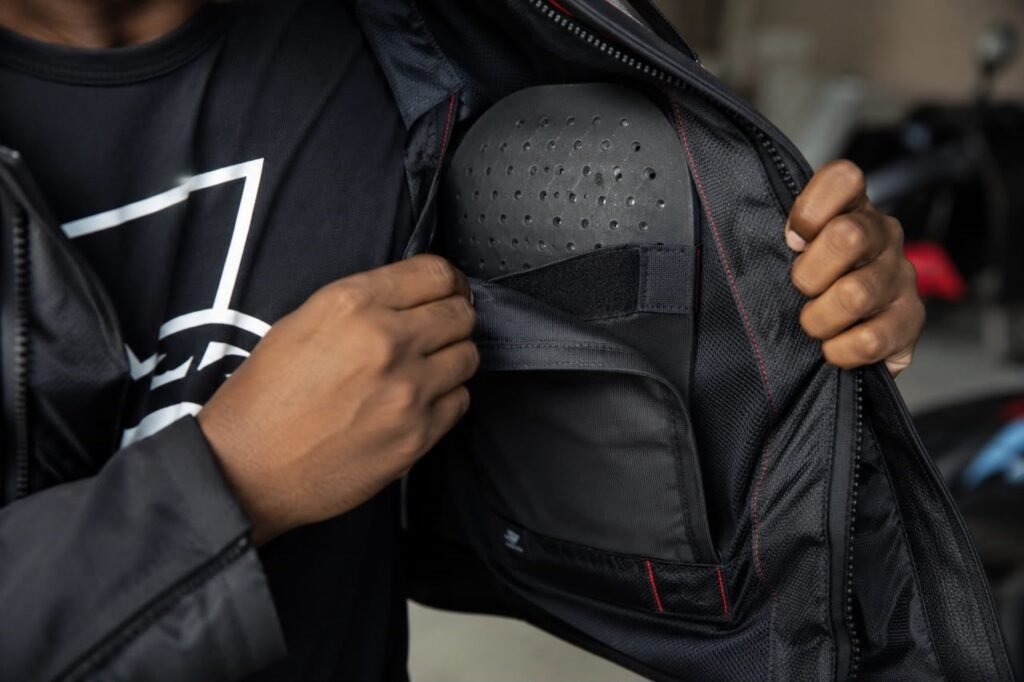
Before you buy, check these:
- Confirm the protector’s shape (CB or FB) matches your jacket or vest’s pocket
- Measure your jacket’s armor pocket dimensions before ordering a universal insert
- Look for T+ and T- ratings, which confirm performance across hot and cold conditions
- Verify the CE level printed on the armor itself, not just the jacket’s marketing copy
- Replace any armor that’s been through a significant impact, even if it looks fine
The Verdict on CE Level 1 vs Level 2 Motorcycle Armor
After years of testing gear on track, on tour, and on the commute, our take is simple: CE Level 1 vs Level 2 motorcycle armor isn’t a debate about which one is “real” protection — both are certified, both work. Conversely, if your budget and jacket pockets allow it, Level 2 is the safer default in nearly every riding scenario we’ve covered here.
Buy CE Level 1 vs Level 2 motorcycle armor based on the numbers, not the thickness you can see or feel in a shop. Check the CE level tag, match the shape to your gear, and choose materials — D3O, SAS-TEC, Viscoflex — that stay comfortable enough that you’ll actually wear them every ride. That’s ultimately the best armor: not the one with the lowest lab number, but the one you’ll have on the day you need it.