
A no-nonsense technical breakdown for real riders — from track racers to vintage collectors
By Chris Mchenga — May 2026 · 12 min read
Introduction: 60% Lighter. But Is That the Whole Story?
Here’s a number that gets riders excited: up to 60% less weight compared to a traditional AGM battery. On a sport bike, that’s not just a spec on a sheet — it’s a meaningful reduction in unsprung weight and rotational mass that you can actually feel through a corner. If that sounds like marketing language, it’s because for a long time, it was. But in 2026, the lithium vs lead-acid motorcycle battery debate has shifted significantly, and the performance gap that once made these batteries an enthusiast-only purchase has largely closed.
That said, AGM lead-acid batteries haven’t exactly been sitting around feeling sorry for themselves. They’re still cheaper upfront, they work flawlessly with every charging system ever bolted to a motorcycle, and they don’t need a warm-up procedure after sitting all winter. For a lot of riders, that’s the whole conversation right there.
This guide covers everything you need to know about the lithium vs lead-acid motorcycle battery decision — and tells you which choice actually makes sense for your specific situation. Because the best battery for a retired Triumph Bonneville owner is not the same answer as the best battery for someone who races a Kawasaki ZX-6R on weekends.
Bottom line upfront: For most riders buying or maintaining a modern motorcycle in 2026, lithium is the smarter long-term investment. But there are three clear cases where AGM is still the right answer — and we’ll tell you exactly what those are.
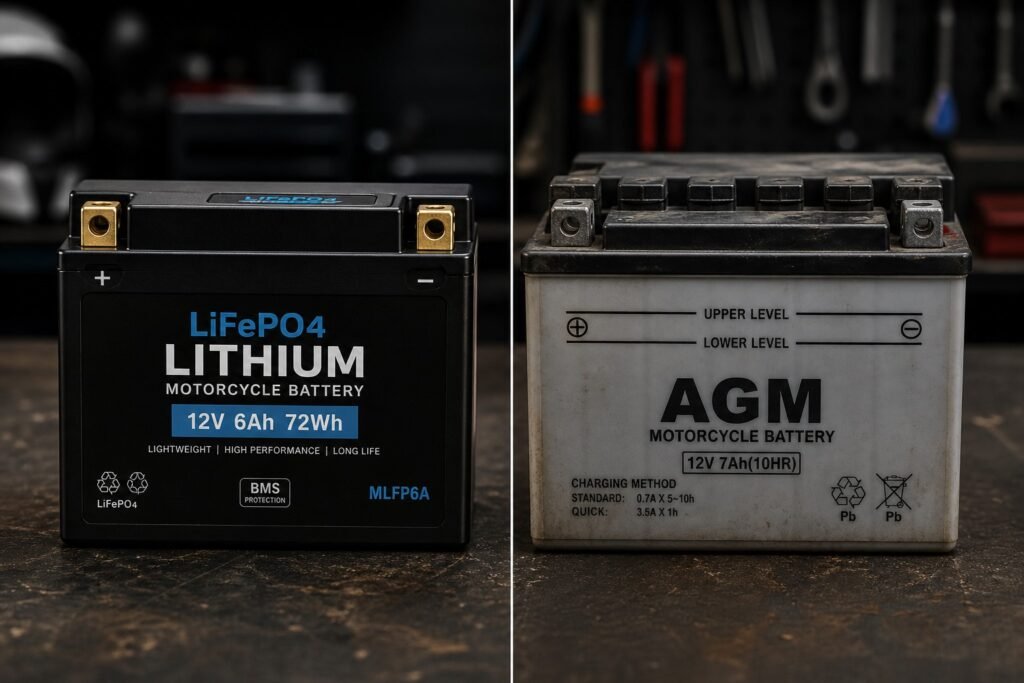
The Technical Breakdown: Lithium vs Lead-Acid Motorcycle Battery Specifications Compared
Before diving into the numbers, understanding what you’re actually comparing in a lithium vs lead-acid motorcycle battery matchup starts with the chemistry — because the labels matter more than most riders realize.
When people say “lithium motorcycle battery,” they almost always mean Lithium Iron Phosphate — abbreviated as LiFePO4 — not the lithium cobalt chemistry found in your laptop or smartphone. LiFePO4 is chosen specifically for its thermal stability and safety profile. It doesn’t go into thermal runaway the way other lithium chemistries can, which matters enormously when the battery is sitting six inches from your fuel tank.
AGM, which stands for Absorbed Glass Mat, is the modern evolution of the old flooded lead-acid battery. The electrolyte is suspended in a fiberglass mat, making it spill-proof, vibration-resistant, and maintenance-free. GEL batteries follow a similar sealed design but use a gel electrolyte instead. Both are reliable, widely compatible, and well-understood by every mechanic on the planet — and that familiarity counts for something.
Here’s how the two technologies compare on the specifications that actually matter to a rider:
| Specification | LiFePO4 (Lithium) | Lead-Acid (AGM/Gel) |
|---|---|---|
| Weight (typical) | 1–3 lbs | 8–18 lbs |
| Life Cycles | 2,000+ cycles | 300–500 cycles |
| Cold Cranking Amps (CCA) | 150–400 CCA* | 200–400 CCA |
| Self-Discharge Rate | ~1–2% per month | ~5–15% per month |
| Charging Voltage | 14.4–14.6V | 14.4–14.8V |
| Usable Capacity | ~95% | ~50–60% |
| Average Lifespan | 6–10 years | 2–4 years |
| Upfront Cost | $80–$250 | $40–$120 |
| Cost Per Year (avg) | $20–$35 | $30–$60 |
| Cold Weather Performance | Good (2026 BMS)* | Excellent |
| Vibration Resistance | Excellent | Good |
| Maintenance | None |

The “Cold Start Myth”: What’s Actually Changed in 2026

The cold-start objection was the single biggest argument against choosing lithium in the lithium vs lead-acid motorcycle battery conversation five years ago — and it was a valid one. Early lithium motorcycle batteries had a real and legitimate problem: lithium cells don’t like delivering high current at low temperatures. Park a bike with an older lithium battery in a 20°F garage overnight, and you might come back in the morning to a battery that simply refused to crank.
Here’s what’s changed: modern LiFePO4 batteries from quality manufacturers now include intelligent Battery Management Systems with built-in self-heating circuits. The battery essentially warms itself up before attempting to deliver cranking current. In practice, this means a 5 to 15 second wait after switching on the ignition before you hit the starter — a minor inconvenience at worst, and one that most riders stop noticing after the first week.
In real-world testing, quality 2026 lithium batteries have demonstrated reliable cold-cranking performance down to approximately 14°F (-10°C), with premium units claiming operation down to -4°F (-20°C). That covers the vast majority of riding conditions in temperate climates.
The honest caveat: if you live somewhere that regularly sees temperatures below -10°C and you’re riding year-round, a quality AGM battery remains the more reliable cold-weather choice. For everyone else, the old cold-start objection is largely obsolete. It’s the kind of criticism that was perfectly valid in 2019 and just hasn’t caught up to where the technology actually is today.
Pro tip: If you’ve purchased a lithium battery and it’s been sitting unused all winter, some units require a “wake-up” charge cycle before the first use of the season. Check your manufacturer’s documentation. It’s a 10-minute process, not a problem.
Charging, Safety, and the BMS: What You Actually Need to Know
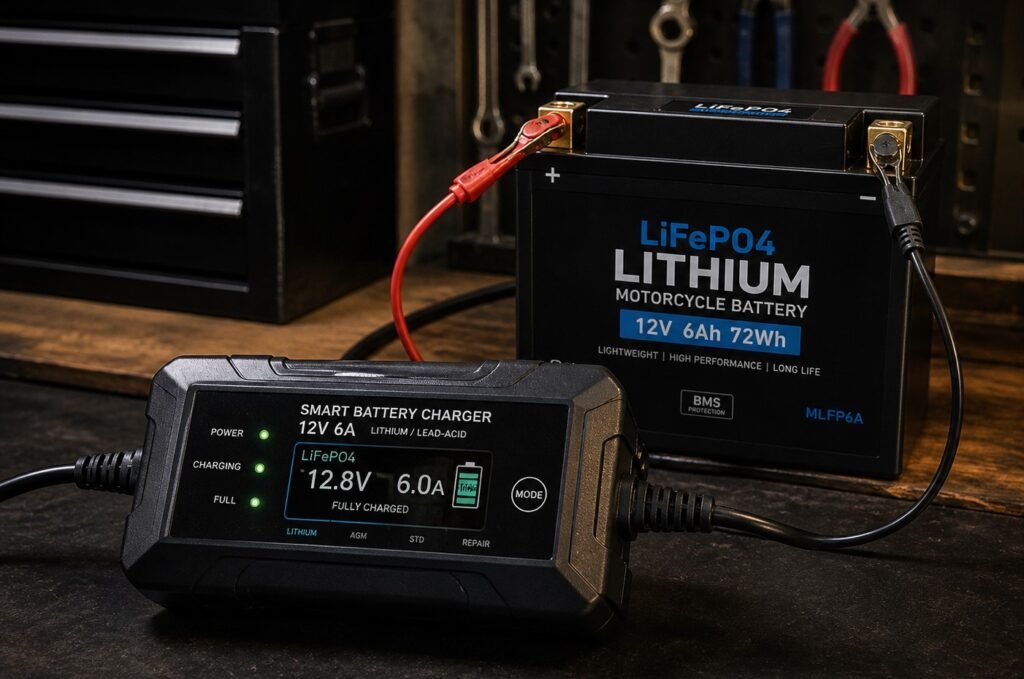
Can You Use a Lead-Acid Charger on a Lithium Motorcycle Battery?
This is one of the most-searched questions in the category, and the answer requires a little nuance. The short answer is: sometimes, with caution. The honest answer is: just buy the right charger.
The issue is desulfation mode. Many lead-acid battery chargers include a pulse or desulfation function designed to break down lead sulfate crystals that form on aging AGM plates. This mode sends voltage spikes well above 15 volts — sometimes to 16 volts or higher. LiFePO4 cells have a maximum safe charging voltage of around 14.6 volts. Exceed that repeatedly, and you’ll degrade the battery, void the warranty, or trigger a BMS protection shutdown that leaves you scratching your head wondering why your brand-new battery won’t charge.
Standard constant-current/constant-voltage chargers without desulfation mode are generally safe for lithium batteries, provided the voltage cutoff is configured correctly. Smart chargers with a dedicated lithium or LiFePO4 mode — from brands like NOCO, Optimate, or Battery Tender — are the proper tool for the job, and they typically cost between $30 and $60. That’s a reasonable insurance policy on a $150 battery.
The BMS: Your Battery’s Internal Bodyguard
The Battery Management System is the electronic brain inside every quality LiFePO4 battery. It monitors cell voltages, temperatures, and current flow in real time. It will disconnect the battery from the circuit if any parameter goes outside safe limits — protecting against overcharge, over-discharge, short circuit, and extreme temperatures.
This is exactly why cheap, no-name lithium batteries are a genuine safety risk. It’s not the lithium cells themselves that are inherently dangerous — it’s the absence of a properly designed BMS. When you’re looking at a $40 lithium battery on an unfamiliar website, you have to ask yourself: where did they cut the cost? The answer is almost always the BMS.
Compatibility with Older Motorcycle Charging Systems
Older motorcycles — particularly anything built before 2000 — may have unregulated or poorly regulated charging systems that allow voltage spikes above 15 volts under certain operating conditions. This is hard on any battery, but lithium units are less forgiving than lead-acid when it comes to overvoltage.
If you’re retrofitting a lithium battery into a vintage or classic bike, have the charging system tested first. It’s a straightforward diagnostic, and it could save you a $200 battery replacement six months later. As a general rule, if your charging system consistently stays between 13.8 and 14.8 volts at 3,000 RPM, you’re in the clear. If it wanders outside that range, fix the charging system before you upgrade the battery.
Financial Reality: Cost Per Year, Not Sticker Price
The number one mistake riders make when approaching the lithium vs lead-acid motorcycle battery comparison is looking at the purchase price and stopping there. A $70 AGM battery sounds much better than a $150 lithium unit — until you run the numbers across a realistic ownership period.
| Specification | LiFePO4 (Lithium) | Lead-Acid (AGM) |
|---|---|---|
| Upfront Cost | $150 (avg) | $70 (avg) |
| Expected Lifespan | 7 years | 2.5 years |
| Replacements Needed (10 years) | ~1.5x | ~4x |
| Total 10-Year Cost | ~$225 | ~$280 |
| Cost Per Year | ~$22.50 | ~$28 |
The math is straightforward: lithium wins on cost-per-year for riders who keep their bikes long-term. The crossover point typically hits around year three — after that, you’re in free territory compared to the AGM owner who’s already bought their second battery.
There’s one additional financial consideration that rarely gets mentioned: a lithium battery adds genuine resale value when selling a bike. A two-year-old motorcycle listed as “still on its original lithium battery” is a real selling point to an informed buyer. A two-year-old AGM just means the next owner will probably need to replace it soon.
Important note: These are average figures based on typical usage patterns. A rider putting 20,000 miles per year on a bike will see different numbers than someone who parks for five months every winter. The principle holds, but the exact math will vary.
Verdict by Rider Type: Where Does the Lithium vs Lead-Acid Motorcycle Battery Debate Actually Land?
So where does the lithium vs lead-acid motorcycle battery debate actually land when you match it to real riding situations? The answer, as with most things in motorcycling, depends entirely on who you are and how you ride.
The Track Racer

Recommendation: Lithium. Not even a close call.
Weight is performance on a track. Every pound removed from a motorcycle — especially rotating and unsprung mass — translates to faster acceleration, better handling, and reduced fatigue on a technical circuit. A quality LiFePO4 battery can save 10 to 15 pounds compared to an OEM AGM, and that weight comes off in the middle of the chassis where it matters most.
Track bikes also tend to sit in heated paddock environments between sessions, which eliminates the cold-weather concern entirely. And modern track-specification lithium batteries are designed for high-discharge scenarios — they can deliver enormous current on demand without the voltage sag you’d see from a lead-acid unit under the same load. If you’re building a proper track weapon and you’re still running an AGM, that’s the easiest performance upgrade you haven’t made yet.
The Daily Commuter
Recommendation: Lithium, with one quick check first.
Daily riders put consistent charge cycles on their batteries — which is exactly what lithium loves. Unlike lead-acid batteries, which prefer to be kept at full charge and don’t enjoy deep discharge cycles, LiFePO4 chemistry handles partial-state-of-charge cycling very well. A commuter bike that gets started twice a day, five days a week, is actually an ideal use case for lithium technology.
The one caveat is the charging system check mentioned in the previous section. If you’re riding a modern bike — 2005 and newer, in most cases — you’re almost certainly fine. If you’re commuting on an older carbureted machine with a stock charging system, spend 10 minutes doing a voltage check before you spend $150. That’s the only hoop you need to jump through.

The Vintage Collector
Recommendation: AGM, probably — but read this before deciding.
This is where we have to be genuinely honest: vintage bikes and lithium batteries can be a problematic combination. Not because lithium is dangerous in these applications, but because the compatibility issues are more likely to be real, and for many vintage owners, the economics of upgrading simply don’t add up.
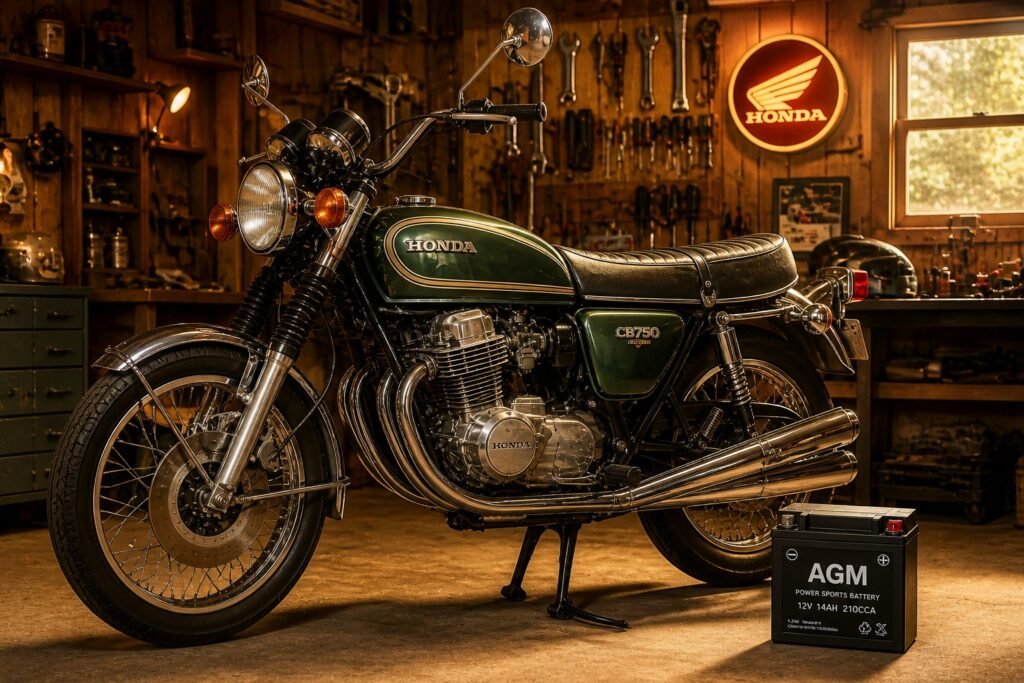
A 1975 BMW R90S, a 1968 BSA Lightning, a 1982 Kawasaki KZ1000 — these machines have charging systems that were never designed with lithium chemistry in mind. Some have unregulated magneto systems. Others have rectifiers that allow significant voltage spikes under load. And many have electrical systems that are already, let’s say, creative in their interpretation of the original wiring diagram.
For a bike that comes out four times a year for a Sunday ride and a show, the AGM is perfectly adequate for the job. It sits on a tender, it cranks reliably when you need it, and it costs $60. There is no compelling argument to upgrade.
The exception: if you’re riding a vintage bike regularly and you’ve had the charging system professionally rebuilt or upgraded to a modern solid-state regulator/rectifier, lithium becomes a genuinely viable option. In that scenario, the weight savings on an older, heavier machine are very welcome — and the long service life starts to make real financial sense.
Frequently Asked Questions
Can I use a lead-acid charger on a lithium motorcycle battery?
It depends on the charger. Standard constant-current/constant-voltage chargers without desulfation mode are generally safe if the voltage cutoff is set at or below 14.6 volts. However, chargers with desulfation or battery recovery modes can send voltage spikes that exceed safe lithium charging limits and should never be used on a lithium battery. The safest approach is a charger with a dedicated LiFePO4 mode — widely available for $30 to $60 — which protects your battery investment properly.
What does a real cost-benefit analysis of a lithium vs lead-acid motorcycle battery look like over time?
Over a 10-year ownership period, lithium typically costs around $22 to $35 per year compared to $30 to $60 per year for AGM, once you account for how often each battery needs to be replaced. The lithium battery pays back its price premium over AGM at approximately the three-year mark. For riders who keep their bikes for five or more years, lithium is the economically superior choice in almost every scenario. Short-term owners or riders who frequently buy and sell bikes may not see the full financial benefit.
Are lithium batteries compatible with older motorcycle charging systems?
Not always, and not without checking first. Older bikes — generally those built before 2000 — may have unregulated or poorly regulated charging systems that allow voltage spikes above 15 volts. LiFePO4 batteries have a maximum safe charging voltage of approximately 14.6 volts. If the charging system regularly exceeds this, the BMS will intervene repeatedly, shortening the battery’s lifespan significantly. A voltage measurement at 3,000 RPM tells you everything you need to know: 13.8 to 14.8 volts is safe; anything consistently above 15 volts means the charging system needs attention before you retrofit a lithium battery.
What should I look for when buying a lithium motorcycle battery?
Four things: a quality BMS with thermal protection, a self-heating function if you ride in cold climates, a CCA rating appropriate for your engine’s displacement, and a manufacturer’s warranty of at least two years. Reputable brands include Antigravity, Shorai, Ballistic, and Lithium Pros, among others. Avoid unbranded units that don’t explicitly list BMS specifications — that’s almost always where the corners have been cut, and a poorly designed lithium battery is not a bargain at any price.
Published 2026. Always verify specifications with the battery manufacturer for your specific motorcycle application.