
Riders drop $600 on a slip-on exhaust, $300 on hand grips, and $150 on bar-end mirrors—then run the same degraded fork oil they haven’t touched in four years. That fluid is the only thing calibrating how your front wheel tracks pavement, absorbs mid-corner bumps, and resists brake dive. Choosing the best fork oil for motorcycle suspension isn’t glamorous, but it’s arguably the highest-return maintenance decision you can make for under $20. Get it wrong and no amount of preload adjustment or compression clicker tweaking will save you.
How to Choose Motorcycle Fork Oil Weight
Here’s where most riders go wrong: they see “10W” on two different bottles and assume they’re buying the same product. They’re not. Not even close.
Fork oil viscosity is measured in centistokes (cSt) at 40°C—a standardized laboratory measurement that reflects how the fluid actually flows under operating conditions. A “10W” from Maxima Racing Fluids measures around 22–24 cSt at 40°C. A “10W” from a budget house brand might clock in at 15 cSt. That’s a massive difference in real damping behavior, and neither bottle tells you this on the label.
So why does this matter to you? Because your fork’s shim stack, needle valves, and damping rod orifices are calibrated to a specific flow rate. When you pour in a fluid that flows 35% faster than intended, you’ve effectively removed compression damping from the equation. The fork dives under braking, the front tire loses feedback on corner entry, and you start wondering if you need stiffer springs—when the real problem is fluid that’s too thin.
The Viscosity Index (VI) compounds this further. VI measures how dramatically a fluid’s viscosity changes across a temperature range. A low-VI oil—say, VI 90—gets noticeably thinner as your forks heat up during aggressive riding. A high-VI synthetic might hold VI 150 or above, meaning it stays close to its rated cSt even when the legs are running hot. For street riders doing long canyon runs, or track riders logging multiple sessions, fluid stability isn’t a luxury—it’s what keeps lap-one handling identical to lap-ten handling.
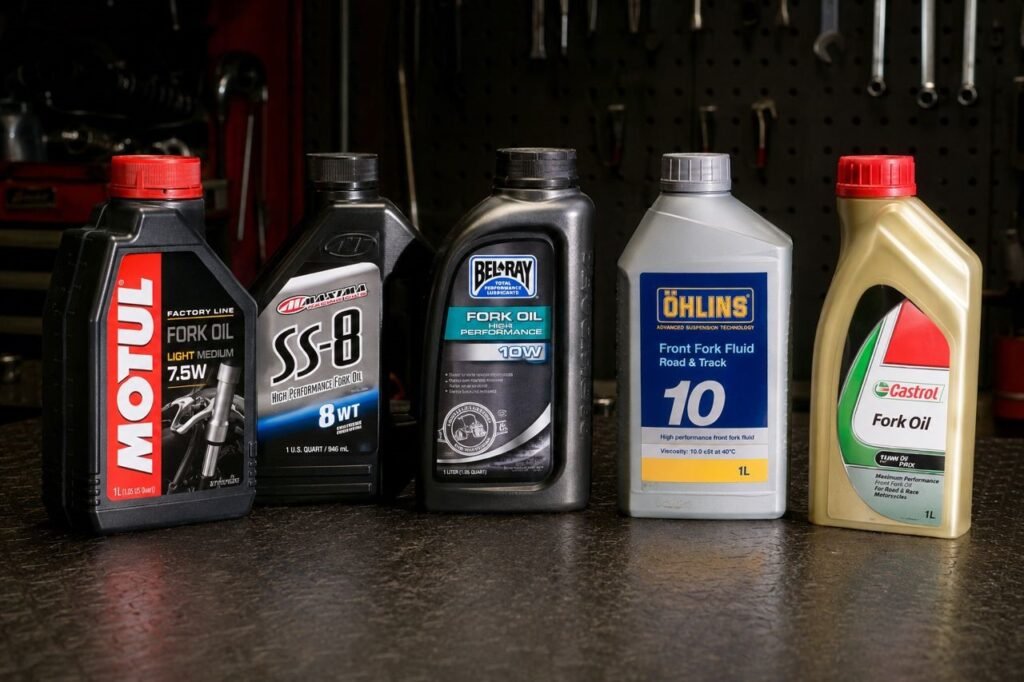
The bottom line on how to choose motorcycle fork oil weight: don’t shop by the number on the label. Look for published cSt at 40°C data. Reputable brands—Ohlins, Motul, Bel-Ray—publish this in their technical data sheets. If a brand doesn’t, that tells you something.
Synthetic vs Mineral Fork Oil Motorcycle
The base stock of your fork oil determines everything downstream. Mineral oils are refined from crude petroleum. They’re inexpensive, widely available, and work perfectly fine in standard damping rod forks running moderate temperatures. But they carry two structural weaknesses: shear instability and thermal breakdown.
Shear stability describes a fluid’s resistance to having its polymer chains physically torn apart by repeated high-speed mechanical action—exactly what happens inside a cartridge fork at 9,000 rpm on a twisty road. Mineral oils shear degrade faster, meaning their actual viscosity drifts downward over time even before the service interval arrives. You set your clickers for a 15 cSt fluid and end up running something closer to 12 cSt six months later.
Fully synthetic fork oils, built on PAO (polyalphaolefin) or ester base stocks, resist shear far more effectively. They also handle thermal cycling better—expanding and contracting more predictably as temperature swings occur—which directly protects your fork seals. A mineral oil that thermally breaks down will start attacking the nitrile and polyurethane in your wiper seals. Seal swell properties matter here: a good synthetic is formulated to be seal-neutral or produce minimal controlled swell, keeping seals pliable without causing leaks.
The trade-off? Synthetic costs two to four times more per fill. But given that a fork seal replacement runs $80–$150 in labor and parts, the math favors synthetic for any bike ridden regularly. Semi-synthetic blends split the difference and make sense for casual street riders who change oil on schedule.
Fork Oil Brand Comparison
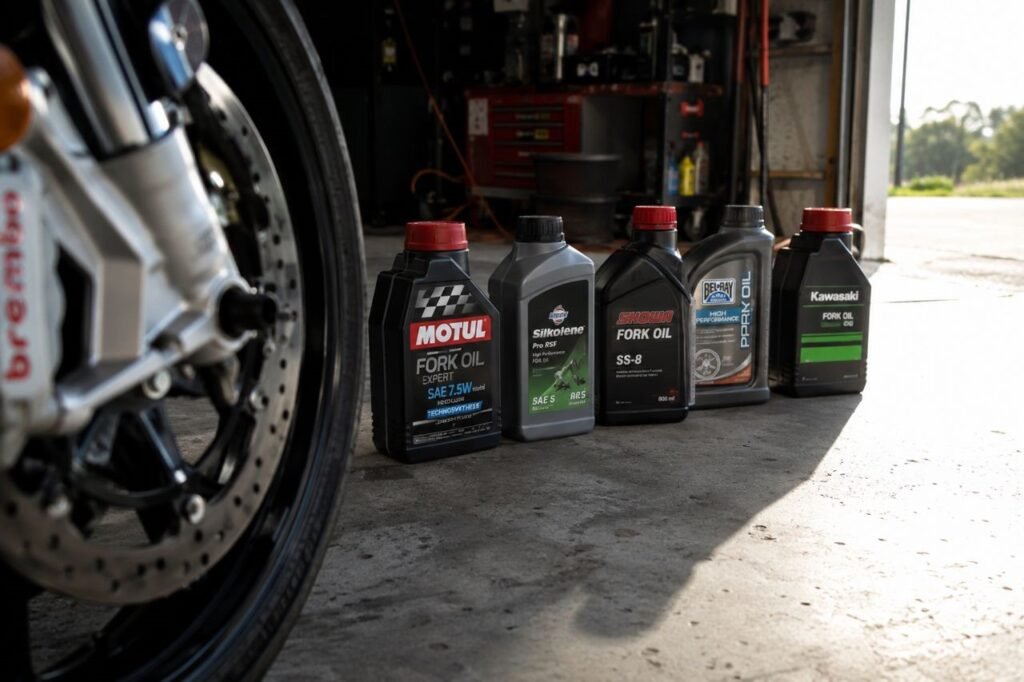
| Brand & Product | Stated Weight | Actual Viscosity at 40°C (cSt) | Viscosity Index (VI) | Best Real-World Application |
|---|---|---|---|---|
| Motul Fork Oil Factory Line | 10W | 23.4 cSt | 152 | Street & light track, cartridge forks |
| Maxima Racing Fluid SS8 | 10W (light) | 22.1 cSt | 144 | Dirt bikes, MX, fast-rebound applications |
| Bel-Ray HVI Fork Oil | 7.5W | 18.8 cSt | 161 | Supermoto, trail, mixed-surface street |
| Ohlins Fork Oil | 10W | 24.0 cSt | 150 | Precision track use, Ohlins cartridge units |
| Castrol Fork Oil | 10W | 21.5 cSt | 138 | Budget street applications, standard forks |
Note: cSt figures sourced from published brand TDS documents. Always verify against the current data sheet for the specific product variant you purchase, as formulations do change.
Best 10W Fork Oil for Street Bike
The 10W class is the sweet spot for most street-oriented motorcycles—from naked standards to sport-tourers to middleweight naked bikes. It delivers enough damping authority to control brake dive under hard stops while remaining compliant enough on broken tarmac to keep the tire in contact with irregular surfaces.

For street riding, anti-foaming performance matters more than most riders realize. Every compression stroke forces air past the oil surface. A fluid with poor anti-foam additives generates micro-bubbles that temporarily compress inside the cartridge, producing that spongy, inconsistent feel mid-corner. Motul’s Factory Line 10W earns its reputation here—its additive package includes robust anti-foam inhibitors, and its VI of 152 means a cold morning start-up produces noticeably less stiction than mineral alternatives.
Longevity is the other street-specific priority. Most street riders change fork oil annually at best. So the fluid needs to resist oxidation, maintain shear stability, and protect seals for 10,000–15,000 miles of mixed conditions. Bel-Ray HVI holds up exceptionally well over extended intervals, thanks to a high-VI ester blend that resists oxidative breakdown even when the forks are cooking in summer stop-and-go traffic. For a rider who changes oil once a year and covers mixed urban and highway miles, Bel-Ray represents the best fork oil for motorcycle suspension in the street category.
Best Fork Oil for Dirt Bike Tracks
MX and enduro riding punishes fork oil in ways street riding never approaches. The fork is fully cycling at high speed—often 100+ full strokes per minute on a rough MX track—while simultaneously dealing with aggressive aeration from the open bath around a damping rod. Heat spikes are brief but extreme. Rebound speed is everything: a fork that returns too slowly after a compression means the next hit catches the suspension still mid-stroke, and the bike starts bucking.
The best fork oil for dirt bike tracks prioritizes three things above all else: rapid stroke recovery, aeration resistance, and anti-friction additives that reduce stiction so the fork initiates movement without hesitation on small chatter bumps.
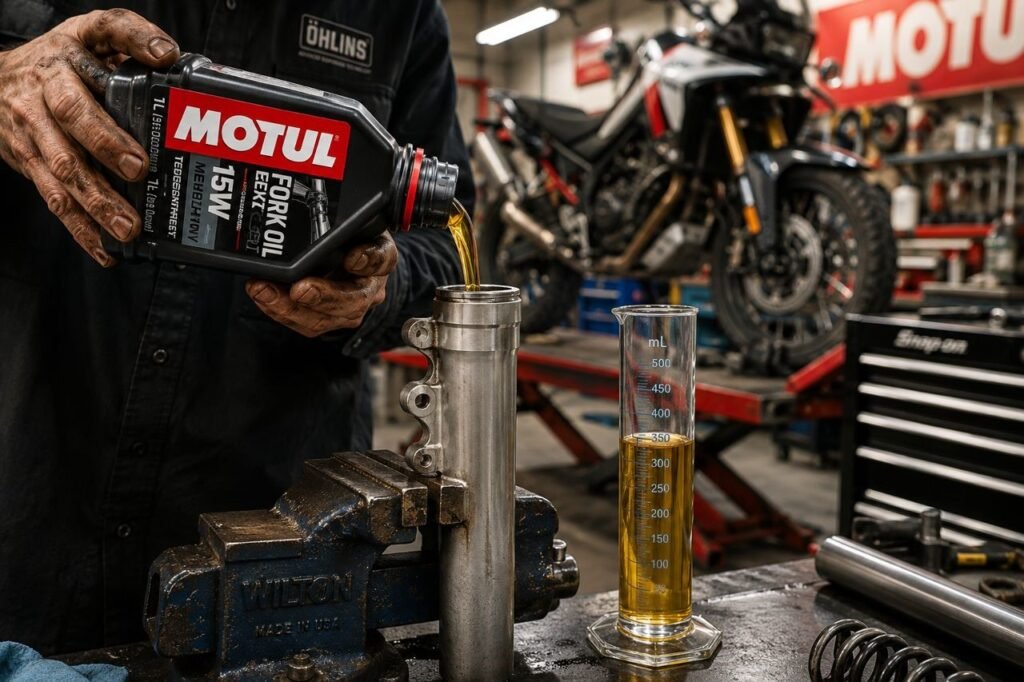
Maxima SS8 is the consistent choice across the MX paddock for good reason. At 22.1 cSt, it sits right at the lower end of the 10W range—fast enough to allow quick rebound without the pogo-stick harshness of an under-damped fork—while its anti-wear additive package reduces the metal-to-metal friction that causes stiction in high-cycle applications. For enduro and hard enduro specifically, where fork temperatures climb higher and stroke cycles are longer, consider bumping to a Motul 15W in the front, particularly if your OEM spec calls for 10W—the added body helps manage the slower, longer compressions over rocks and roots.
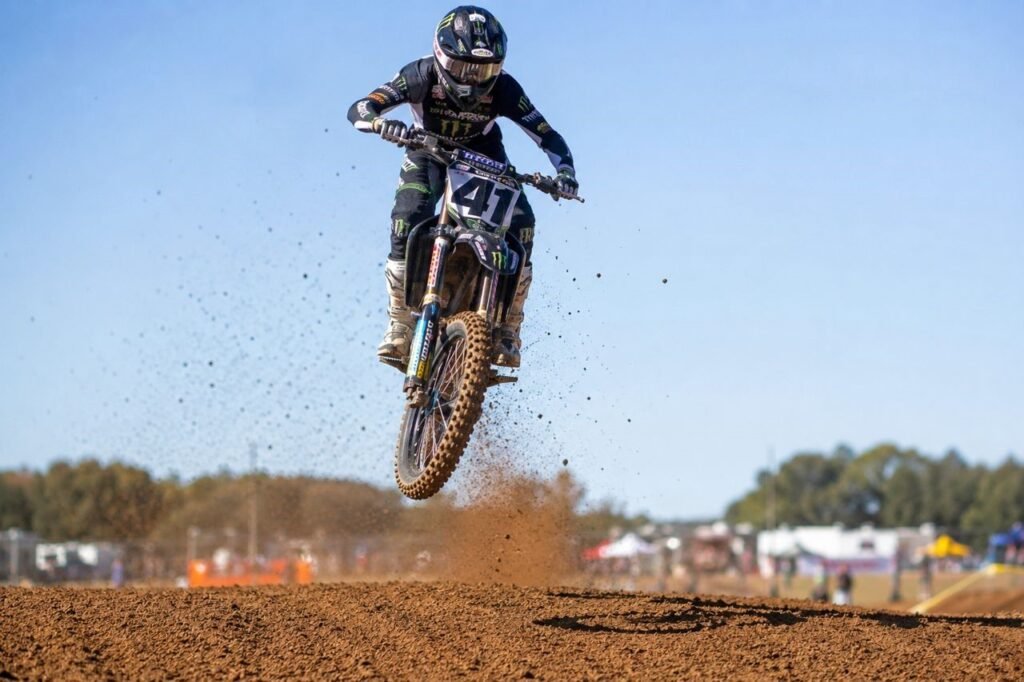
Air gap management also becomes critical on dirt: a smaller air gap creates more progressive spring action late in the stroke, which is exactly what you want when launching off a jump face. But that’s a setup variable, not a fluid variable—the oil viscosity handles damping speed, not spring rate.
What Happens If You Use Wrong Fork Oil
The physical symptoms of incorrect fork oil are distinct enough that you can diagnose them from the saddle without pulling the legs apart.
Too heavy: The fork feels artificially stiff and harsh over small, fast inputs—road surface texture, pebbles, painted lines. It resists initial movement, a condition called stiction, and instead of absorbing ripple irregularities, it transmits them directly into the handlebar. Mid-corner, the front tire loses contact time with the road because the fork can’t respond quickly enough to follow surface variations. Under braking, the fork control feels wooden and confidence-inspiring at first—until you realize you’ve lost front-end feel entirely.
Too light: Brake dive becomes excessive and hard to predict. The fork compresses rapidly and bottoms more easily, producing that pogo-stick rebound effect where the bike springs back violently after a compression. Rebound damping is compromised because the fluid flows too freely through the shim stack. On a sport bike, this translates directly into corner-entry instability.
One critical distinction that’s worth burning into memory: fluid height controls progressive spring rate, while fluid viscosity controls damping speed. Raising the oil level (reducing the air gap) makes the fork progressively stiffer in the last 20% of travel—useful for heavy riders or loaded touring. It does not increase damping. Switching to a heavier viscosity increases damping resistance throughout the stroke—it does not act as a spring. Confusing these two variables is the single most common fork setup mistake.
Frequently Asked Questions
My OEM spec calls for a brand-specific oil that costs $40 per leg. Can I substitute? Yes, but substitute by cSt, not by brand name. Pull the OEM’s technical data sheet and find the actual cSt at 40°C for their recommended fluid. Then match it with a quality aftermarket product at the same cSt. The fork’s calibration responds to viscosity—not to logos.
My forks have always felt slightly harsh in cold weather but smooth out after 10 minutes. What’s happening? This is classic low-VI behavior. Your fluid is significantly thicker at ambient temperature than at operating temperature, so the fork damps heavily until it warms up. Switching to a high-VI synthetic—VI 150 or above—will dramatically reduce this cold-start harshness and give you consistent feel from the first corner of the ride.
I just rebuilt my forks with fresh oil but they still feel spongy. What did I miss? Cavitation. If you didn’t bleed the forks properly after refilling—typically by slowly pumping the legs 20–30 times with the caps off before topping off and sealing—air pockets remain trapped in the cartridge. That air compresses before the oil does, creating that spongy, inconsistent mid-stroke sensation. Drain, refill, and bleed them correctly.
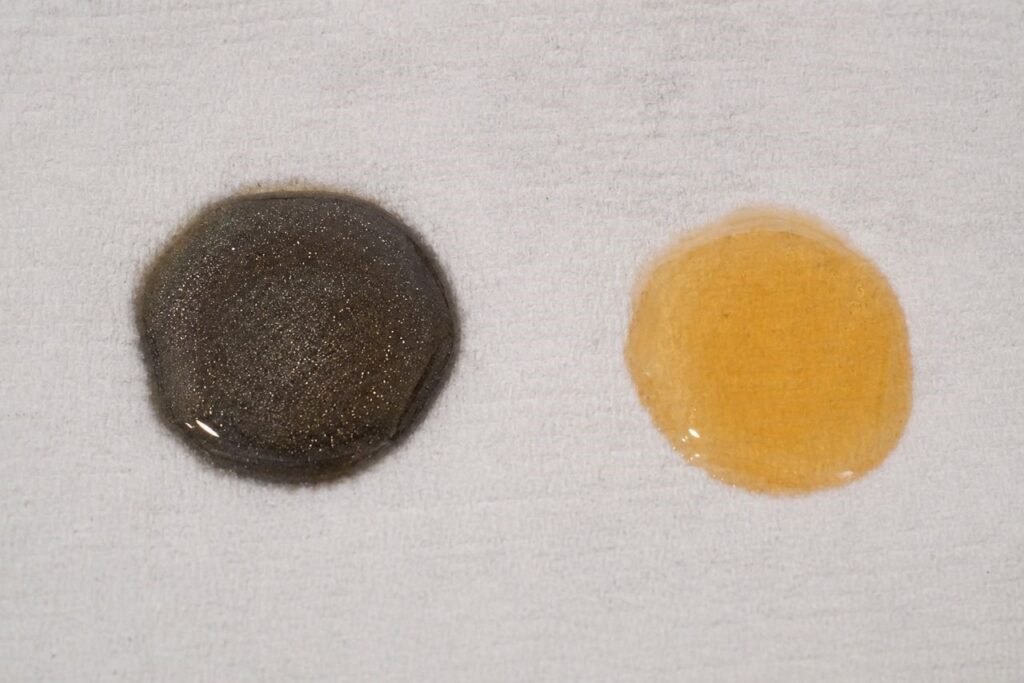
How do I know when fork oil actually needs changing, beyond just following a mileage interval? Pull the drain plug and inspect the oil on white paper. Dark grey or black coloration with metallic flake indicates bushing and seal wear particles suspended in the fluid. A sour, burnt smell indicates thermal breakdown of the base stock. Either condition means change it now, interval be damned. Clean, functioning fork oil runs golden to light amber.
The Right Call, Every Time
Front-end confidence isn’t built on suspension hardware alone—it’s built on the fluid moving through it. The best fork oil for motorcycle suspension is the one matched precisely to your riding style, your fork’s design, and your service interval habits. Street riders should prioritize high VI and seal protection. Dirt riders need aeration resistance and rapid stroke recovery. Everyone benefits from knowing the actual cSt behind the weight number on the label.
Stop guessing at setup changes when the real variable is a $20 bottle you last thought about two years ago. Get the fluid right, set your air gap correctly, and the front end will communicate clearly—every lap, every canyon run, every time.