
Disclosure: As an Amazon Associate, this site earns from qualifying purchases. This article contains Amazon affiliate links — if you make a purchase through these links, we may earn a small commission at no extra cost to you. This helps support the site and allows us to continue creating detailed motorcycle guides. Thank you for your support!
The Trade-Off Every ADV Rider Faces
Adventure riding asks one tire to do two jobs that pull in opposite directions. A sportbike tire only has to grip pavement. A dirt bike tire only has to grip dirt. A big ADV bike often does both in the same ride — highway miles, then gravel, then a rutted trail — while carrying a loaded bike that can weigh 500+ pounds with gear.
That’s the core tension in this category. Softer, knobbier tread bites into mud and sand but squirms and wears quickly on pavement. Harder, more street-oriented compounds run smooth and last longer on the highway but lose grip fast once the pavement ends. The “right” tire depends entirely on how you actually ride — not how you imagine riding.
This guide covers the technical factors that matter most (terrain ratio, load rating, bead stiffness, heat cycling) and compares five well-regarded adventure tires so you can match a tire to your riding rather than to marketing copy.
A note on this guide: tire performance depends heavily on your specific bike, tire size, pressure, load, terrain, and riding style. Treat the comparisons below as a starting point for research, not a substitute for checking current manufacturer specs and recent, dated reviews before buying.
Quick Comparison
| Tire | Terrain Bias | Best For | Main Strength | Main Trade-Off |
|---|---|---|---|---|
| Dunlop Trailmax Mission | Mixed-surface (roughly 50/50–60/40) | Long-distance touring with gravel | Balanced durability and stability | Not built for deep mud |
| Motoz Tractionator Adventure | Off-road-biased (~75/25) | Rocks and loose terrain | Off-road durability, stiff sidewall (bias-ply versions) | More road noise, faster street wear |
| Michelin Anakee Adventure 2 | Road-biased (~80/20) | Highway touring with occasional gravel | Wet-road grip, claimed mileage gains | Limited soft-terrain capability |
| Continental TKC 80 Gen 2 | Even mixed (50/50) | True mixed terrain | Strong off-road traction | Faster pavement wear, more noise |
| Pirelli Scorpion Rally STR | Road-biased trail tire | Heavy bikes, road + light gravel | Stable street handling with some off-road bite | Not intended for deep mud/sand |
Terrain-bias percentages are rider/industry shorthand, not a standardized measurement — treat them as relative guidance, not an exact spec.
Understanding Terrain Ratios
The ratio you’ll see next to most ADV tires (50/50, 80/20, 90/10) is the fastest way to narrow down your options before you even look at tread pattern.
- 50/50 tires split design intent evenly. Bigger knobs, wider gaps between tread blocks, softer compound. Good bite in loose surfaces; more road noise and faster wear on asphalt.
- 80/20 or 90/10 tires prioritize pavement. Tighter tread, a nearly solid center strip for stable highway contact, firmer compound for mileage. Grip drops off quickly in sand, mud, or loose rock.
If your riding is mostly pavement with the occasional gravel road, an 80/20 tire is usually the more practical, longer-lasting choice. If you’re genuinely splitting time between dirt and street, a 50/50 or 60/40 tire is worth the shorter tread life. Tires around 80/20 also tend to blur into sport-touring territory — a reasonable choice for riders who tour more than they trail-ride. Anything above roughly 70/30 (road-biased) starts losing meaningful bite once conditions get loose.
Tire-by-Tire Breakdown
Dunlop Trailmax Mission
Widely recommended as a “do-everything” ADV tire. It’s built to deliver stable highway manners while still handling gravel and moderate off-road surfaces reasonably well, with a carcass reinforced enough to suit a fully loaded large-displacement ADV bike without excessive squirm.
Its main strength is consistency — riders commonly report even wear and predictable turn-in over several thousand mixed-use miles. It won’t out-perform a true knobby tire in mud, and it won’t out-last a pure street tire, but for riders who want a single set of tires for a trip mixing highway and gravel forest roads, it’s a solid middle-ground pick. A dense sipe pattern in the tread blocks helps wet-pavement grip without softening the compound enough to hurt mileage — useful in a surprise rain shower, a scenario where more aggressive knobby tires often struggle.
👉 See current pricing and sizes for the Dunlop Trailmax Mission on Amazon — our top all-around pick for riders who want one tire to handle both highway slabs and gravel forest roads.

Good fit for: riders who want one tire for both slab and gravel, and don’t want to think too hard about the choice.
Motoz Tractionator Adventure
Motoz built its reputation off-road first, and this tire reflects that. Depending on size, it’s available in bias-ply or radial construction; bias-ply versions have stiffer sidewalls that resist pinch flats on rocky trail — a real advantage on a loaded bike being ridden hard over rock gardens, where a softer sidewall flexes and squirms. Note that Motoz currently sells the Tractionator Adventure as a rear-only tire, typically paired with a Tractionator DualVenture or RallZ front.
The trade-off for that off-road strength is more road noise, vibration, and faster wear than a road-focused ADV tire. It’s a strong choice for riders who prioritize technical off-road capability and just need something that can also survive the highway miles between trailheads.
👉 Check Motoz Tractionator Adventure availability and sizing on Amazon — built for riders who spend real time on rocks and technical trail, not just gravel.
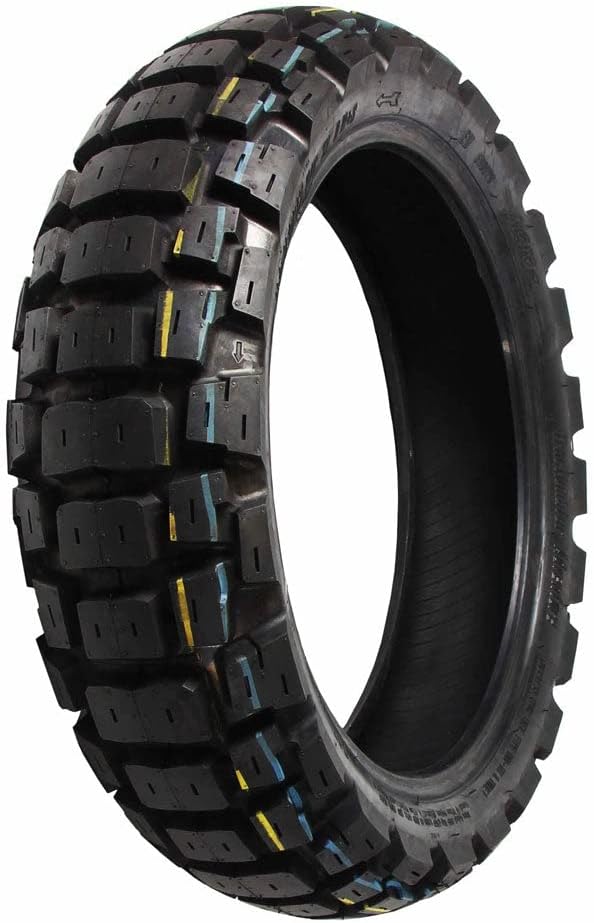
Good fit for: riders spending real time on rocks and loose, technical terrain.
Michelin Anakee Adventure 2
Aimed at riders logging serious interstate mileage between trailheads. Michelin states this generation improves rear tire life by about 21% and front tire life by about 7% over the outgoing Anakee Adventure, via a reworked compound and reinforced casing. These are manufacturer-stated figures — the tire launched globally in early 2026, so independent long-term mileage data is still limited at the time of writing. Early rider reports out of Europe describe confident wet-weather grip and solid gravel manners, consistent with Michelin’s positioning, but treat the specific percentages as a claim to verify against your own experience or independent long-term tests as they emerge.
Tread depth and block spacing are shallow enough that mud and wet clay pack the tire quickly, and traction drops off fast once terrain turns soft. This is a touring tire that tolerates gravel, not a trail tire.
Good fit for: pavement-heavy touring riders who see gravel occasionally but not serious trail.
Continental TKC 80 Gen 2
A true 50/50 tire with an open tread pattern that grips well in mud, sand, gravel, and loose terrain. The trade-off is exactly what you’d expect from that level of off-road bite: more road noise and noticeably faster pavement wear than road-biased options on this list.
Good fit for: riders who want strong, balanced performance both on and off pavement and are willing to replace tires more often.
Pirelli Scorpion Rally STR
Aimed at riders who spend most of their time on pavement but want real capability on gravel and light off-road terrain. Larger tread blocks and a broad contact patch give it stable, predictable handling on the street while still offering some bite off it.
Its reinforced build makes it a reasonable option for heavier adventure bikes — machines like a KTM 1290 Super Adventure or Ducati Multistrada V4 that generate significant lean-angle loads. Off-road performance is competent but not class-leading: confident on hardpack and light gravel, overwhelmed by deep sand or mud.
👉 Find the Pirelli Scorpion Rally STR on Amazon — a strong match for heavier ADV bikes like the 1290 Super Adventure or Multistrada V4 that want street precision with light off-road bite

Good fit for: riders on heavy ADV bikes who want sport-touring-grade street handling without giving up all off-road ability.
How Bead Stiffness Affects Trailside Repairs
This detail gets skipped in most buying guides, but it matters if you tour off the grid. Stiffer beads — common on tires built for stability on heavy bikes — resist unseating during aggressive cornering, which is a genuine safety benefit. The trade-off is that the same stiffness makes manual tire changes noticeably harder without the right tools.
A softer bead, more common on dirt-focused tires, tends to break down more easily with hand tools and standard spoons. Riders planning long, remote trips should factor this into their choice — and should always carry (and practice with) the tools their specific tire actually requires, since bead stiffness varies by model and manufacturer.
Buyer’s Guide: What Actually Matters
Load Rating
Tread pattern gets all the attention, but load rating deserves equal weight — especially if you tour with luggage. A fully loaded ADV bike with hard panniers, a top case, and camping gear can easily add 100–150 lbs to the bike’s total weight. That pushes the tire closer to its rated load limit, which increases heat buildup and accelerates wear.
Always check the load index printed on the tire’s sidewall against your bike’s fully loaded weight, not its dry curb weight. If you tour long distance with gear, prioritize an adequate load index over a marginally grippier tread pattern — an overloaded tire runs hot and wears unevenly regardless of compound quality.
Heat Cycling
Sustained highway speeds generate more heat than stop-and-go dirt riding, and repeated heat cycling gradually hardens rubber over time. So tire lifespan isn’t just about tread depth — it’s also about how many heat cycles the compound has absorbed. Newer silica-based compounds generally resist heat-hardening better than older carbon-black formulas, which is part of why manufacturers highlight silica compounds in newer tire lines. As with any compound claim, treat manufacturer statements as a starting point and look for independent long-term reviews once a tire has real mileage behind it.
Rim Size and Compatibility
Most adventure bikes run either a 21-inch front / 18-inch rear, or a 19-inch front / 17-inch rear. The 21/18 setup (common on GS-style bikes) favors a taller sidewall that absorbs off-road impacts better and opens up more genuinely dirt-oriented tire options. The 19/17 setup behaves more like a sport-touring combination — sharper street handling, fewer aggressive knobby choices. Confirm your rim size before buying; not every tire in this guide is available in both fitments.
Tube-Type vs. Tubeless
Most modern adventure bikes run tubeless wheels, which generally make roadside puncture repairs faster since small punctures can often be plugged. Tube-type setups remain common on some off-road-focused bikes and can suit riders who prioritize trail repairability with spoke wheels. Always follow your motorcycle and tire manufacturer’s recommended tire pressures rather than applying a generic pressure reduction for off-road riding.
Front-to-Rear Matching
Mixing tire brands or models front-to-rear can save money, but it affects handling more than most riders expect. A soft, grippy front paired with a harder, longer-wearing rear can create a mismatched feel, where the front bites hard while the rear steps out unexpectedly. Unless you have specific experience mixing tire models, a matched front-and-rear set is the safer, more predictable starting point.
Longevity Tips
- Check pressure cold, before the compound heats up and gives a false reading.
- Use manufacturer-recommended pressures as your baseline, including for off-road riding — resist the urge to apply a generic PSI reduction.
- Restore full highway pressure before sustained higher-speed riding; underinflated tires overheat quickly at speed.
- Watch for age, not just tread depth. A tire within legal tread limits can still have hardened or cracked from age and heat cycling — inspect sidewalls for cracking each season.
- Match the tire to your actual riding, not your aspirational riding. If most of your weekends are gravel forest roads, buy toward the 50/50 end. If most are highway with occasional gravel, buy toward 80/20.
FAQ
What’s the best adventure tire for a rider who mostly stays on pavement? An 80/20 tire like the Michelin Anakee Adventure 2 is built for that use case — mileage and wet-weather grip matter more than deep off-road bite if dirt only shows up occasionally.
Which tires hold up best on a heavy, fully loaded bike? Prioritize a reinforced carcass and adequate load index over an aggressive tread pattern. The Pirelli Scorpion Rally STR and Dunlop Trailmax Mission are both built to handle the extra weight of panniers and camping gear without excessive squirm at highway speed.
How often should ADV tires actually be replaced? Don’t rely on tread depth alone. Hardening rubber and sidewall cracking are signs of accumulated heat cycles and age, and a tire can lose meaningful grip well before it’s legally worn out. If a tire has seen several seasons of use, inspect it carefully regardless of remaining tread.
Specific performance claims attributed to manufacturers (e.g., Michelin’s stated mileage improvements) reflect manufacturer marketing at time of writing and should be checked against current, independent long-term reviews before purchase.