
Disclosure: This article contains Amazon affiliate links. If you make a purchase through these links, we may earn a small commission at no extra cost to you. This helps support the site and allows us to continue creating detailed motorcycle guides. Thank you for your support.
A smart motorcycle helmet is the first thing I check before any ride longer than an hour now. That wasn’t always true. Two summers ago I glanced down at a tank-bag GPS mid-corner on a wet mountain switchback. The front end got loose for a half-second that felt like ten. Nothing happened, but it stuck with me. Every rider eventually learns the same lesson: taking your eyes off the road, even for a beat, is where trouble starts.
That close call is exactly why this category of gear exists. It combines the impact-dispersion materials of a traditional lid with onboard electronics. Think heads-up display, Bluetooth intercom, crash sensors, and sometimes a built-in camera. It’s not a gimmick strapped onto safety gear. Done right, a smart motorcycle helmet keeps your attention on the pavement, right where it belongs.

How Do Smart Motorcycle Helmets Work?
At the core, a smart motorcycle helmet is a small computer wearing a crash helmet’s shape. Inside the shell sits a control processing unit. There’s also a rear-mounted lithium-ion battery for weight balance, micro-speakers near your ears, and a small sensor array. That array feeds data to your phone or a paired display.
Because of this layered design, manufacturers split into two camps. Brands like Shoei and Sena build factory-integrated systems. Here, the electronics are baked into the shell during manufacturing. Cardo and other aftermarket makers take a different route. They sell bolt-on modules you clip to any standard helmet instead.
That distinction matters more than it sounds. Factory-integrated units route wiring through channels molded into the EPS liner. Nothing snags your jacket collar or catches wind at highway speed. On top of that, integration usually means better dB noise attenuation. The shell gets engineered around the electronics instead of having them glued on afterward.
I’ve worn both setups on the same bike, back to back. The aftermarket module added a faint whistle above 70 mph. The factory-integrated smart motorcycle helmet simply didn’t have that problem. Connectivity runs on Bluetooth 5.2 in most current units, with mesh networking layered on top for group rides. Latency stays low enough that voices don’t lag behind lip movement, even on a video call at a gas stop.
Processing power matters more than most buyers realize. The control unit handles GPS calculations, camera encoding, and intercom audio all at once. A weaker chipset can stutter when every feature runs together. Picture a busy interstate merge, HUD active, camera recording. An underpowered unit sometimes delays the next turn prompt by a second. That’s a small lag on paper. It’s the kind of thing you notice right when you can’t afford it.
Ready for a fully integrated smart helmet? Check the latest price of the Sena Impulse on Amazon and see why it’s one of the most complete all-in-one smart helmets available today.

Essential Smart Helmet Features for Motorcycle Riders
Not every smart motorcycle helmet ships with the same toolkit. That’s worth knowing before you compare prices. A lot of the price swing across this category comes down to which features are included versus bolted on later as an upsell. Here’s what shows up across most serious smart helmet features for motorcycle riders on the market right now.
Heads-Up Display (HUD) and Adaptive Navigation
The HUD is usually the headline feature. It works through waveguide optics that project turn-by-turn directions onto a small panel in your peripheral vision. That way, you never fully leave the road ahead. The best units also keep the focal projection distance far enough out that your eyes don’t have to refocus.
That said, not every HUD is created equal. I tested one on a bright Arizona afternoon. The display washed out almost completely in direct sun, and I ended up squinting to guess at the next turn. Glance-value is everything here. If you have to stare at the display to understand it, the feature has failed its one job.
Adaptive navigation on the better units dims automatically at dusk. That sounds small until you’re riding into a sunset and the display would otherwise blind you for a second.
Best Smart Motorcycle Helmet with Camera
A growing number of riders want the best smart motorcycle helmet with camera built right into the shell. I get why. Recording at 1080p or 4K is genuinely useful for insurance disputes. It also doubles as a highlight reel for your favorite roads.
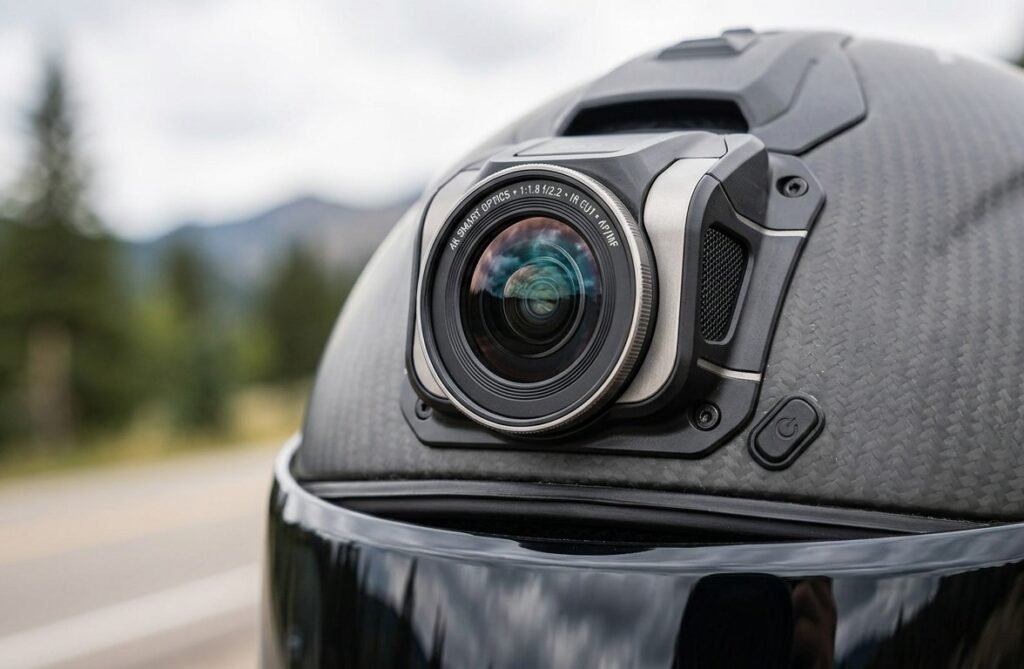
However, higher resolution drains the battery fast, especially with image stabilization running. A 4K unit with stabilization active burns through battery noticeably faster than the same camera shooting 1080p. Match the setting to how long you’re actually riding. Loop buffer storage helps too. It overwrites old footage automatically instead of forcing you to manually clear files at every gas stop.
Built-in helmet cameras are convenient, but if recording quality matters, many riders prefer using the Insta360 X5 for superior stabilization and 360-degree footage.

Smart Motorcycle Helmet with Crash Detection
This is the feature I’d never skip. A smart motorcycle helmet with crash detection relies on a 3-axis accelerometer and gyroscope working together. Together, they spot the sudden deceleration pattern of an actual impact, not just hard braking or a pothole.
Once the sensors cross a preset G-force threshold, the helmet triggers an SOS dispatch through a cellular tether to your phone. Because of this automated layer, someone gets alerted even if you’re unconscious on a rural highway shoulder with no witnesses around. That alone justifies the price for a lot of solo riders I know.
Mesh Intercom & Active Noise Cancellation (ANC)
Group rides get a lot easier once everyone’s running mesh intercom. Sena and Cardo both use mesh protocols. Riders can drop in and out of a shared channel without a fixed master-slave pairing order, so nobody gets left out when someone peels off for fuel.
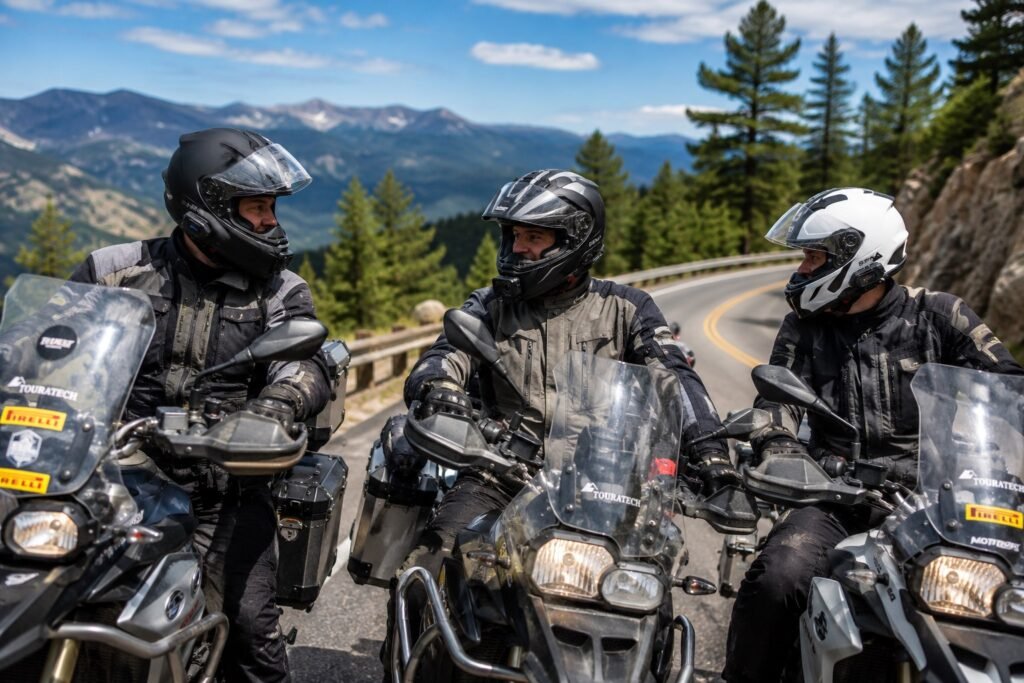
On top of the intercom, dual-mic beamforming handles active noise cancellation. That matters once wind noise climbs above 60 mph. We’ve all had that moment on a group ride where someone’s voice disappears into static right as they’re warning you about a pothole. Good ANC fixes that.
Range varies by brand and terrain. Mesh networks generally hold a stronger connection through hills and tree cover than older Bluetooth-only intercoms did. Riding through a canyon with switchbacks used to mean losing the group channel every few minutes. With a mesh-based setup, that dropout mostly disappeared for me.
Already own a quality helmet? Add premium mesh communication with the Cardo Packtalk Edge instead of buying a completely new helmet. See current Amazon deals.

Are Smart Helmets Safe? Understanding ECE 22.06 Standards
Whether a smart motorcycle helmet is actually safer than a standard one is the real question underneath all the feature talk. Riders worry, reasonably, that cramming electronics into a shell might compromise the structure meant to protect their skull.
ECE 22.06 Testing Explained
Here’s the good news. The current ECE 22.06 standard replaced the older DOT and ECE 22.05 benchmarks with far tougher testing. That includes oblique-angle impacts, which measure rotational forces rather than just straight-line impact. Rotational trauma is a major cause of brain injury in real-world crashes. This update closes a gap the old tests missed entirely.
On top of the oblique-angle testing, ECE 22.06 raised the total number of impact points checked on the shell. It also added multiple test speeds instead of just one. Formal testing now covers helmets sold with attached accessories, like cameras and communication units. That’s directly relevant to anyone shopping this category. In practice, a certified smart motorcycle helmet has been dropped, twisted, and struck at angles a 22.05-rated helmet was never required to survive.
Weight, EPS Density, and Certification
Weight is the other concern, and it’s a fair one. Electronics typically add somewhere between 200 and 350 grams of payload to a helmet shell. Manufacturers offset that with carbon fiber or aramid fiber construction. That cuts base shell weight enough that a certified unit often lands within a few grams of a traditional helmet.
The EPS liner density also gets adjusted around the electronics bay. That way, impact absorption doesn’t get shortchanged just because there’s a battery pack nearby. Engineers typically use a slightly denser foam directly behind the battery housing to keep crush characteristics consistent. Without that adjustment, the area around the electronics could compress differently than the rest of the liner. That’s exactly the kind of inconsistency ECE 22.06 testing is designed to catch.
That said, always confirm the specific model carries a current ECE 22.06 certified smart motorcycle helmet rating before you buy. Electronics bolted onto an older-rated shell can shift the balance point in ways the original testing never accounted for. That gap between marketing and certification is where corners get cut.
Smart Helmet vs Regular Helmet: A Direct Comparison
Choosing between a smart motorcycle helmet and a regular one really comes down to how and where you ride. Here’s how they stack up side by side.
| Feature | Traditional Helmet + Aftermarket Accessories | Integrated Smart Motorcycle Helmet |
|---|---|---|
| Wind noise / drag | Higher, due to bolt-on modules | Lower, molded into shell profile |
| Weight distribution | Often front-heavy or lopsided | Balanced via rear battery placement |
| Cable management | Exposed wiring, more snag points | Internal channels, cleaner setup |
| Total cost | Cheaper upfront, adds up per accessory | Higher upfront, bundled value |
| Crash-test uniformity | Varies once accessories are added | Tested as one certified unit |
For track days, a stripped-down traditional helmet still wins. You don’t want a battery pack or camera mount adding weight and bulk when you’re chasing lean angle at the limit. Most tracks don’t care about your navigation display anyway.
But for daily commuting or multi-day touring, the smart option earns its keep. That’s the trade-off in plain terms: minimalism for the track, connectivity for the road. I switch between both depending on the ride. Neither choice feels wrong once you match it to the day ahead.
Cost is worth breaking down honestly, too. A traditional helmet plus a bolt-on intercom, a separate action camera, and a phone mount can add up fast. Once you factor in mounts and cables, the total often gets close to a mid-range integrated unit anyway. The difference is that the integrated helmet arrives as one certified system. The stacked setup is only as reliable as its weakest connection point.
Want integrated Bluetooth without paying flagship prices? The Sena Momentum Lite is one of the best value smart helmets available. Check the latest price on Amazon.

How to Choose the Best Smart Motorcycle Helmet for Your Ride
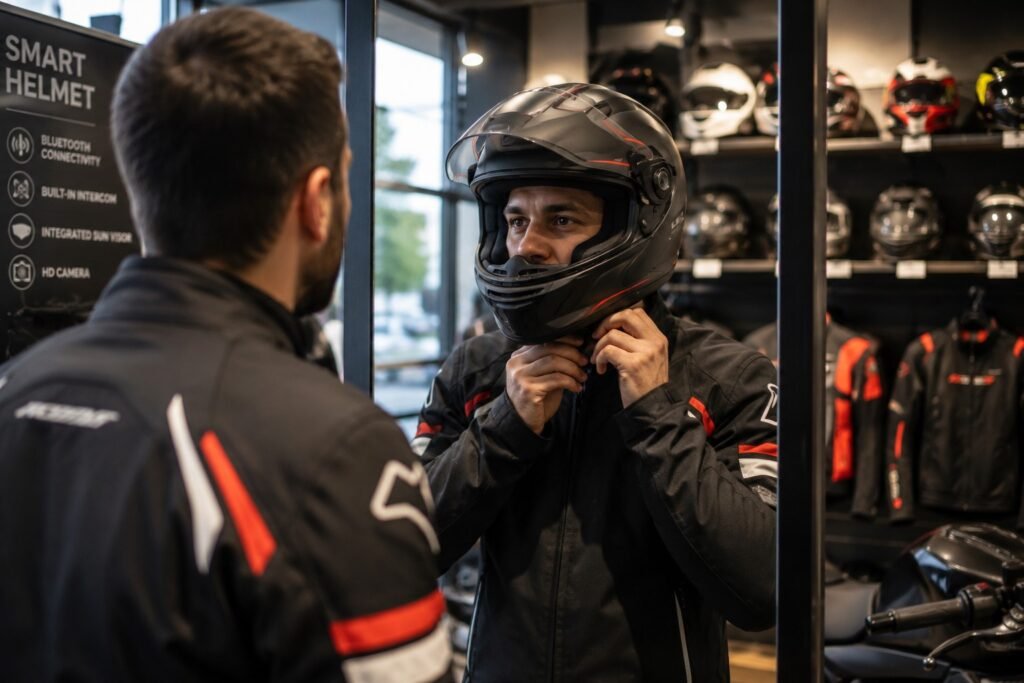
Picking the right smart motorcycle helmet means matching the tech to your actual riding habits, not just the spec sheet. A few criteria matter more than the marketing copy suggests.
Battery Life and Cold Weather
Start with battery life, and don’t ignore cold weather. Lithium batteries lose noticeable performance below 5°C. A helmet rated for eight hours of use can drop closer to five on a cold morning commute. If you ride through winter, factor that drop-off into your decision now. You don’t want to find out on a freezing highway with a dead HUD.
Visor Clarity and Fitment
Visor clarity comes next. Photochromic compatibility is worth checking, since some HUD projection systems interact poorly with certain tinted visors and create distracting glare. I once rode home from a dealer demo with a visor that fogged up every time the display kicked on. No amount of adjusting the vents fixed it, and I ended up swapping visors entirely. Test this before committing if you can.
Fitment matters just as much as electronics. Riders with an Intermediate Oval head shape need different internal geometry than those with a Round Oval shape. A mismatched fit undermines even the best safety rating. Try the helmet on with the intercom running before you buy, since fit changes how the speakers sit against your ears.
Ventilation and Budget
Ventilation is easy to overlook until you’re stuck at a low-speed crawl in traffic. Electronics generate their own heat inside the shell. A helmet with weak airflow channels can feel noticeably warmer than a standard lid at the same temperature. If you commute through stop-and-go city traffic, ask about airflow design specifically, not just the feature list.
Finally, budget. Finding the best budget smart motorcycle helmet doesn’t mean settling for unverified safety claims. I wouldn’t trust a budget unit below a certain price point if it can’t show current ECE or DOT certification clearly on the box. Spend the extra money to confirm the rating first. Compare features once safety is settled. A cheaper helmet with no verifiable certification isn’t a bargain. It’s a gamble.
Riders wanting the best balance of safety, communication, and comfort should consider the Sena OutForce. It offers integrated Bluetooth and quality construction at a price that suits most commuters and touring riders.

Frequently Asked Questions
1. Is a smart motorcycle helmet worth the extra money?
For daily commuters and touring riders, usually yes. The connected features cut down on distraction compared to juggling separate gadgets, and the crash detection feature can matter in a real emergency.
2. Do smart helmets meet the same safety standards as regular helmets?
A properly certified unit meets ECE 22.06, the same standard applied to top traditional helmets. Always check the certification on the box rather than assuming it from the marketing.
3. How long does the battery last on a smart motorcycle helmet?
Most units run six to eight hours with the HUD, camera, and intercom active. Cold weather and 4K recording both shorten that window, sometimes by a few hours.
4. Can I add smart features to a helmet I already own?
Yes. Aftermarket modules from brands like Cardo let you add Bluetooth communication, navigation prompts, and music to your existing helmet. They won’t integrate as cleanly as a factory-built smart helmet, but they’re a cost-effective way to experience the technology before upgrading.
5. Does a smart motorcycle helmet weigh more than a regular one?
Slightly, though carbon fiber and aramid shells usually close most of that gap. A well-built, certified smart helmet often weighs only a little more than a comparable traditional helmet, making the difference barely noticeable during normal riding.
Conclusion
A smart motorcycle helmet represents a real shift in what head protection is supposed to do. It’s no longer just about absorbing impact after something goes wrong. It’s about giving you the situational awareness to avoid that moment in the first place. The global smart helmet market has reportedly crossed the $1 billion mark, and that growth tracks with rising demand for rider safety and connected riding alike.
That said, the tech only matters if the fundamentals hold up. Confirm the ECE 22.06 rating, check the fit, and only then start comparing HUDs and cameras. If you ride enough miles to know what a close call feels like, a proper smart motorcycle helmet is worth the investment. I’d tell any friend asking me the same thing today.