
You spent three months wiring a custom light setup. The bike looks perfect under the shop lights — low-slung accent strips, a projector headlight swap, integrated LED turn signals tucked clean into the bodywork. Then a traffic stop ten minutes into your first real ride unravels everything. The officer doesn’t care how good it looks. He cares about what’s legal.
Lighting modifications are consistently among the top reasons riders get pulled over, face failed inspections, and end up voiding their insurance coverage after an accident. Most builders don’t realize how detailed — and how unforgiving — motorcycle lighting laws actually are. Federal standards, state statutes, and international equivalents rarely agree on every point, and aftermarket parts are sold every day that technically fail compliance the moment they leave the box.
This guide breaks it all down: LEDs, accent lights, underglow, turn signal geometry, auxiliary setups, and the paperwork questions nobody answers straight. Whether you’re building a full custom or just upgrading your factory headlight, you need to know where the legal lines sit before you throw the first switch.

Are Motorcycle LED Lights Legal? Understanding Motorcycle Lighting Laws
The short answer: it depends entirely on how you’re installing them.
Whether are motorcycle LED lights legal comes down to one distinction — are you swapping just the bulb, or replacing the entire headlight assembly? Most riders assume a bulb swap is fine. It usually isn’t, and the physics explain why.
Halogen reflector housings are engineered around a specific filament position. That geometry determines how light bounces off the reflector and through the lens. Drop in an LED and the light source shifts, changes shape, and emits from multiple points. The result is scattered, uncontrolled output — some of it firing straight into oncoming drivers’ eyes. That’s not an aesthetic issue. That’s a hazard.
Federal Motor Vehicle Safety Standard 108 (FMVSS 108) requires headlights to meet precise photometric output patterns. A drop-in LED in a halogen housing almost never passes. The beam pattern is wrong, the cutoff disappears, and both inspectors and law enforcement can flag it. Understanding motorcycle lighting laws at the federal level is what separates a clean build from an expensive roadside conversation.
So is it illegal to put LED bulbs in halogen motorcycle headlights? In most cases, yes. Replacing the full sealed assembly with a DOT-approved LED unit is the legal path — housing, lens, and light source engineered and tested together, carrying correct DOT/SAE markings. Internationally, ECE Regulation 112 follows the same logic. The assembly matters. The bulb alone doesn’t.
Motorcycle headlight regulations protect everyone on the road. A headlight that blinds oncoming traffic at 60 mph is an active hazard, regardless of how clean the install looks from the seat.
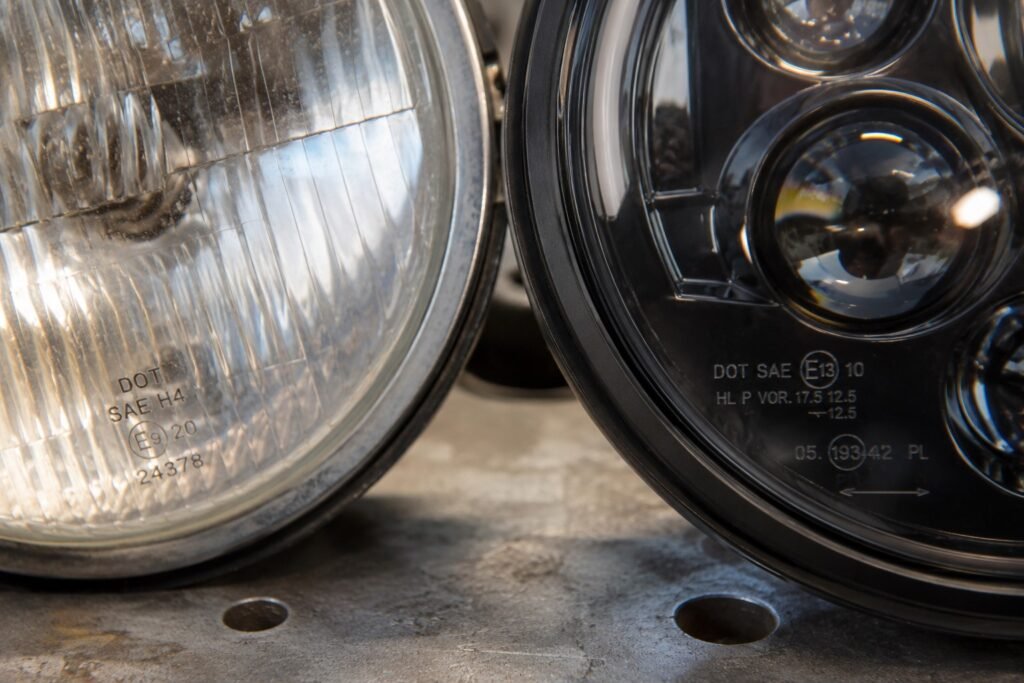
Headlight Technology Comparison
| Lighting Technology | Average Lumens | Lifespan (Hours) | Legal Compliance Status | Beam Pattern Impact |
|---|---|---|---|---|
| Halogen | 700–1,200 lm | 450–1,000 hrs | Fully compliant in OEM housings | Predictable, well-defined cutoff |
| LED (Drop-in Bulb) | 1,500–3,000 lm | 15,000–30,000 hrs | Generally non-compliant in halogen housings | Scattered glare, no clean cutoff |
| LED (Sealed Assembly) | 1,200–2,500 lm | 15,000–30,000 hrs | Compliant if DOT/SAE approved | Engineered beam, sharp cutoff |
| HID/Xenon | 2,800–3,500 lm | 2,000–3,000 hrs | Non-compliant in most retrofit kits | High glare without projector housing |
Note: Lumen output alone does not determine legal compliance. Beam pattern accuracy is the governing factor under FMVSS 108 and ECE R112.
What Colors Are Legal for Motorcycle Accent Lights?
Color rules are where builders most often get burned. The answer to “what colors are legal for motorcycle accent lights” varies by state, but federal guidelines and near-universal state law share the same core principle: don’t look like a cop or an ambulance.
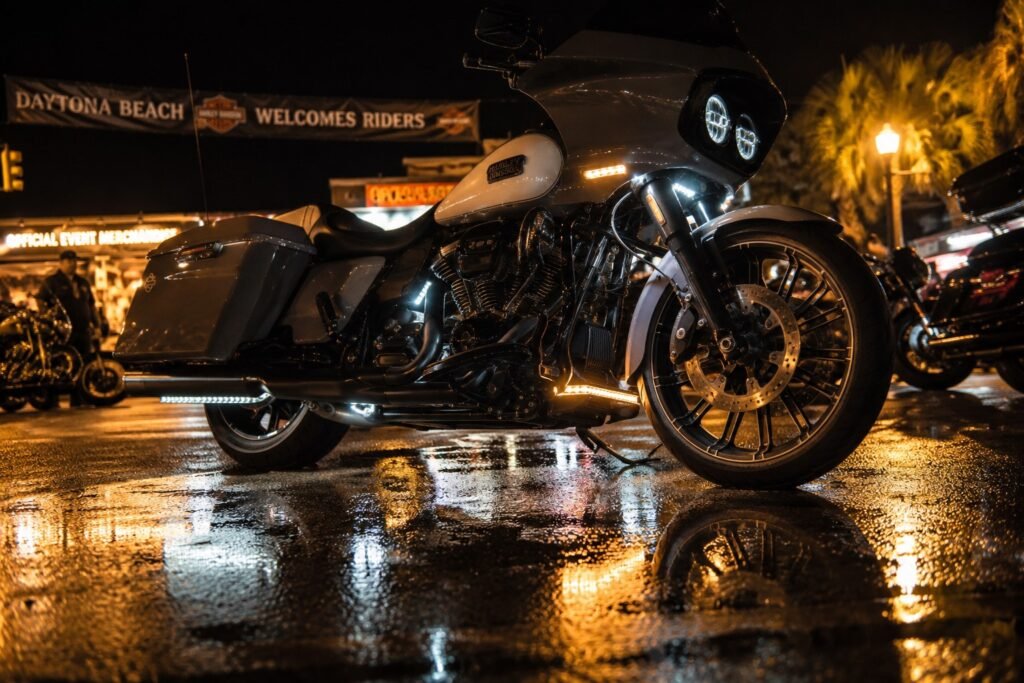
Red and blue flashing or rotating lights are reserved for emergency vehicles in every U.S. state. Running them on a motorcycle doesn’t just earn you a ticket — it can bring serious criminal charges in many jurisdictions. Even solid blue lights are prohibited in the forward-facing position in most states. Don’t go there.
For accent and decorative lighting, the legal framework generally breaks down by position. At the front of the motorcycle, white or amber are the only widely accepted colors. At the rear, red is the standard, with amber acceptable as a supplemental turn signal indicator. Green is restricted in several states because it’s associated with volunteer emergency responders.
Motorcycle underglow laws by state vary more than almost any other lighting category. California, for example, restricts any flashing or moving light effect visible to other drivers, even in permitted colors. Florida is comparatively permissive for stationary lighting. Texas prohibits any red or blue accent light visible from the front. Illinois requires that decorative lights not be visible from a normal driving position. You have to check your specific state — there’s no uniform federal standard for underglow on motorcycles.
How many auxiliary lights are legal on a motorcycle is another question with a non-universal answer. Federal guidelines suggest no more than two auxiliary lamps in a forward-facing position, and most states follow that framework. Exceeding two auxiliary forward lights is a common citation trigger during inspections.
Keep accent lighting steady, keep it in legal colors for its position, and check your state DMV website before you wire anything.
Motorcycle Turn Signal and Auxiliary Light Regulations
Turn signals get dismissed as a boring topic until your bike fails inspection because the blinkers are two inches too close together. These rules are specific and unforgiving.
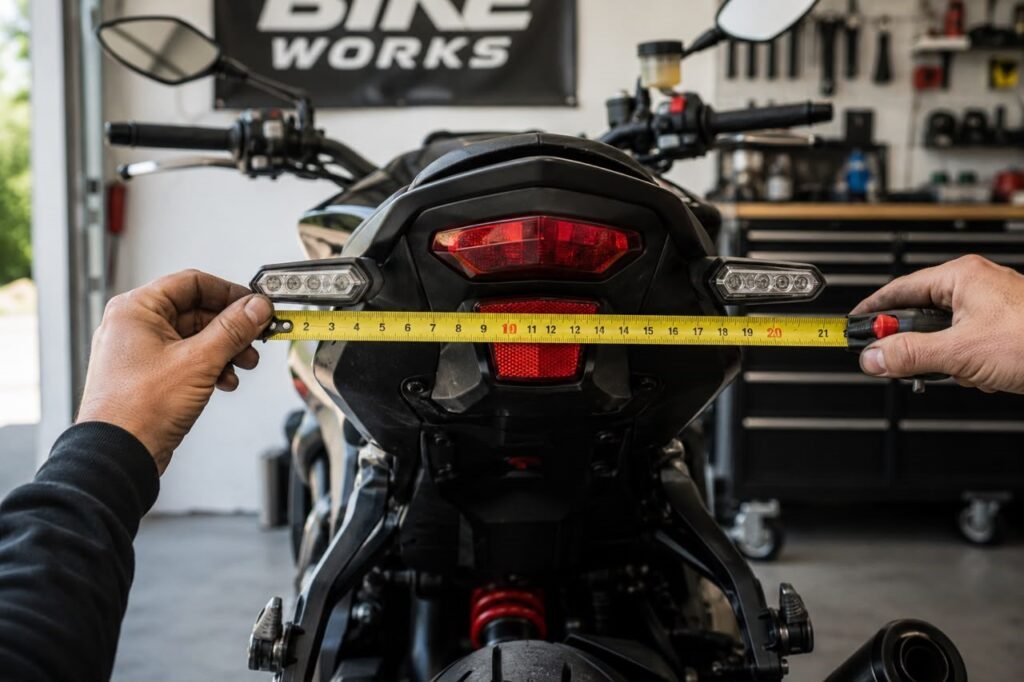
Under FMVSS 108, motorcycle turn signal height and width legal requirements mandate that front turn signals must be mounted at least 16 inches apart (edge to edge) on motorcycles over 35 inches wide. On narrower bikes, a minimum of 6 inches of separation is required. Rear signals must be at least 9 inches apart. Vertical mounting height must fall between 15 inches and 83 inches from the ground for front signals, with rear signals required between 15 and 72 inches.
Flash rate also matters. Signals must cycle between 60 and 120 flashes per minute. Many LED turn signal kits flash far faster than this unless they include a load resistor or CAN bus adapter. Hyperflashing isn’t just annoying — it’s a compliance failure.
This is why so many integrated taillight and turn signal kits fail inspections. Manufacturers often sell them as DOT-compliant, but the separation distance between the turn signal function and the brake light function is too narrow. The standard requires that turn signals be optically separated from stop lamps — meaning the same lens illuminating both functions may still be legal, but only if the turn signal amber zone is clearly distinguishable.
Auxiliary lights — fog lamps, driving lights, spot beams — must be switched off when the headlight is in low-beam mode in most states, and many states require auxiliary lights to be mounted below the headlight centerline. Wiring them to a dedicated switch isn’t just smart practice. In several states, it’s the law.
Frequently Asked Questions
Is motorcycle underglow illegal everywhere?
No, but it’s heavily regulated nearly everywhere. Solid, non-flashing underglow in white or amber is legal in most states while riding, provided no red or blue appears up front and nothing flashes. Michigan and Pennsylvania restrict it while moving entirely. Others allow it only when stationary — show lighting that must go off before you roll. Check your state’s vehicle code. “I saw it on another bike” won’t hold up.
Do auxiliary fog lights require a separate switch by law?
In many states, yes. California Vehicle Code Section 24403 requires auxiliary lights to be switched independently. Federal guidance under FMVSS 108 supports the same approach. Even where it isn’t explicitly required, a dedicated switch protects you during a stop — an officer spotting four forward lights all running together has every reason to look closer.
Can I tint my motorcycle headlight lens cover?
Not legally on public roads. Tinted covers reduce output and distort beam pattern, pushing the headlight outside FMVSS 108 compliance — and outside motorcycle lighting laws in several states that explicitly ban any colored material over headlights. It’s also a safety issue — you need every lumen available in rain and low light. Save the tinted cover for shows and track days.
What happens if my aftermarket lights don’t have a DOT stamp?
They’re non-compliant for street use. An inspector or officer can flag them on the spot. More seriously, if you’re in an accident and lighting is found non-compliant, your insurer has grounds to dispute coverage. The risk isn’t just a fine — it’s real financial exposure. Buy from manufacturers who publish actual compliance documentation, not ones who just slap a sticker on the box
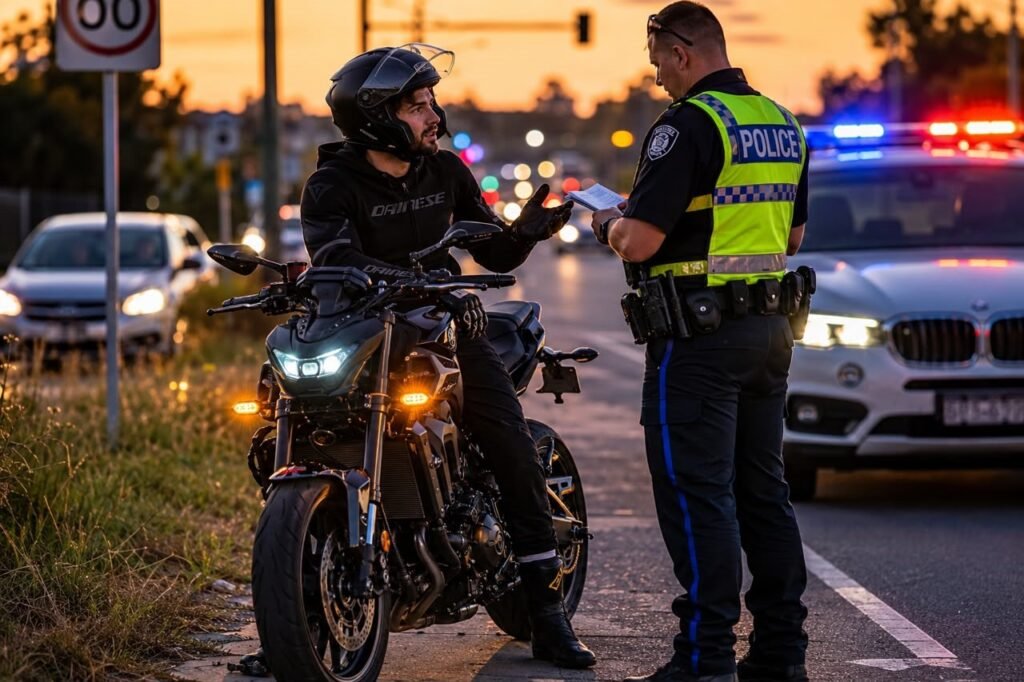
Motorcycle rider pulled over by traffic officer at dusk due to non-compliant aftermarket lighting