
By Chris Mchenga · May 2026 · 10 min read
Every motorcycle owner knows this problem. You finish washing your bike, but water is still trapped in small gaps and hard-to-reach places. No matter how much you wipe or use a spray can, the water keeps dripping out later.
Sometimes the problem is bigger. You change a tire, but the new tire will not seal properly on the wheel. You keep pumping air, but nothing happens.
And the worst situation is getting a flat tire far from home, with no repair shop nearby.
All of these problems can be solved with the right air compressor. Choosing the best air compressor for motorcycle maintenance is not about buying the cheapest one you can find. It is about choosing the right type for the jobs you actually do.
Some riders need a large compressor for a home garage and power tools. Others only need a small portable pump for emergencies on the road. No single model works for everyone, which is why finding the best air compressor for motorcycle maintenance depends on your riding style, storage space, and the type of maintenance you perform most often.
In this guide, you will learn which type of air compressor is best for your needs, what features matter, and which option gives the best value for your money.
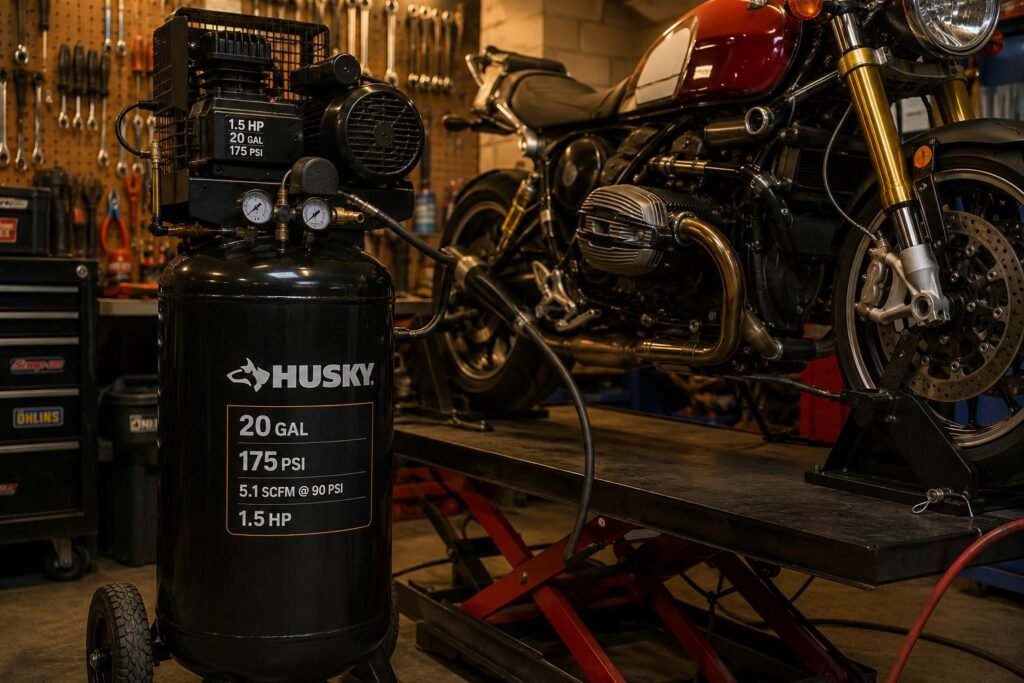
The Real Question: Portable Motorcycle Air Compressor vs CO2 Cartridges
Before we talk tanks and CFM ratings, there’s a fundamental question worth settling: when you’re on the road or trail, should you carry a portable air compressor or CO2 cartridges?
Both have genuine use cases, and the answer depends on what kind of riding you actually do.
CO2 cartridges are undeniably fast. Thread one onto a compatible inflator head, puncture the seal, and you can fill a motorcycle tire in under 60 seconds. They’re also tiny—a couple of 16-gram cartridges and a threaded inflator head weigh practically nothing and take up almost no space. For road riders who want the absolute minimum emergency kit and are fine stopping at a gas station for a top-up, CO2 is hard to beat.
The problems, though, are real. CO2 is single-use. If your first cartridge doesn’t fully seat the bead or get you to riding pressure, you’d better hope the second one does. For tubeless setups that need a sudden blast of volume to seat a bead, a single 16g cartridge often isn’t enough. Larger cartridges help, but you’re now carrying more gear and spending more money per use. CO2 also dissipates from the tire faster than regular air—worth keeping in mind on extended trips.
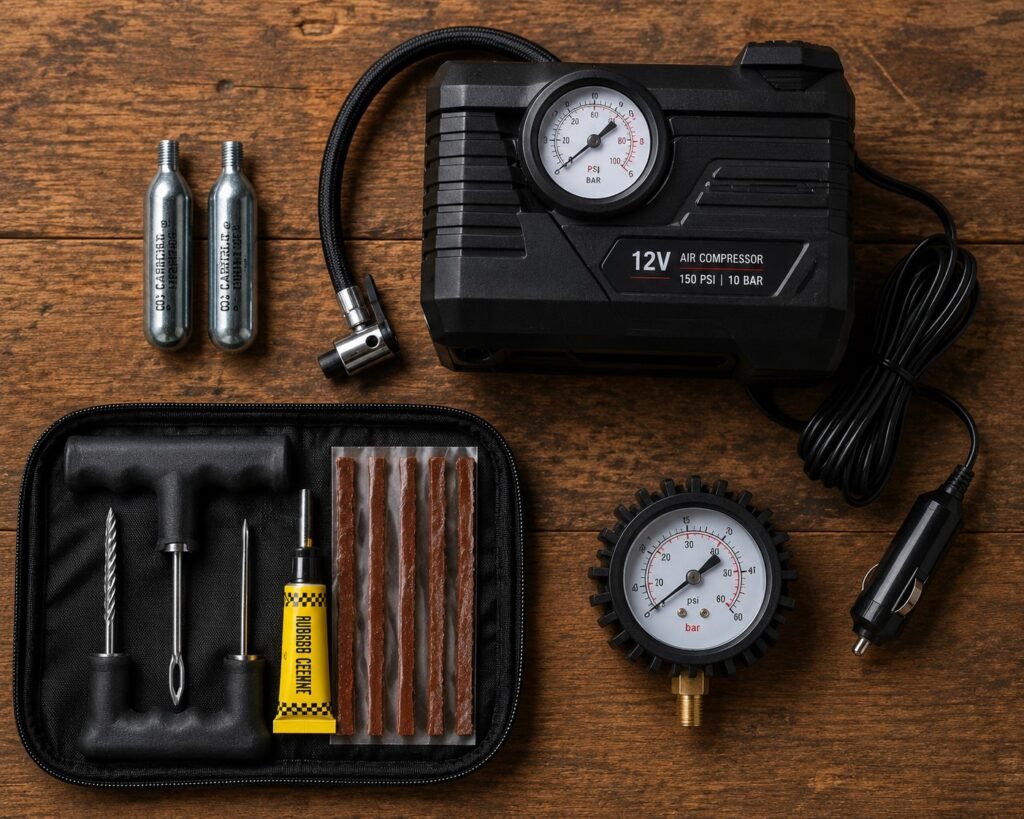
Portable air compressors—12V units powered by your battery, or rechargeable wireless pumps—take longer, sometimes three to five minutes for a full inflation from zero. But they give you unlimited air. You can reseat a stubborn bead, top off a spare tube, and check your front pressure while you’re at it. They’re reusable indefinitely, require no consumables, and the better modern units have digital gauges accurate enough to replace your dedicated pressure gauge.
For adventure tourers doing remote routes, the portable compressor wins clearly. For a minimalist road rider who wants a last-resort emergency kit, CO2 is still valid. Ideally, serious riders carry both—a portable compressor for proper inflation work and a CO2 cartridge or two for genuine emergencies when you need immediate action.
Now let’s talk about what’s living in your garage.
How Big of an Air Compressor Do I Need to Work on Motorcycles?
This is where a lot of riders either overbuy or undersell themselves. The answer requires understanding two numbers: PSI and CFM.
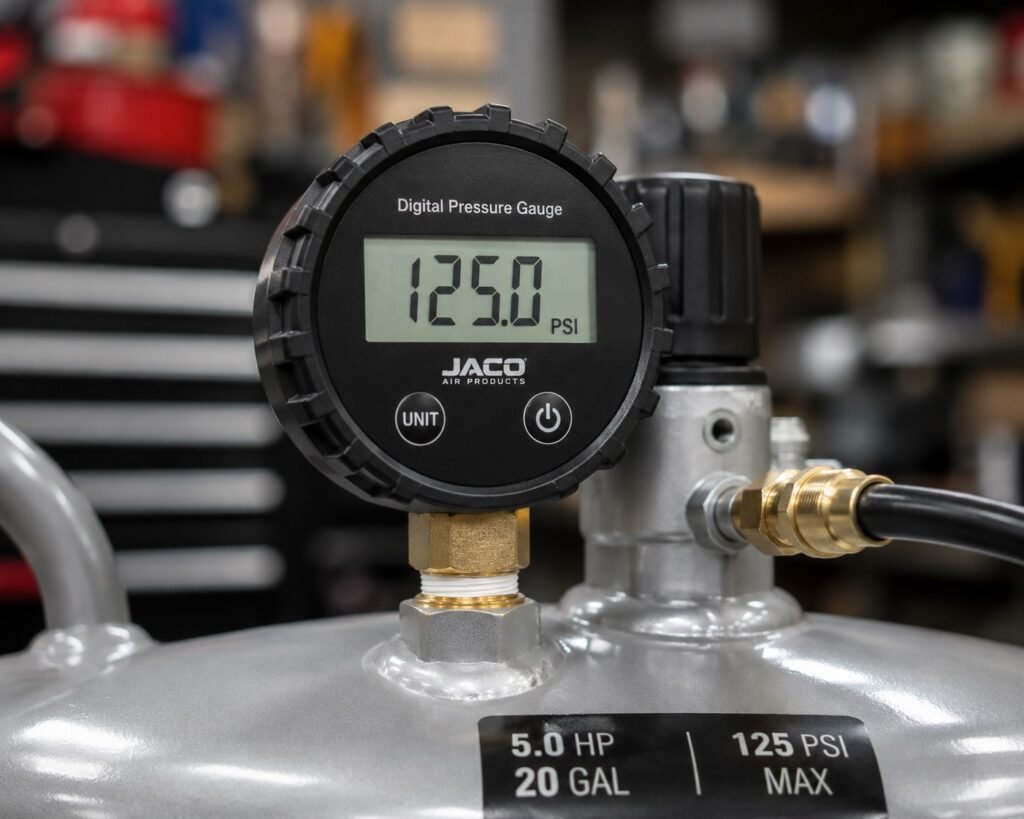
PSI (Pounds per Square Inch) is pressure—the force behind the air. Most motorcycle tires sit between 28 and 42 PSI. Impact wrenches and air ratchets need 90 PSI to operate properly. Most home compressors top out between 125 and 150 PSI, which is more than enough for every motorcycle application you’ll encounter.
CFM (Cubic Feet per Minute) is volume—how much air the compressor can actually move. This is the number people overlook, and it’s the one that determines whether your tools work properly. A cheap compressor might have a big tank at 150 PSI but a pathetically low CFM delivery rate. You’ll hear it constantly cycling while you’re trying to use a tool, because you’re consuming air faster than it can replenish.
Here’s a practical CFM breakdown for motorcycle work:
- Tire inflation only: 1–2 CFM at 90 PSI. Even a small pancake compressor handles this.
- Air blowgun and detail drying: 2–3 CFM. Still manageable with smaller units.
- Air ratchet for axle nuts and engine bolts: 3–5 CFM at 90 PSI. A 6-gallon tank starts to feel limiting here.
- Impact wrench for heavy fasteners: 4–6 CFM sustained. You want a 20-gallon tank or larger so you’re not waiting every 30 seconds.
- Sandblasting or spray painting: 8–15 CFM. This is professional territory.
For the home motorcycle mechanic handling tire changes, wheel removal, airbox cleaning, and occasional air ratchet use, a 20-gallon compressor delivering 4–5 CFM at 90 PSI is the sweet spot. Enough power to keep up with your tools without becoming a space monster in a one-car garage.
If you’re running a dedicated motorcycle shop—multiple bikes a day, several tools simultaneously, paint work—you’re looking at a 60-gallon or larger unit. The best garage air compressor for motorcycle shop environments typically starts at 80-gallon capacity with twin-cylinder pumps delivering 15-plus CFM continuously.
One more consideration: single-stage vs. two-stage pumps. Single-stage compressors compress air once, going directly to the tank. Two-stage pumps compress air twice, achieving higher pressure more efficiently and running cooler over long periods. For home use, single-stage is fine. For a busy shop running tools all day, two-stage is worth the investment.
Compressor Comparison: The Four Categories Every Motorcycle Rider Should Know
| Category | The Heavy-Duty Garage Unit | The Quiet Workhorse | The Adventure Tourer 12V | The Pocket Wireless Inflator |
|---|---|---|---|---|
| Power Source | 120V / 240V AC Outlet | 120V AC Outlet | 12V DC (Battery/Cigarette Lighter) | Built-in Li-ion Battery (USB-C Charge) |
| Max PSI | 150–175 PSI | 125–150 PSI | 150 PSI | 100–120 PSI |
| Tank Size / Portability | 20–60 Gallon, Fixed | 6–20 Gallon, Portable | No Tank, Ultra-Portable | No Tank, Pocket-Sized |
| Best For | Full shop use: tools, tires, paint | Home garage: tire changes, air tools | Adventure touring, trail riding, remote repairs | Quick tire top-offs, urban commuter emergency kit |
| Noise Level | 80–90 dB (wear ear protection) | 60–70 dB (quiet induction motor) | 70–80 dB (DC motor, manageable outdoors) | 65–70 dB |
Deep-Dive: The Four Categories That Matter for Motorcycle Work
Category 1: The Heavy-Duty Garage Unit
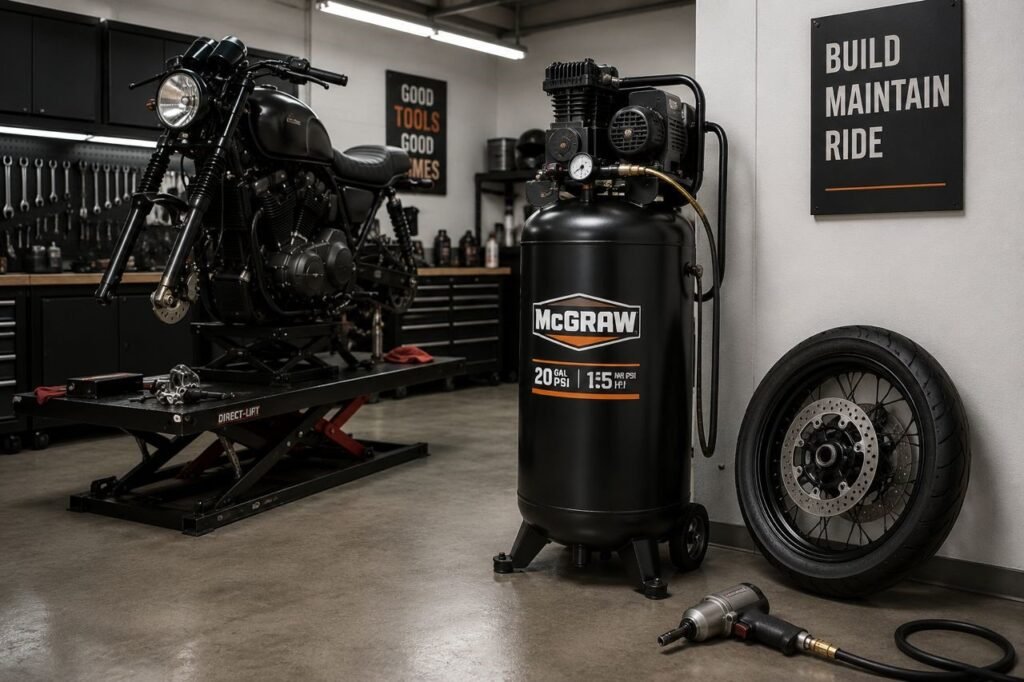
If you have the space and you’re serious about doing your own work, a full-size garage compressor transforms what’s possible in your shop. We’re talking about a 20-gallon or larger tank, a one-and-a-half to two horsepower induction motor, and CFM delivery in the four-to-six range at 90 PSI—the kind of unit you’ll find in every serious home workshop and small professional shop.
The practical advantages show up immediately. When you thread an impact wrench onto the fitting and start cracking wheel nuts, the tank handles the load while the compressor catches up quietly in the background. You’re not waiting. You’re not fighting a unit that’s struggling to keep up.
The heavy-duty unit earns its keep most dramatically during tire work. Seating a tubeless bead—especially on a fat front tire that’s been sitting for a while—requires a sudden, high-volume blast of air. A small compressor often can’t deliver that volume fast enough. A 20-gallon tank pre-charged to 125 PSI absolutely can. You’ll hear the bead click into place on both sides within seconds.
Hose length matters here too. Most units come with a short coiled hose, maybe 15 to 25 feet. For a motorcycle garage, invest in a quality 50-foot rubber hose or a wall-mounted retractable reel. Cheap PVC hoses get stiff in cold weather and crack after a season. A rubber hose is worth every extra dollar.
The trade-off is noise. Piston compressors run at 80 to 90 decibels—ear-protection territory during extended use. If you have close neighbors or like to work late, that matters. Oil-lubricated piston compressors also require periodic oil checks and changes, but they run cooler and last far longer than oil-free units. A well-maintained oil-lubed compressor can run for decades.
For anyone asking how big of an air compressor do I need to work on motorcycles in a home setting, a 20-gallon, 150 PSI, oil-lubricated unit with 4.5 CFM at 90 PSI covers every task without becoming a space-eating liability.
Category 2: The Quiet Workhorse — Best Quiet Air Compressor for Motorcycle Garage
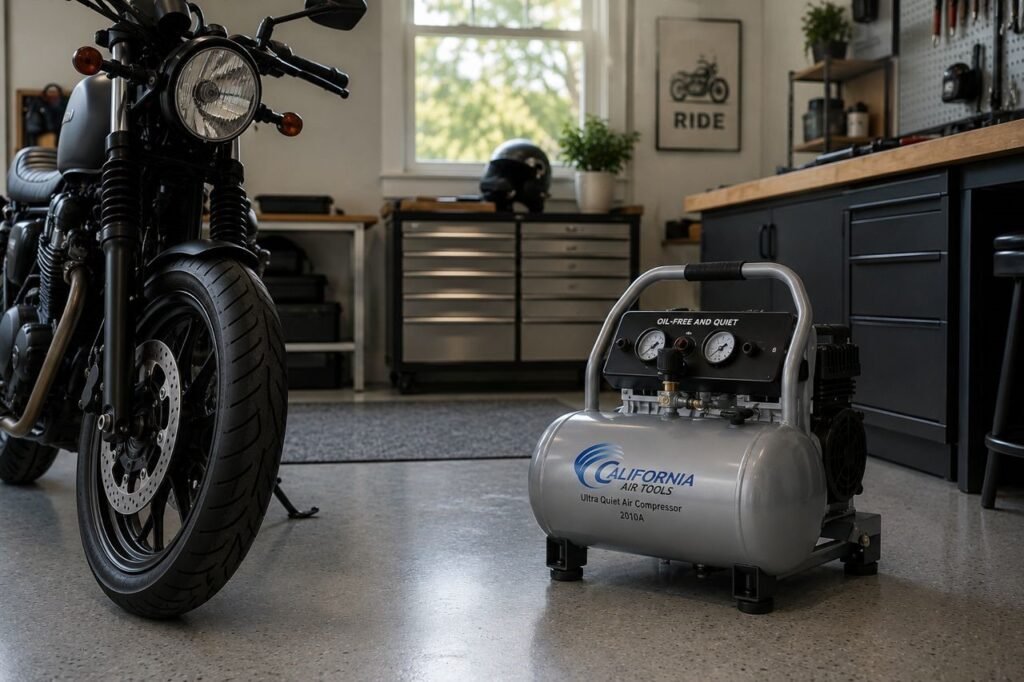
Not everyone wants to rattle the neighborhood at 85 decibels on a Saturday morning. Maybe you live in a townhouse. Maybe your garage is attached and your partner’s office sits just beyond the wall. Or maybe you simply value your hearing and peace of mind.
The quiet air compressor for motorcycle garage category has matured enormously in recent years. Oil-free ultra-quiet compressors with induction motors have brought noise levels down to 60 to 70 decibels—roughly equivalent to a normal conversation. You can actually talk while these are running.
The mechanical secret is the induction motor, which spins slower than the brushed universal motors used in budget compressors. Slower speed means less vibration, less friction noise, and dramatically lower operating temperature. These compressors run cool enough to cycle on repeatedly without needing extended cool-down breaks.
The trade-off is CFM and price. A quiet six-gallon unit delivering 2.6 CFM at 90 PSI costs as much as a louder six-gallon unit pushing 3.5 CFM. But for tire inflation, running an air ratchet, blowing out your bike after a wash, and occasional impact wrench use, a quiet six-to-ten gallon unit in the 2.5 to 3.5 CFM range handles the vast majority of home motorcycle maintenance without making enemies.
These units also tend to be genuinely portable within the garage—most weigh under 30 pounds and have a comfortable carry handle. They typically top out around 125 to 135 PSI, which is still plenty for all motorcycle work.
One honest caveat: if you plan to run an impact wrench heavily—swapping wheels on multiple bikes in a session—a quiet six-gallon unit will cycle constantly and potentially overheat. For that workload, step up to the 20-gallon quiet unit or accept the volume trade-off with a larger tank.
Category 3: The Adventure Tourer 12V — Best Portable Tire Inflator for Motorcycle Adventure Touring
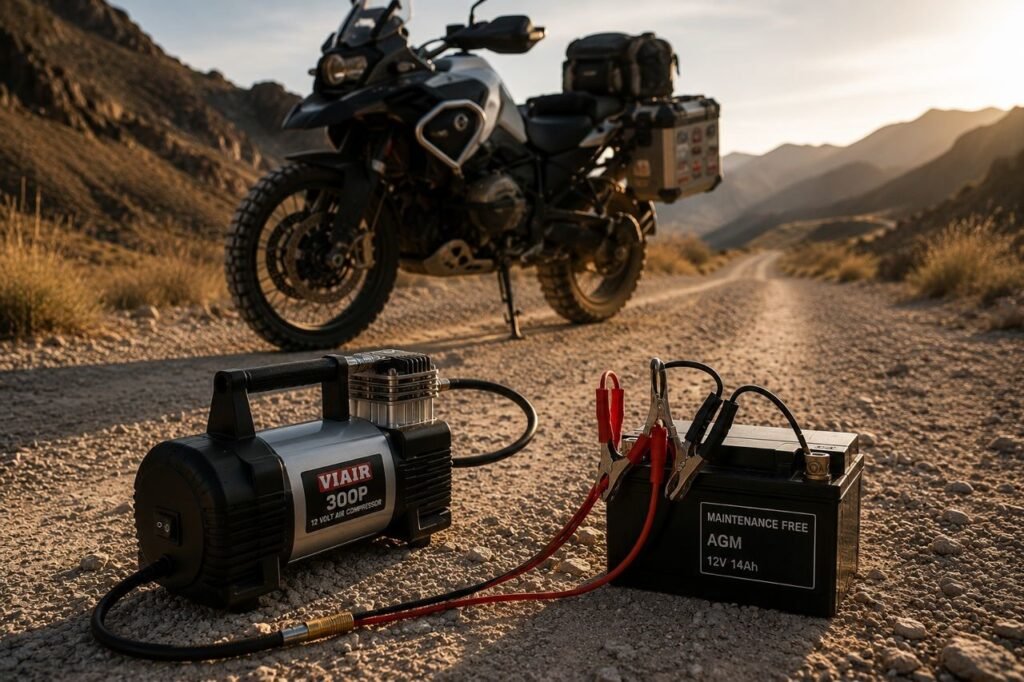
This is where gear selection gets genuinely personal. The best air compressor for motorcycle maintenance and the best portable tire inflator for motorcycle adventure touring need to be light enough to not wreck your weight budget, capable enough to reseat a tubeless bead after a plug repair, durable enough to survive a dropped pannier on gravel, and fast enough that you’re not stranded on a mountain pass for 20 minutes.
The 12V mini air compressor for motorcycle tires has become a mature product category with some impressive performers. The best units weigh under 600 grams with their carrying case and cables. They plug into any 12V accessory socket or clip directly to the battery, and can take a completely flat 150-section rear tire from zero to 30 PSI in about four to five minutes. For riders building a home workshop setup, many of these models also double as the best air compressor for motorcycle maintenance thanks to their compact size and reliable pressure output.
The digital pressure gauge integrated into quality units deserves specific attention. A preset pressure function—where you dial in 36 PSI and the compressor shuts off automatically—means accurate inflation without hovering over a gauge needle. That’s not a luxury when you’re cold, tired, and an hour into a trailside repair.
Hose and connector quality is where cheaper 12V units fail you. The hose needs to reach from your accessory port to a valve stem that’s now at the bottom of the wheel—60 to 80 centimeters minimum. The valve connector needs to lock securely without leaking; cheap twist-on connectors on budget units bleed air while you’re trying to get a reading.
Look for units with both a Schrader connector and a presta adapter, and a coiled hose that doesn’t go stiff in cold temperatures. Silicone hoses are significantly better than PVC in this regard.
One significant limitation of even the best 12V compressor: duty cycle. Most quality portable units handle 10 to 15 minutes of continuous operation before needing a cool-down. That’s enough for one tire, but if you’re refilling two tires after pulling tubes, pace yourself. Running a DC compressor past its duty cycle kills the motor—and that will happen exactly once, in the most inconvenient location imaginable.
Purpose-built adventure units from brands catering specifically to dual-sport riders tend to have reinforced housings, braided hose covers, and storage bags designed for pannier organization. They’re worth the premium over car-focused units optimized for car tires rather than motorcycle-specific requirements.
Category 4: The Pocket Wireless Inflator — Best Wireless Electric Pump for Motorcycle Roadside Repair
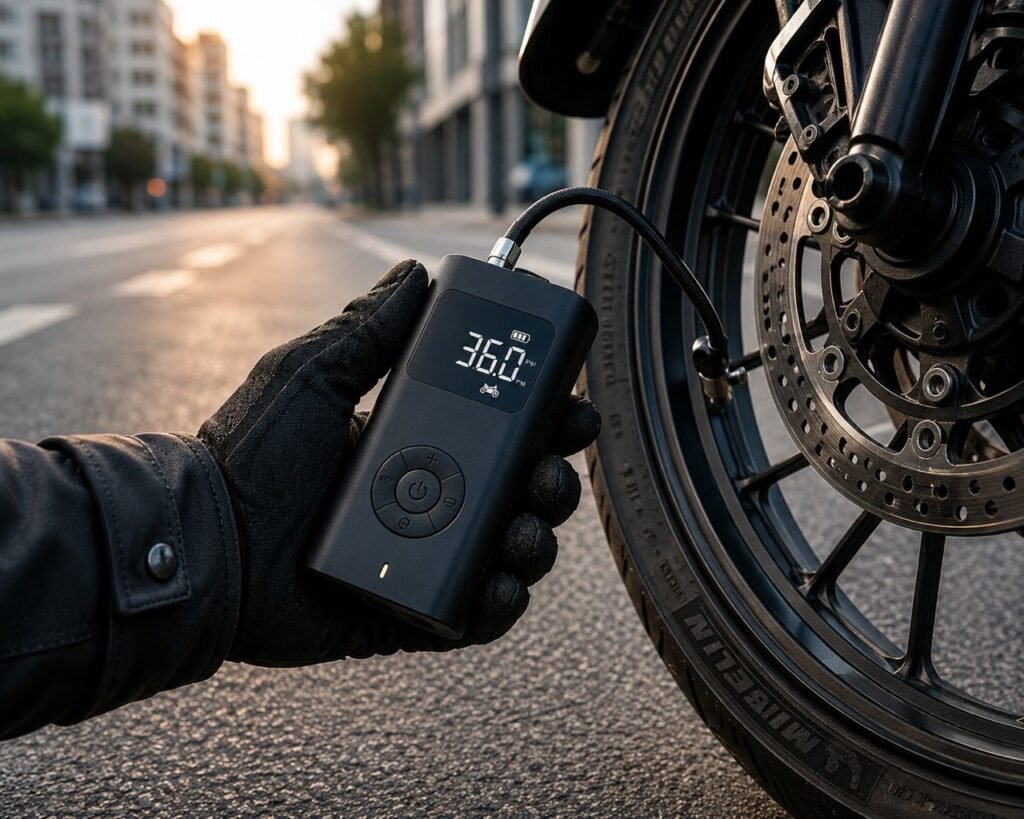
This is the newest category, and it’s genuinely impressive how capable these tiny units have become. The best wireless electric pump for motorcycle roadside repair is roughly the size of a thick smartphone—some are literally pocketable in a jacket chest pocket—with a built-in lithium battery, a micro pump, a digital pressure display, and enough capability to top off a motorcycle tire in minutes.
The appeal is simple. No hose to an accessory port. No draining your battery with the engine off. Just pull it from your jacket, thread it onto the valve stem, and press a button.
A quality unit in this category can inflate a completely flat 120-section front tire from zero to 40 PSI in around four to six minutes. Battery capacity typically covers three or four full inflations before needing a USB-C recharge. That’s a genuine emergency tool.
The limitations are real but manageable. These units aren’t designed to reseat stubborn tubeless beads—they don’t deliver enough volume fast enough for that. They’re also slower than 12V compressors for full inflation. Their pressure ceiling of 100 to 120 PSI is fine for motorcycle tires but rules out any air tool work.
Think of the wireless inflator as your first line of roadside defense: fast to deploy, zero setup, and more than sufficient for any pressure top-off or slow-leak situation. Pair it with a plug kit and you have a capable emergency system that fits in a jacket pocket.
The best wireless electric pump for motorcycle roadside repair also tends to have better gauges than you’d expect—accurate to within plus or minus one PSI on quality units. Many include preset pressure modes, auto-shutoff, and LED work lights for roadside use at dawn or dusk.
Matching Your Setup to Your Riding Reality
Here’s the honest framework for choosing the best air compressor for motorcycle maintenance in your specific situation.
You’re a weekend warrior with a two-car garage: Get a 20-gallon oil-lubed piston compressor. It’ll last 20 years, run every air tool you’ll ever own, and seat any bead you throw at it. Budget 200 to 400 dollars and never think about it again.
You have a shared space, attached garage, or noise-sensitive situation: The quiet induction-motor compressor in the six-to-ten gallon range is your answer. Spend more than you think you need to on the quiet version—you’ll thank yourself every time you run it at seven in the morning.
You’re an adventure tourer doing remote routes: A quality 12V portable is non-negotiable. Pair it with a tubeless plug kit, a few CO2 cartridges for genuine emergencies, and a high-quality pressure gauge.
You’re a daily commuter who wants basic peace of mind: The wireless pocket inflator plus a CO2 backup fits in any jacket. It won’t seat a bead, but it’ll get you home from a slow leak more times than you can count.
Many serious riders combine a full garage unit with a portable option for touring—and that’s genuinely the complete solution. The best air compressor for motorcycle maintenance at home handles everything in the shop, and a capable 12V or wireless unit handles everything on the road.
Top Air Compressor & Inflator Picks (2026)
For a heavy-duty garage unit, the California Air Tools 8010 is an excellent quiet compressor for home mechanics. It runs at just 60 dB, delivers 2.2 CFM at 90 PSI from an oil-free dual-piston pump, and holds 8 gallons in a steel tank — all for $199–$230. It handles nail guns, inflation, and light air tool use with minimal maintenance, though its modest CFM makes it unsuitable for heavy bead seating or sustained impact wrench work.
For a capable workshop workhorse, the Makita MAC2400 steps up significantly. Its Big Bore cast-iron oil-lubricated pump produces 4.2 CFM at 90 PSI and up to 130 PSI max, enough to run two nailers simultaneously through dual outlets. It operates at 79 dB — quieter than most in its class but not whisper-quiet — and weighs 77 lbs. Budget around $350, and factor in periodic oil changes.
Adventure and off-road riders should look at the Viair 88P, a 12V DC inflator that clamps to your car battery and reliably handles tires up to 33 inches at up to 150 PSI. It’s the best sub-$100 option for off-road use, priced at around $72, with all-metal construction built for trail durability. Just note it requires a running vehicle — it’s not a standalone unit.
For a pocket cordless inflator, the Fanttik X8 APEX is the current leader. It weighs just 1.74 lbs, inflates a mid-size car tire in roughly 56 seconds, shuts off automatically at your preset PSI with ±1 accuracy, and runs for up to 40 minutes on a charge — all in a glove-box-friendly package for $60–$70. If budget is the priority, the AstroAI Cordless delivers comparable core performance for less.
Prices across these four categories run from roughly $60 for a quality cordless inflator up to $350 for a serious workshop compressor.
A Few Things Worth Knowing Before You Buy
Fittings matter more than people think. Most compressors use standard quarter-inch NPT quick-connect fittings, but there are multiple incompatible quick-connect standards—Industrial, Automotive, ARO, Milton. Make sure your hose and tools use the same standard, or buy an adapter set when you set up your system. It’s a fifteen-dollar fix that prevents a lot of frustration.
Oil-free versus oil-lubricated: Oil-free compressors need less maintenance but run hotter, are noisier, and wear out faster. For occasional home use, oil-free is fine. For regular shop work, oil-lubed is worth the minimal upkeep.
Moisture is your enemy. Compressed air contains water vapor that condenses in your tank. Drain it through the petcock at the bottom after every use—especially in humid climates. Water sitting in a steel tank corrodes from the inside out, eventually sending rust through your hose and into your tools. An inline water separator is cheap insurance for any setup used with air tools.
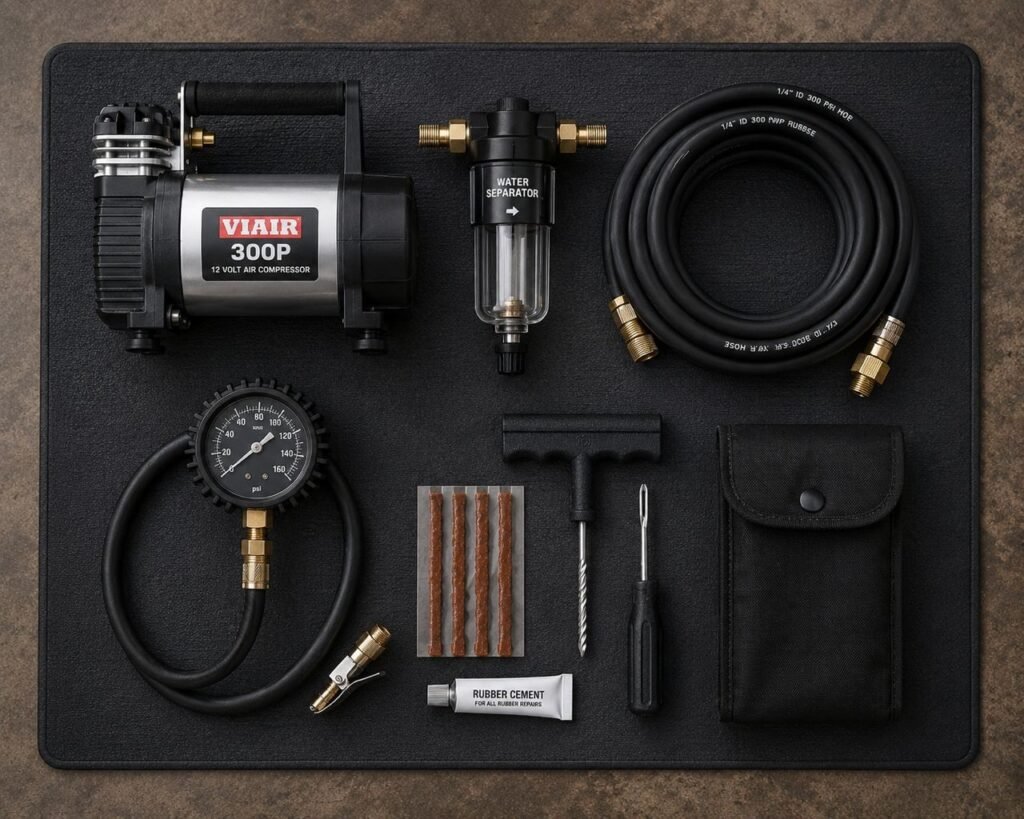
For shop applications, an automatic tank drain valve is a small investment that pays off by handling the maintenance step you’ll eventually forget to do. These devices automatically release condensate whenever the compressor depressurizes.
Finding the best air compressor for motorcycle maintenance ultimately comes down to honest self-assessment: where you ride, how you work, what space you have, and how much frustration you’re willing to tolerate. Every category covered here has strong options at reasonable price points, and any of them will put you dramatically ahead of no compressed air at all.
The right compressor isn’t the most expensive one—it’s the one that’s actually there when you need it. Whether that’s the best air compressor for motorcycle maintenance humming quietly in your garage while you torque cylinder head bolts, or a pocket-sized inflator you barely notice until the moment it saves your ride.
Have a compressor setup you love? A roadside inflation story to share? Drop it in the comments—real-world data from real riders is always more valuable than any spec sheet when choosing the best air compressor for motorcycle maintenance