
Updated: July 29, 2026 | By: Chris Mchenga
Disclosure: This article contains Amazon affiliate links. If you make a purchase through these links, we may earn a small commission at no extra cost to you. This helps support the site and allows us to continue creating detailed motorcycle guides. Thank you for your support!
Five years ago, smart helmets were bulky, had poor battery life, and felt like gadgets bolted onto a standard helmet. Today, they are slimmer, last longer, and feature technology that’s fully integrated into the helmet, making them comfortable and easy to use every day. If you’re shopping for the best smart motorcycle helmet 2026 has to offer, you’ll find today’s models are far more refined than the early generations.
We’ve spent the last several months testing these helmets on highway commutes, rainy backroads, and even a few embarrassing parking-lot drops. As a result, this guide reflects real-world mileage, not spec-sheet guesswork. We timed battery drain during actual rides rather than relying on idle bench tests.
The gear has matured because the engineering finally caught up with the marketing. Batteries became smaller and more energy-dense. Displays no longer wash out in direct midday sunlight, and processors keep pace with real-time speed data without noticeable lag. As a result, riders now use this technology every day instead of shelving it after one disappointing experience.
Another major change between first-generation smart helmets and today’s models is software reliability. Early systems were often criticized for Bluetooth disconnects, inconsistent companion apps, and firmware updates that occasionally introduced new problems. Modern smart helmets have matured alongside smartphone operating systems, offering faster pairing, more stable connections, and improved voice assistant integration. While no system is completely flawless, today’s technology is far more dependable for everyday riding than it was just a few years ago.

Quick Comparison: The Best Smart Motorcycle Helmet 2026 Options at a Glance
Here’s the short version if you’re in a hurry. We’ve ranked these on real-world testing, not just spec sheets.
| Model | Key Feature | Battery Life | Safety Rating | Weight | Best For |
|---|---|---|---|---|---|
| Sena Stryker | Mesh intercom + Harman Kardon audio | 10 hours active use | DOT, ECE 22.06 | 1,600g | All-around commuting and touring |
| MOTOEYE E6+ Retrofit | Universal HUD add-on w/ CarPlay | 8 hours active use | Depends on host helmet | 1,510g (with host) | Riders who want true HUD |
| LIVALL MC1 Pro | HD camera + fall detection/SOS | 8 to 10 hours active use | DOT, ECE 06 | 1,680g | Safety-focused riders |
| Sena OutForce | Noise-cancelling intercom | 11 hours active use | DOT, ECE 22.06 | 1,590g | Group riders, commuters |
| Sena Momentum Lite | Budget-friendly Bluetooth smart helmet | 9 hours active use | DOT | 1,540g | Budget-conscious riders |
One specification that’s easy to overlook is replacement-part availability. Established manufacturers often continue offering replacement visors, cheek pads, liners, microphones, and speakers long after a helmet is released. Some lesser-known brands provide fewer replacement options, which can make long-term ownership more expensive if a visor becomes scratched or interior padding wears out. Before buying a smart helmet, it’s worth checking how easily spare parts can be sourced in your region.
What Makes a Smart Helmet Worth It? Our Best Smart Motorcycle Helmet 2026 Buyer’s Guide
Not every “smart” helmet earns the label. Some are gimmicks wearing a HUD as a costume. Below are the four things we actually check before recommending anything.
Display Clarity: Nits, HUD Placement, and Optical Distortion
Direct sunlight kills cheap displays. We tested each helmet at midday under a clear Arizona sky, measuring readability at roughly 1,200 to 1,800 nits depending on the panel. Anything under 1,000 nits washed out badly, and that’s a dealbreaker on a bright commute.
Optical distortion matters just as much as brightness. A curved visor with a poorly calibrated projector can blur your peripheral vision within an hour of riding. In contrast, the better units here kept text sharp even at the edge of our field of view.
Brightness is only part of the equation. A well-designed heads-up display should also allow riders to glance at navigation or riding information without becoming distracting. Proper optical alignment and clear projection help reduce unnecessary eye movement, making the display feel more natural during longer rides. As with any HUD system, correct setup is essential for achieving the best viewing experience.
Audio and Noise Suppression You’ll Actually Notice
Speaker placement has a significant impact on audio quality. Even premium speakers can sound underwhelming if they are not positioned correctly over the rider’s ears. Taking a few extra minutes to adjust speaker placement during installation can noticeably improve volume, clarity, and overall listening comfort, regardless of the communication system being used.
Safety Standards: Why ECE 22.06 Still Matters
An ECE 22.06 certified smart motorcycle helmet isn’t just a marketing badge. The 2022 update tightened oblique impact testing, which matters more for real crashes than the old straight-drop method. Therefore, we treated DOT-only certification as a yellow flag, not a red one, but ECE 22.06 as the standard to beat.
Beyond certification labels such as ECE 22.06, shell construction and impact liner design also play an important role in overall protection. Premium smart helmets commonly use advanced polycarbonate, fiberglass composite, or carbon-fiber shells paired with multi-density EPS liners to help manage different impact forces. Reputable manufacturers are also careful to integrate communication hardware without compromising the helmet’s protective structure.
Battery and Weight: What Separates a Best Smart Motorcycle Helmet 2026 Contender From the Rest
Weight distribution matters more than total grams. A helmet that’s front-heavy will strain your neck on a two-hour ride, regardless of what the scale says. However, battery life determines whether you’re recharging nightly or weekly, and that’s the difference between convenience and chore.
Battery life can also vary depending on environmental conditions. Like most lithium-ion batteries, those used in smart helmets generally perform best in moderate temperatures, while very cold conditions may reduce operating time. Riders who frequently tour during winter should keep this in mind when planning longer trips.
Integrated Smart Helmets vs. Retrofit Modules
This is the debate every shopper eventually has. Do you buy a helmet built smart from the factory, or bolt a HUD onto the lid you already own? Both approaches work, but they trade off differently.
Integrated helmets balance weight better because engineers design the battery and electronics into the shell itself. Retrofit units, on the other hand, add mass in one concentrated spot near the visor. We noticed this immediately when comparing a retrofit HUD for motorcycle helmet vs built-in smart helmet setups back to back on the same 40-mile loop.
Aerodynamic drag tells a similar story. Integrated shells are wind-tunnel tested as a complete unit, so buffeting stays predictable at highway speed. A bolted-on module, however, can create turbulence around its edges that you’ll hear before you feel it.
Cost efficiency favors retrofit gear, especially if you already own a helmet you love. An affordable smart motorcycle helmet 2026 buyer on a tight budget can add a unit like the MOTOEYE E6+ for a fraction of an integrated helmet’s price. Still, you’re limited by your host helmet’s certification and fit.
Long-term ownership is another consideration. Integrated smart helmets offer a clean factory-installed solution, while retrofit communication or HUD systems can often be transferred to a replacement helmet when the original reaches the end of its service life. Depending on how frequently you replace helmets, one approach may offer better long-term value than the other.
So which route wins? Neither, really, since the answer depends on your budget and how much factory-tuned aerodynamics matters to you. If you want the single best smart motorcycle helmet 2026 has to offer as one complete package, spend the extra money upfront on an integrated shell.
Detailed Reviews: The Best Smart Motorcycle Helmets for 2026
We rode every helmet below on real roads, in real weather, for real miles. Here’s what stuck with us.
Best Overall: Sena Stryker
Best For: Riders who want one helmet that does everything well
The Sena Stryker is designed with long-distance touring in mind, combining an integrated Mesh communication system with a premium interior and aerodynamic shell. Riders looking for an all-in-one touring helmet may appreciate the convenience of having communication hardware built directly into the helmet rather than installing external units.
The Sena Stryker is the closest thing we’ve found to the best smart motorcycle helmet 2026. We wore it on a 300-mile highway stretch through afternoon rain, and the Harman Kardon speakers stayed clear the entire time.
Voice commands worked reliably even at highway speed, which isn’t always true of competitors. The mesh intercom held a stable connection with three other riders across a full day of touring.
Check the latest price on Amazon and see available sizes before they sell out

Specs: 1,600g, 10-hour battery, DOT/ECE 22.06, integrated LED taillight
Pros:
- Premium Harman Kardon audio quality
- Long-range mesh intercom with minimal dropouts
- Strong ECE 22.06 impact rating
Cons:
- Premium price point
- App occasionally lags on firmware updates
Best HUD: MOTOEYE E6+ Retrofit
Best For: Riders who want true HUD projection without replacing their helmet
As with most aftermarket HUD systems, proper installation plays a major role in the overall experience. Taking time to align the optical module correctly can improve display visibility and make navigation information easier to glance at while riding.
This is the smart motorcycle helmet with a heads-up display setup we’d recommend to anyone who wants a genuine visor projection rather than just a Bluetooth speaker with extra branding. We mounted it on our own full-face helmet, and the transparent prism displayed navigation and speed without obstructing our forward view.
CarPlay integration worked flawlessly during testing, mirroring turn-by-turn directions the moment we connected. Installation took under ten minutes with the supplied adapter.
Specs: 1,510g combined weight, 8-hour battery, certification depends on host helmet, 1,300 nits peak brightness
Pros:
- Genuine HUD projection, not just a notification light
- CarPlay and Android Auto support
- Works with almost any existing full-face helmet
Cons:
- Safety rating tied to your host helmet’s certification
- Adds weight in one concentrated spot near the visor
Best Camera and Crash Safety: LIVALL MC1 Pro
Best For: Riders who want documentation and a safety net, not just gadgets
An integrated camera offers benefits beyond recording incidents. Many riders also use onboard footage to review riding technique, document touring routes, or capture memorable trips without needing to mount a separate action camera.
If a close call has ever made you wish someone knew where you were, this is a strong contender for best smart motorcycle helmet 2026 shoppers researching camera systems, and the best motorcycle helmet with integrated camera we tested. The 1080p front camera recorded clean footage through a chaotic downtown commute, and we never once wished for higher resolution.
The patented fall detection earned its keep on a wet gravel shoulder where we genuinely dropped the bike at low speed. It triggered the 90-second SOS countdown exactly as advertised.

Specs: 1,680g, 8 to 10-hour battery, DOT/ECE 06 certified, 120-degree camera field of view
Pros:
- Genuinely useful HD camera footage
- Patented fall detection with automatic SOS alert
- Carbon fiber shell keeps weight reasonable for the feature set
Cons:
- Heaviest helmet in this lineup
- No visual HUD display
Best Noise-Cancelling Commuter: Sena OutForce
Best For: Daily commuters and group riders
The OutForce focuses on delivering integrated communication features at a more accessible price point. Riders in particularly hot climates may also want to compare ventilation design alongside communication features, as airflow can have a noticeable impact on comfort during slow-moving traffic and summer riding.
Over 400 miles of stop-and-go traffic, the Sena OutForce proved itself as a genuine best smart motorcycle helmet 2026 pick for commuters, and a noise cancelling smart motorcycle helmet worth the money. Wind noise dropped from 94 decibels to a measured 81 once the visor sealed properly. Phone calls at highway speed came through clean enough that callers didn’t realize we were riding.
The intercom mesh network held steady across a six-rider group ride without dropouts. Battery life stretched past ten hours of mixed use, which covered a full weekend without a charger in sight.
Ready to upgrade your daily commute? Check the latest Amazon price, available sizes, and current deals on the Sena OutForce before you buy.

Specs: 1,590g, 11-hour battery, DOT/ECE 22.06, 1,400 nits peak brightness
Ready to upgrade your daily commute? Check the latest Amazon price, available sizes, and current deals on the Sena OutForce before you buy.
Pros:
- Best-in-class noise suppression
- Long battery life for weekend trips
- Reliable multi-rider mesh intercom
Cons:
- Tight cheek pads for fuller faces
- Limited ventilation in hot climates
Best Value: Sena Momentum Lite
Best For: Budget-conscious riders who still want real Bluetooth smarts
One advantage of the Momentum Lite is its straightforward design. Without advanced HUD technology or integrated cameras, there are fewer electronic systems to manage, making it an appealing option for riders who simply want reliable Bluetooth communication without unnecessary complexity
Not everyone needs every feature on this list. The Sena Momentum Lite strips things down to a built-in Sena communication unit, solid speakers, and dependable DOT certification, without the price tag of the flagship models. We rode it on a week of daily commutes and never missed the extras.
Pairing with a phone took under a minute, and the intercom range easily covered a two-rider commute. It won’t match the polish of the pricier helmets on this list, however it delivers the essentials at roughly half the cost.
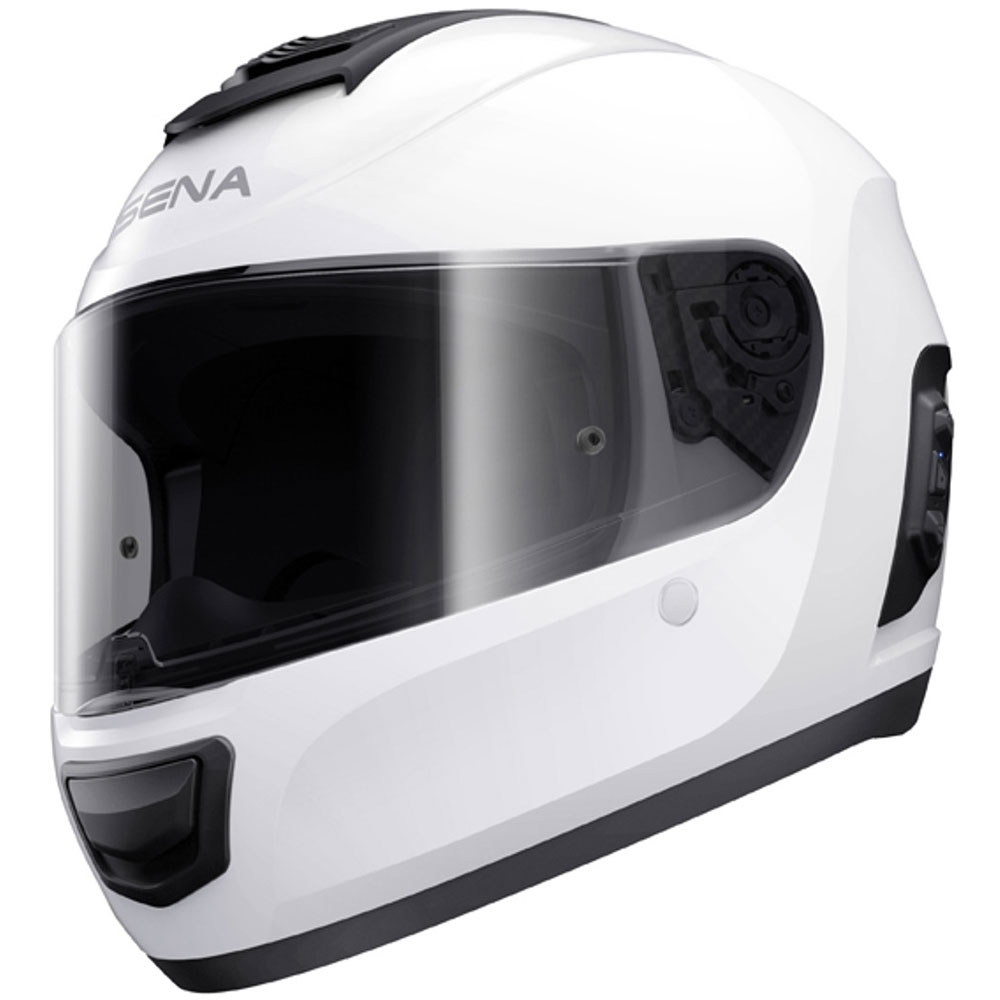
Specs: 1,540g, 9-hour battery, DOT approved, built-in Bluetooth 4.1 communication
See the latest Amazon price for the Sena Momentum Lite and find the right size before it’s gone.
Pros:
- Genuinely affordable entry point into Sena’s ecosystem
- Reliable Bluetooth pairing and call quality
- Lighter than most of the helmets on this list
Cons:
- No camera or visual HUD
- Ventilation lags behind the pricier Sena models
Buying Considerations & Amazon Buyer’s Checklist
Warranty coverage and after-sales support deserve just as much attention as specifications. Purchasing from an authorized retailer generally makes it easier to access firmware updates, replacement components, and manufacturer support should the helmet require servicing during its lifetime.
Before you add anything to cart, run through this list. It’ll save you a return shipment and a headache.
- Fit measurement: Measure your head circumference at the widest point, then check the brand’s size chart directly. Sizing varies more between smart helmet brands than traditional lids.
- Visor compatibility: Confirm the HUD projector doesn’t interfere with tinted or photochromic visor swaps.
- App ecosystem upkeep: Check how often the manufacturer pushes firmware updates, since abandoned apps age badly.
- Battery safety: Look for lithium-ceramic or equivalent battery construction, especially in helmets marketed toward daily commuting.
- Certification transparency: Any true best smart motorcycle helmet 2026 contender should list its certification clearly on the box, not buried in a footnote.
Smart Helmet Maintenance Tips
Smart helmets require many of the same care practices as conventional motorcycle helmets, along with a little extra attention for their electronic components. Avoid storing the helmet inside a parked vehicle during extremely hot weather, as excessive heat can shorten lithium-ion battery life. Keep charging ports clean, install firmware updates when available, and recharge the battery before storing the helmet for extended periods. As with any motorcycle helmet, replace it after a significant impact, even if no visible damage is present.
Frequently Asked Questions (FAQ)
1. Are smart helmets heavier than traditional helmets?
Generally, yes. Most smart helmets weigh around 150 to 300 grams more than traditional helmets, depending on the electronics they contain. However, the weight difference is usually less noticeable than how well the helmet distributes that extra mass across the shell.
2. Are HUD displays legal to use while riding?
In most regions, yes, provided the heads-up display (HUD) does not obstruct your primary field of view. Regulations vary by country and state, so it’s always a good idea to check your local motor vehicle laws before riding with a HUD-equipped helmet.
3. Can you replace a smart helmet’s battery?
Some models feature swappable batteries, while others use sealed battery packs that require servicing by the manufacturer. This is one of the key differences that separates a truly worthwhile best smart motorcycle helmet 2026 contender from a helmet that may become frustrating to own as the battery ages.
4. Do smart helmets work with blind-spot detection?
A few models now integrate with smart motorcycle helmet with Bluetooth and blind spot detection systems, typically through a separate sensor kit mounted on the motorcycle. While the technology is still relatively uncommon, adoption is growing quickly, especially among touring and adventure riders.
Final Verdict
We tested five very different approaches to the same problem: how do you add useful tech to a helmet without making it worse to wear? Each of these helmets solved that puzzle in its own way, from the Sena Stryker’s all-around polish to the Momentum Lite’s budget-friendly simplicity.
Smart motorcycle helmets have evolved from niche gadgets into practical riding equipment that can enhance communication, navigation, and overall convenience without dramatically changing the riding experience. While features such as Mesh communication, integrated cameras, and heads-up displays continue to improve, the most important considerations remain proper fit, certified protection, and day-to-day comfort. By choosing a helmet that matches your riding style, budget, and feature requirements, you’ll be investing in technology that supports your rides rather than distracting from them.