
A motorcycle intercom buying guide from someone who’s burned through six units and three bad decisions
Updated: August 1, 2026 | By: Chris Mchenga
Disclosure: This article contains Amazon affiliate links. If you make a purchase through these links, we may earn a small commission at no extra cost to you. This helps support the site and allows us to continue creating detailed motorcycle guides. Thank you for your support.
I still remember the ride where I learned this lesson. My buddy was two bikes back, shouting something about a gas station exit, and I caught exactly none of it over 70 mph of wind roar inside my helmet. That’s the moment I started treating every purchase like a real motorcycle intercom buying guide instead of a five-minute Amazon scroll. Specifically, I wanted to know what actually mattered before I spent $200 to $600 on gear I’d be stuck with for years. As a result, I built this motorcycle intercom buying guide around everything I wish someone had told me before my first purchase.

I’ve tested a dozen units across canyon roads, cross-country tours, and rainy commutes. Some held up beautifully. Others died at the worst possible moment, usually somewhere far from a gas station or a returns counter. Meanwhile, I kept notes on what separated the units I’d buy again from the ones I quietly retired to a drawer. Below, I’ll walk you through the six things that actually separate a smart purchase from an expensive mistake, in the order I now check them myself before spending a dollar.
Mesh vs. Bluetooth Networking: The Core Tech Split
Here’s where most riders get confused, and honestly, it’s the first fork in the road any real motorcycle intercom buying guide needs to address head-on. Traditional Bluetooth intercoms work like a daisy chain — Rider A talks to Rider B, who relays to Rider C. That’s fine for two riders. However, it falls apart fast in a group.

Dynamic mesh communication solves this differently. Instead of a fixed chain, every headset in a mesh network talks to every other headset directly and automatically reroutes around dropouts. For instance, if Rider B drops out of range at speed, the mesh network simply reconnects the moment they’re back in range — no manual re-pairing, no shouting into a dead mic. That’s the real appeal of mesh vs bluetooth motorcycle intercom systems for anyone who rides in packs of four or more.
That said, mesh isn’t automatically better for everyone. Bluetooth-only systems are cheaper, simpler to pair, and perfectly capable for solo riders or couples who just want bike-to-bike or rider to passenger motorcycle communication without a crowd.
| Protocol | Max Group Size | Real-World Range | Reconnection Behavior | Battery Drain | Ideal User |
|---|---|---|---|---|---|
| Bluetooth (chain) | 2–4 riders | 200–500m, line of sight | Manual re-pair often needed | Lower | Solo riders, couples |
| Dynamic Mesh | 8–24+ riders | 500m–1 mile, terrain dependent | Automatic, seamless | Moderate to higher | Group and club rides |
Our Top Recommendation: If you regularly ride with groups, the Cardo PACKTALK Edge is one of the best motorcycle intercoms you can buy. Its Dynamic Mesh Communication offers more reliable connections than traditional Bluetooth, while JBL speakers provide excellent sound quality even at highway speeds. Check today’s price on Amazon before your next ride.

Decibels, Wind Noise, and Audio Clarity
At highway speed, your helmet isn’t quiet. Wind noise inside a full-face lid regularly hits 100dB or more, which is roughly the volume of a chainsaw a few feet away. As a result, cheap intercom speakers get drowned out almost instantly, and that’s a problem no spec sheet will warn you about.
This is why audio hardware matters more than most riders assume, and it’s a section every honest motorcycle intercom buying guide has to take seriously. Look for units with DSP, or digital signal processing — think of it as a tiny computer inside the headset that cleans up your voice and strips out background noise before it reaches the other rider. Paired with CVC noise suppression, DSP is what lets you hold a normal conversation at 80 mph instead of yelling over static.
Branded speaker partnerships matter too. Cardo’s collaboration with JBL and Sena’s work with Harman Kardon aren’t just marketing badges. In my experience, they produce noticeably richer bass and clearer highs than generic drivers, which makes a real difference if you’re also using the intercom for music or GPS turn-by-turn. If you’re comparing the best motorcycle intercom with JBL speakers against a no-name alternative, the gap is obvious within the first ten minutes of riding.
Don’t Forget the Microphone
Beyond this, a motorcycle intercom with noise cancellation earns its price the moment you hit a stretch of highway construction or ride behind a loud exhaust. Trust me, you’ll notice the difference immediately.
That said, no amount of DSP fixes a bad microphone position. Even the best chipset struggles if the boom mic sits too far from your mouth or gets buried under a chin curtain. Consequently, I always test mic placement at a standstill before trusting it at speed — a five-second check that’s saved me from a dozen garbled conversations on the highway.
Recommended Product: Sena 60S EVO
If clear conversations at highway speeds are a priority, the Sena 60S EVO delivers upgraded speakers, effective noise cancellation, and reliable communication even on windy rides.

Real-World Range vs. Manufacturer Marketing Claims
Manufacturers love to print big numbers on the box. A claimed 1.2-mile range sounds impressive, and technically, it might be true — under perfect lab conditions, with zero obstructions, flat terrain, and nothing but open air between two units. Specifically, that number describes ideal line-of-sight range, not the ride you’re actually going to take.
Real-world motorcycle intercom range tells a different story. Once you add hills, buildings, dense trees, or a curve in the road, that 1.2-mile figure often shrinks to somewhere between 200 and 500 meters. That’s not a defect — it’s physics. Radio signals don’t bend around a mountain just because the packaging promised they would.

This gap is exactly why any credible motorcycle intercom buying guide should push you toward mesh systems for group rides. Mesh networks handle this problem through relay chaining: if Rider A can’t reach Rider D directly, the signal hops through Riders B and C instead. As a result, your effective group range stretches far beyond what any single unit could manage alone. For a five-person canyon run, that difference decides whether you stay connected or ride the last twenty miles in silence.
Helmet Compatibility, Fitment, and Physical Ergonomics
An intercom that sounds incredible but won’t actually fit your helmet is worthless. This is the part of a motorcycle intercom buying guide that riders skip and then regret two days later when the unit won’t sit flush against their shell.
Start with the mount. Clamp mounts fit almost any helmet shape and swap between lids easily, which is great if you own more than one helmet. 3M adhesive mounts sit lower and more discreet, but they’re semi-permanent — pulling one off a carbon shell isn’t something you want to do often. Beyond this, check your cheek pad routing space before you buy. Some helmets have almost no room to tuck speaker wires, and forcing it can pinch the padding uncomfortably against your jaw.
Speaker cutout depth matters just as much. If your helmet’s ear pockets are shallow, speakers will press directly against your ears rather than sitting in the recess, which gets uncomfortable fast on a six-hour ride. Helmet compatibility bluetooth intercom issues are one of the most common return reasons I’ve seen, so measure before you commit.
Finally, think about controls. Gloved hands are clumsy, so glove-friendly buttons, a raised jog dial, and reliable voice control aren’t luxuries — they’re the difference between adjusting volume at a stoplight versus fumbling with tiny buttons at 60 mph.
Weatherproofing and Battery Endurance for Long Tours
“Water resistant” and genuinely waterproof are not the same claim, even though marketing copy loves to blur the line. A true waterproof motorcycle intercom IP67 rating means the unit can survive submersion in up to a meter of water for thirty minutes. IP68 goes even further. Anything less, and a hard rainstorm on a highway shoulder could end your unit’s life early.

I learned this the expensive way, riding through an unexpected downpour with a unit rated only for light splashes. It died before I reached the next exit. That’s why I now treat weatherproofing as non-negotiable in every motorcycle intercom buying guide I write, and I’d tell any touring rider to do the same.
Battery life matters just as much for long days in the saddle. Realistic talk time runs 10 to 13 hours on a good unit — enough for a full riding day without a midday charge. Standby time stretches much longer, which matters if you’re using the intercom intermittently across a multi-day tour. USB-C fast charging has become the standard worth insisting on, since a quick 20-minute top-up at a gas stop can carry you through the rest of the day.
Smart Buyer Strategy: Matching Your Budget to Your Riding Style
Here’s where a motorcycle intercom buying guide earns its keep — not by naming one “best” product, but by matching the tech to how you actually ride.
Which Rider Type Are You?
Solo commuters rarely need mesh at all. A simple Bluetooth unit with GPS audio and phone calling covers nearly everything, and there’s no reason to overspend on group features you’ll never use.
2-up couples should prioritize audio clarity and a genuinely comfortable rider to passenger motorcycle communication system above almost everything else. You’re talking to one person, constantly, for hours — clarity beats range every time.
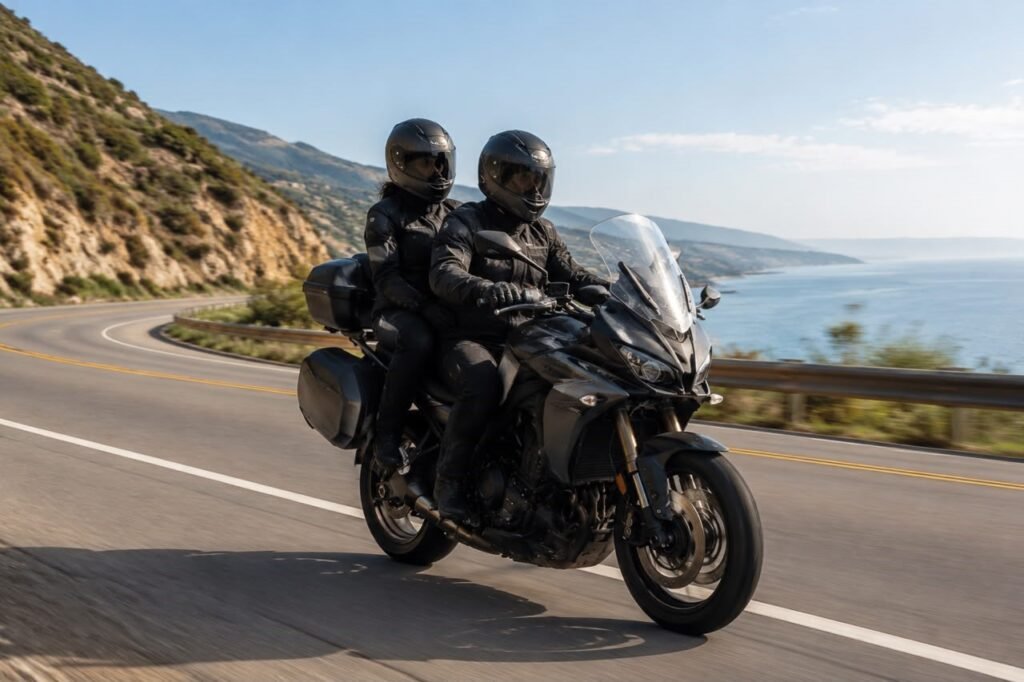
Weekend group riders are the sweet spot for mesh. If you regularly roll with three or more friends, dynamic mesh removes the constant re-pairing headache and keeps everyone connected without babysitting the tech.
Touring clubs need the full package: long battery life, true waterproofing, and mesh range that holds up across a spread-out formation. This is also where the best budget motorcycle intercom for group rides becomes a real research question, since club rides often mix riders with different budgets and different-brand headsets that still need to talk to each other.
Buy for the Group You Ride With, Not the One You Imagine
That mismatch is precisely why I keep coming back to the same rule in every motorcycle intercom buying guide I put together: buy for the group you actually ride with, not the group you might ride with someday. Overbuying wastes money. Underbuying leaves someone stranded off the mesh network on the next long weekend, and that’s a worse outcome for everyone involved.
A Quick Word on Installation
One more thing worth mentioning here — installation. How to install motorcycle intercom units varies by brand, but the general process stays consistent: mount the clamp or adhesive base, seat the speaker pockets in your cheek pads, route the boom mic close to your lips, and pair the units before you ever leave the driveway. Do this at home, not in a parking lot five minutes before a group departure. I’ve watched more than one rider miss the first ten miles of a ride fumbling with a firmware update they should have handled the night before.
Budget Pick: Fodsports M1-S Pro
If you’re buying your first motorcycle intercom or simply want dependable communication without spending a fortune, the Fodsports M1-S Pro offers excellent value with waterproof construction, long battery life, and support for multiple riders. 👉 Check today’s Amazon deal before you buy.

Final Verdict on Choosing Your Intercom
If you take one thing from this motorcycle intercom buying guide, let it be this: buy for the riding you actually do, not the riding you imagine doing someday. A solo commuter doesn’t need mesh. A five-person touring club can’t get by without it.
Check the real IP rating, not the vague “water resistant” label. Test the mount against your specific helmet before you’re stuck peeling off adhesive at midnight. And don’t let a manufacturer’s best-case range number talk you into skipping mesh if group rides are your normal weekend.
I’d tell a friend this straight, over coffee in the garage: figure out how you ride first, then let that decision — not the flashiest spec sheet — decide what you buy. That’s the whole point of a motorcycle intercom buying guide, and it’s the only approach that’s never let me down.